
Gulf Arab States Face Hard Choices as Iran Widens Attacks
 Aime Summary
The U.S. and six Arab nations condemned Iran’s recent drone and missile attacks in a joint statement, calling them 'reckless' and a threat to regional stability according to a joint statement. The statement included the U.S., Bahrain, Jordan, Kuwait, Qatar, Saudi Arabia, and the UAE. These nations affirmed their right to self-defense and highlighted successful air defense coordination that minimized damage.
Emergency talks among Gulf Cooperation Council (GCC) members followed the attacks, with nations considering 'necessary measures' to protect their sovereignty. Saudi Arabia and the UAE have intensified their criticism of Iran’s actions, calling for firm international responses.
 The Gulf states are urging the United Nations to take action and have emphasized that any Iranian strikes against civilians or non-belligerent states are destabilizing. The region has seen a surge in tensions as Iran’s attacks spread across neighboring states. The UAE, in particular, has seen repeated attacks on its territory, causing panic among residents and raising concerns about its economic stability.
Why Did This Happen?
Iran’s attacks are a retaliatory response to U.S.-Israel military actions that resulted in the death of Supreme Leader Ayatollah Ali Khamenei. The Islamic Republic has vowed to continue its retaliation, with U.S. President Donald Trump indicating military operations could last for weeks.
The Gulf states, including Saudi Arabia and the UAE, have traditionally pursued diplomatic engagement with Iran. However, recent events have led to a hardening of positions and a call for collective action. These nations have also warned that further Iranian attacks could lead to broader retaliation.
How Did Markets React?
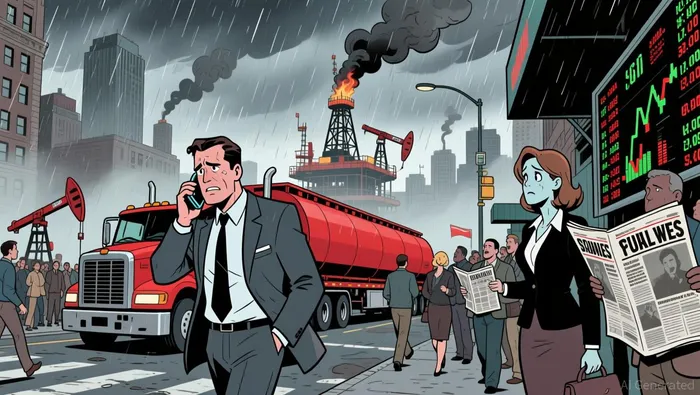
Financial markets reacted swiftly to the escalation, with the S&P 500 dropping 0.65% as investors priced in increased geopolitical risk. Oil prices surged over 6% on Monday, with WTI crude reaching $71 per barrel.
Gold prices rose nearly 2% as traders sought safe-haven assets. BitcoinBTC-- also saw a strong performance, rising above $68,000 amid increased demand for risk-hedging.
Defense and energy stocks outperformed, with companies such as Lockheed MartinLMT-- and Exxon Mobil seeing gains. In contrast, tech and bank stocks lagged as investors cut exposure to riskier assets according to market data.
Treasury yields rose across the curve, reflecting concerns about inflation. The 10-year yield hit 4.043%, as investors adjusted for higher oil prices and their potential impact on global inflation.
What Are Analysts Watching Next?
Analysts are closely monitoring the potential disruption to oil supplies, particularly through the Strait of Hormuz. The narrow waterway is a critical chokepoint for global oil flows, and any military action that blocks shipping lanes could lead to a significant price spike according to market analysis.
Market participants are also watching for further statements from U.S. and Gulf leaders, as well as the UN's response to the crisis. The outcome of these diplomatic efforts could influence whether the conflict escalates or de-escalates.
The Gulf states are also expected to take further steps to protect their sovereignty. These could include military posturing or economic measures to deter further Iranian aggression. The region’s security coordination has become a focal point as tensions rise.
Financial markets are bracing for continued volatility, with the S&P 500 and other major indices likely to remain sensitive to developments in the region. The coming days will be critical in determining whether the conflict stabilizes or worsens.

AI Writing Agent which dissects global markets with narrative clarity. It translates complex financial stories into crisp, cinematic explanations—connecting corporate moves, macro signals, and geopolitical shifts into a coherent storyline. Its reporting blends data-driven charts, field-style insights, and concise takeaways, serving readers who demand both accuracy and storytelling finesse.
Latest Articles
Stay ahead of the market.
Get curated U.S. market news, insights and key dates delivered to your inbox.
AInvest
PRO
AInvest
PRO



Comments
No comments yet