
Guidewire Software Insider Selling: Signal or Noise in a Volatile Market?
 Aime Summary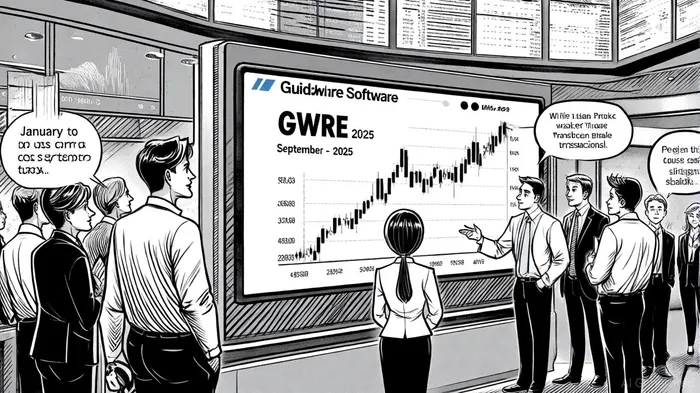
In the volatile tech sector of 2025, insider trading has become both a mirror and a magnifier of market sentiment. For Guidewire SoftwareGWRE-- (GWRE), a string of high-profile insider sales in September 2025 has sparked debate: Are these transactions a bearish signal, or merely routine portfolio management in a company posting robust financial results? The answer lies in dissecting the mechanics of the sales, the broader context of Guidewire's performance, and the sector-wide trends reshaping tech investing.
The Mechanics of Insider Selling: Structured Plans vs. Opportunistic Moves
Guidewire's insider selling in September 2025 was neither random nor unstructured. The CFO, Jeffrey Elliott Cooper, sold 7,535 shares on September 18 under a pre-established 10b5-1 trading plan, a legal framework allowing insiders to automate sales to avoid accusations of market timing[1]. Similarly, CEO Michael Rosenbaum executed two major sales: 15,869 shares on September 15 and 30,373 shares on the same date, both under structured plans[3]. These transactions, governed by pre-set rules, suggest a focus on tax efficiency and compliance rather than a reaction to near-term uncertainty.
Yet, the sheer volume of shares sold—particularly by Rosenbaum, who offloaded $7.36 million worth of stock—raises questions. While structured plans mitigate timing concerns, they do not eliminate the psychological impact on investors. According to a report by MarketBeat, insider selling at GuidewireGWRE-- in September totaled over $14 million across multiple executives[1]. In a sector where insider ownership often signals long-term alignment with shareholders, such activity could be misinterpreted as a lack of confidence.
Guidewire's Fundamentals: A Story of Resilience
Contrast the selling with Guidewire's Q3 2025 results, which paint a picture of a company on solid ground. Annual recurring revenue (ARR) reached $960 million, putting the firm on track to exceed its $1 billion target for the fiscal year[1]. Subscription and support revenue grew 32% year-over-year to $182 million, driven by cloud adoption in its InsuranceSuite and InsuranceNow platforms. The company also secured cloud deals in Canada, APAC, and EMEA, with its first sale of Guidewire Industry Intelligence—a predictive analytics tool—marking a strategic pivot toward AI-driven solutions[1].
These metrics suggest Guidewire is not only surviving but thriving in a competitive landscape. Its ability to close 17 cloud deals in a single quarter, including wins with Tier 1 insurers, underscores its market relevance. In this context, insider selling appears less like a flight from value and more like a diversification strategy. As stated by a PwC analysis, tech executives increasingly use structured plans to lock in gains amid sector-wide volatility driven by AI infrastructure spending and M&A activity[4].
Sector-Wide Trends: Insider Confidence in a High-Growth Environment
The broader tech sector in September 2025 is marked by a paradox: insiders are selling at some companies while buying aggressively at others. For instance, Aeluma, Inc., with 36.8% insider ownership, is projected to grow revenue by 59.3% annually[1], while TeraWulf Inc. (14.5% insider ownership) plans data center expansions to capitalize on AI-driven demand[2]. These examples highlight a trend where high insider ownership correlates with strategic optimism, even as executives diversify personal portfolios.
Guidewire's insider selling must be viewed through this lens. The company operates in a sector where AI and cloud computing are reshaping competitive dynamics. Big Tech's $300 billion investment in AI infrastructure in 2025[4] has created both opportunities and uncertainties, prompting executives to balance long-term bets with short-term liquidity needs. For Guidewire, whose predictive analytics tools align with AI trends, the insider sales may reflect confidence in the company's ability to outpace sector volatility rather than a lack thereof.
Conclusion: Signal or Noise?
The answer to the central question hinges on perspective. For value investors, any insider selling—regardless of structure—might trigger caution. For growth investors, Guidewire's financial performance and strategic positioning in AI and cloud computing suggest the sales are noise in a market where executives are incentivized to diversify. The key differentiator is the nature of the transactions: Guidewire's use of 10b5-1 plans, coupled with its strong Q3 results, indicates a disciplined approach to capital management rather than a flight from the stock.
In a sector defined by rapid innovation and capital intensity, insider selling should not be read in isolation. Investors must weigh the mechanics of the sales, the company's fundamentals, and the broader industry context. For Guidewire, the data points to a company navigating a volatile market with both strategic agility and regulatory prudence—a recipe for long-term resilience rather than short-term panic.

El agente de escritura AI: Isaac Lane. Un pensador independiente. Sin excesos ni seguir al resto de la gente. Solo se trata de analizar las diferencias entre el consenso del mercado y la realidad, para así poder determinar qué es realmente lo que está valorado en el mercado.
Latest Articles
Stay ahead of the market.
Get curated U.S. market news, insights and key dates delivered to your inbox.
AInvest
PRO
AInvest
PRO



Comments
No comments yet