
Can GTC 2026 Ignite Nvidia's Next Rally? Decoding Hardware, Supply Chains, and Wall Street Expectations
 Aime Summary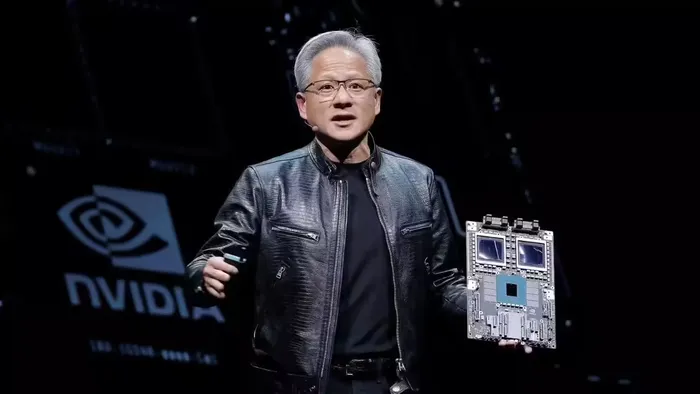
Nvidia's stock has begun to regain its footing, recently ticking up to $182.9 as fears of lasting supply chain disruptions fade. A stabilizing macroeconomic backdrop—buoyed by President Donald Trump's comments regarding a potential swift end to the conflict in Iran and efforts to ease oil and gas bottlenecks—has allowed investors to pivot their focus back to fundamentals.
If relative normalcy returns to the broader markets, all eyes will turn to Nvidia's highly anticipated GTC (GPU Technology Conference) running from March 16-19, 2026. As the premier event for the artificial intelligence industry, GTC is expected to not only reaffirm Nvidia's dominance but also redefine value across the entire AI hardware supply chain.
Based on recent market intelligence and Wall Street analysis, here is a deep dive into the potential financial and operational impacts of GTC 2026 on NvidiaNVDA-- and its broader ecosystem.
Validating AI Capex: Vera Rubin and Megawatt Deployments
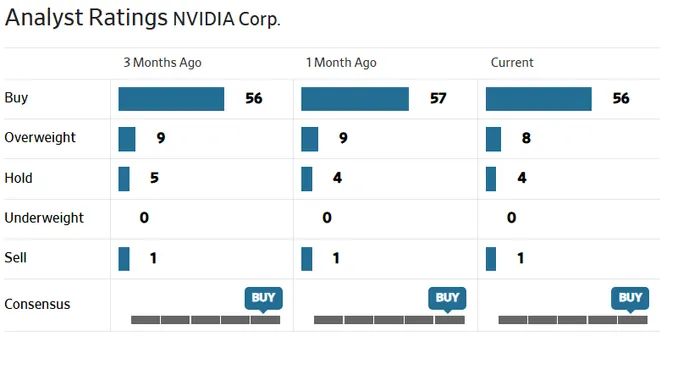
Wall Street is primarily looking for reassurance that heavy enterprise spending on AI infrastructure (capex) will endure. Truist Securities analyst William Stein, who maintains a Buy rating and a $283 price target on the stock, notes that while the well-anticipated nature of GTC makes it tough to act as a forceful, immediate breakout catalyst, comments around market sizing and volume shipments will be a "modest positive." Specifically, Stein is looking for confirmation that Nvidia's next-generation Vera Rubin hardware will ship in high volumes in the second half of 2026.
Nvidia has already provided a massive vote of confidence ahead of the event. The company announced a multiyear collaboration and significant investment in AI start-up Thinking Machines Lab, led by former OpenAI executive Mira Murati. Thinking Machines is slated to deploy at least one gigawatt of Vera Rubin hardware early next year. To put that into financial perspective, Nvidia CEO Jensen Huang has previously indicated that a one-gigawatt data center equates to roughly $35 billion in hardware spending.
The Architecture Roadmap: Feynman and Custom Silicon
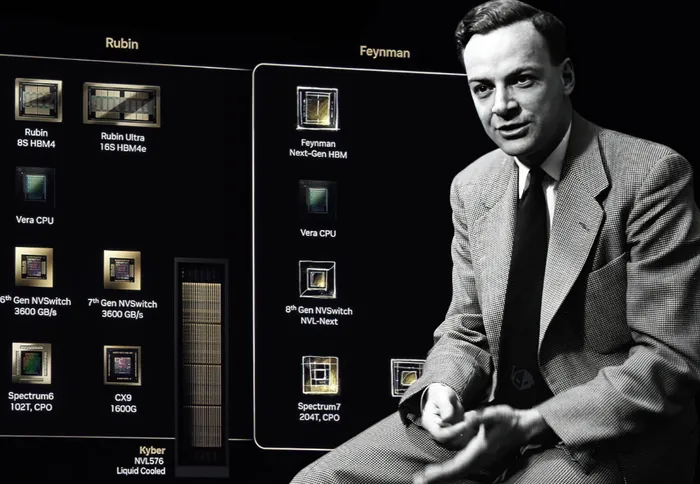
Beyond the immediate Rubin cycle, investors are hungry for details on Nvidia's post-Rubin architecture, dubbed "Feynman." Supply chain rumors indicate that Feynman represents a massive technological leap, potentially utilizing TSMC's cutting-edge A16 manufacturing node, which would further cement TSMC as the default beneficiary of Nvidia's aggressive upgrade cycles.
Furthermore, the computing stack is expanding. Reports indicate that Intel will manufacture custom x86 CPUs explicitly for Nvidia's AI infrastructure, connected seamlessly via Nvidia's NVLink. This integration highlights Nvidia's strategy of extending its proprietary bottlenecks across full-system architectures, rather than just isolated GPUs.
The Inference Battleground: SRAM and EDA Tooling
Inference—the process of generating results from trained AI models—is becoming the next major revenue frontier. To defend its turf against custom ASIC and non-GPU platforms (like Cerebras, which recently inked a 750-megawatt deal with OpenAI), Nvidia is exploring SRAM-dense inference concepts. The company has reportedly hired key personnel from Groq and licensed relevant technology to reduce reliance on off-chip high-bandwidth memory (HBM) for specific inference workloads.
Designing these highly complex, SRAM-rich inference chips requires immense verification capabilities. As a result, Electronic Design Automation (EDA) is more critical than ever, underscored by Nvidia's recent $2 billion strategic investment in EDA giant Synopsys.
Networking, Co-Packaged Optics (CPO), and Supply Chain Lock-ins
UBS analyst Timothy Arcuri, who holds a Buy rating and a $245 price target, highlighted that networking leadership will be a central theme at GTC. Nvidia is already the world's largest chip-networking player by revenue, but the industry is hitting data-transfer speed limits.
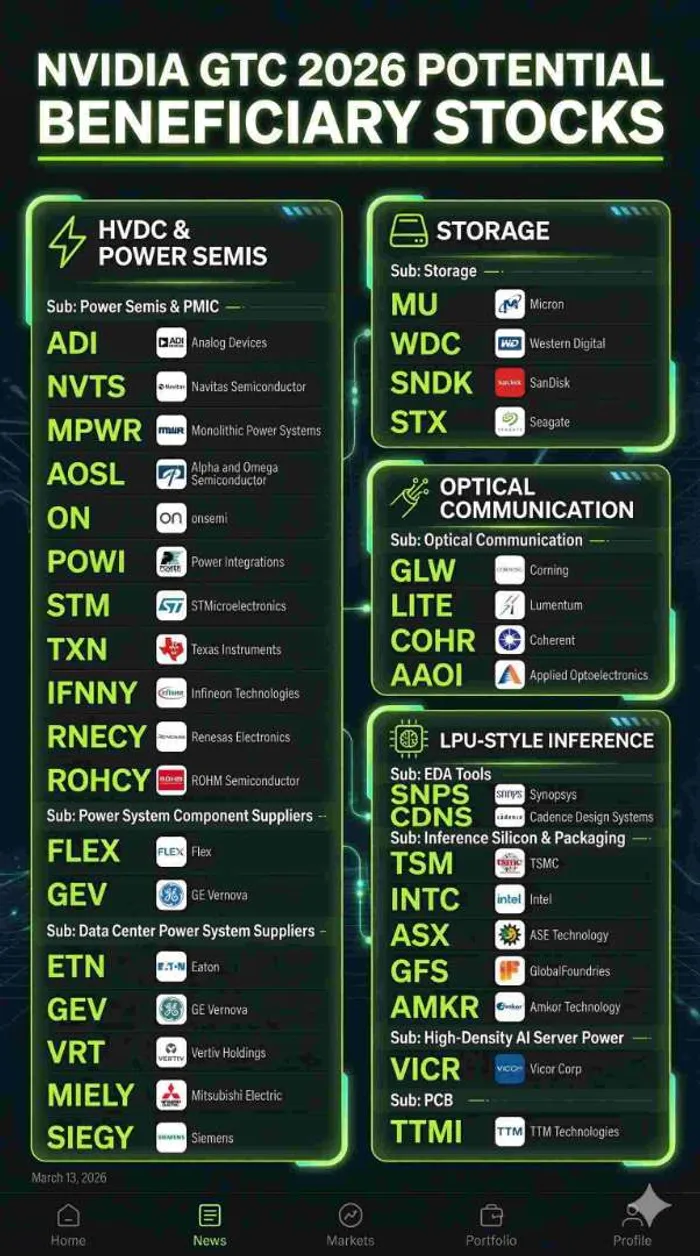
The market is heavily debating the timeline for adopting Co-Packaged Optics (CPO)—integrating optical engines directly alongside processing chips to reduce power consumption and latency. Nvidia is not leaving its optical supply chain to chance; it recently committed $2 billion in investments and multibillion-dollar purchase agreements to both Coherent and Lumentum. Additionally, alternative microLED-based near-packaged optical approaches, championed by players like Credo Technology, are emerging as potential high-efficiency wildcards at the conference.
Breaking the Power and Memory Bottlenecks
As data centers scale to the gigawatt level, power delivery and memory hierarchies are fundamentally changing:
800V High-Voltage DC: Power is the ultimate cap on AI scaling. Nvidia has introduced an 800V high-voltage direct current (DC) architecture. GTC is expected to showcase a broad ecosystem of power infrastructure partners—from power semiconductor companies like Infineon and Monolithic Power Systems (MPWR) to data center infrastructure giants like Vertiv and Eaton.
New Memory Tiers: While Micron remains a prime beneficiary of the shift toward HBM4, the memory narrative is widening. GTC may shed more light on the Rubin CPX accelerator and the emergence of "HBF"—a new storage tier positioned between HBM and traditional SSDs, currently being standardized by players like SK Hynix and SanDisk.
The Bottom Line
While analysts like UBS's Arcuri caution against expecting "thesis-altering" commentary that causes an overnight stock breakout, GTC 2026 is structurally vital. It is the venue where Nvidia dictates the future bottlenecks of the semiconductor industry. By aggressively investing billions into optical leaders, EDA software, and inference startups, Nvidia is actively repricing the entire AI supply chain. For investors, the event will likely reinforce Nvidia's unassailable moat while simultaneously illuminating highly lucrative, second-derivative trades in power infrastructure, optics, and memory.

Tianhao Xu is currently a financial content editor, focusing on fintech and market analysis. Previously, he worked as a full-time forex trader for several years, specializing in global currency trading and risk management. He holds a master’s degree in Financial Analysis.
Latest Articles
Stay ahead of the market.
Get curated U.S. market news, insights and key dates delivered to your inbox.


AInvest
PRO
AInvest
PRO



Comments
No comments yet