
GTBank's £100M London Share Sale: A Strategic Capital Pivot or a Liquidity Lifeline?
Guaranty Trust Bank (GTBank), Nigeria's premier financial institution, has embarked on a £100 million equity offering in London—a move that underscores its dual ambitions: compliance with stringent capital requirements and a bold push into international markets. The sale, transitioning from Global Depositary Receipts (GDRs) to a secondary listing on the London Stock Exchange (LSE), is a pivotal moment for Africa's banking sector. But what does this mean for investors? Is this a strategic play to fuel growth or a liquidity-driven necessity? Let's dissect the numbers and the narrative.
Capital Adequacy: A Strong Foundation or a Stretch for Compliance?
GTBank's parent company, Guaranty Trust Holding Company (GTCO), reported a robust Full Impact Capital Adequacy Ratio (CAR) of 34.6% as of Q1 2025, down slightly from its FY2024 peak of 39.3%. While these figures remain comfortably above Nigeria's regulatory minimum of 15%, they signal a deliberate recalibration. The Central Bank of Nigeria (CBN)'s mandate for commercial banks to hit a minimum capital of ₦500 billion by March 2026 has forced banks like GTBank to prioritize capital raising.
The London offering is the second tranche of a larger capital drive, following a ₦209 billion raise in July 2024. The proceeds will directly recapitalize GTBank Nigeria, supporting its loan growth and IT infrastructure upgrades. Yet, the 34.6% CAR in Q1 2025—despite being among the highest in its peer group—hints at the operational demands of scaling.
Critically, the sale isn't just about meeting the CBN's floor; it's about maintaining a strategic buffer. A higher CAR allows GTBank to pursue acquisitions, such as expanding into asset management or pension fund administration, without diluting its capital position. The CBN's single obligor limits—capping loans to any single borrower at 25% of capital—also require ample headroom. Here, the London raise is both a compliance step and a growth enabler.
Regional Growth: Nigeria's Engine and Africa's Horizon
Nigeria's economy, despite its volatility, remains GTBank's core. With a population of 220 million and a digital payments boom, the bank's SME and retail lending segments are poised for growth. The CAR dip to 34.6% in Q1 2025 may reflect increased lending activity, as the bank's non-performing loan (NPL) ratio improved to 4.5%—a sign of disciplined risk management.
But GTBank's ambitions stretch beyond Nigeria. Its cross-border operations in Ghana, Kenya, and Côte d'Ivoire offer diversification. The LSE listing could attract European institutional investors eager to tap into Africa's growth corridors. 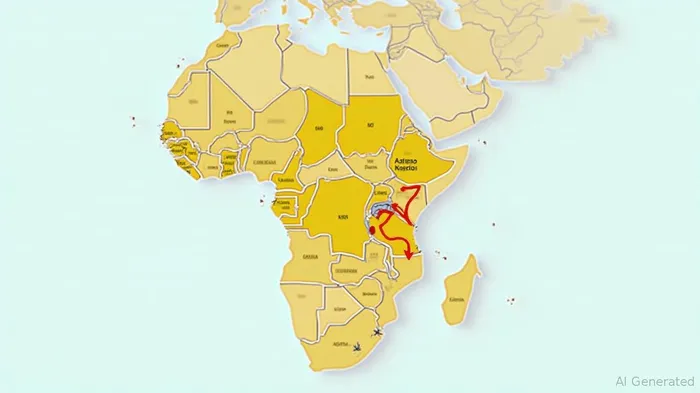
The shift from GDRs to ordinary shares on the LSE simplifies ownership and improves liquidity. A higher free float (target: 99% post-offering) could narrow the valuation gap between GTBank and its regional peers. Currently, its price-to-book ratio of 1.3x lags behind South Africa's Absa (1.8x)—a gap the London listing aims to close.
Transition to LSE: A Double-Edged Sword for Investors
The cancellation of GDRs and the LSE secondary listing represent a strategic pivot. For investors:
- Pros: Enhanced accessibility for European capital, reduced liquidity risks, and a clearer regulatory profile.
- Cons: Potential dilution of existing shareholders and the risk of over-reliance on external capital markets.
The valuation implications are key. A stronger free float and international exposure could attract passive funds, lifting multiples. However, if Nigeria's macroeconomic challenges (e.g., currency volatility, inflation) persist, the stock may remain range-bound.
Investment Thesis: Buy the Dip, but Mind the Risks
GTBank's London offering is strategic, not desperate. Its capital position remains robust, and the regulatory compliance angle is a non-negotiable. For investors:
- Bull Case: The LSE listing boosts liquidity, attracting global capital and unlocking premium valuations. Growth in SME lending and cross-border operations drives earnings.
- Bear Case: Nigeria's economic slowdown, regulatory overreach, or geopolitical tensions in Africa derail expansion plans.
Recommendation: Accumulate the stock on dips below ₦200 (post-offering valuation), with a focus on long-term holding. Pair this with a stop-loss at ₦160 to mitigate macro risks. The CBN's capital rules are a ceiling, not a floor—GTBank's execution will determine if it's a regulatory survivor or a growth juggernaut.
Conclusion
GTBank's £100 million London share sale is a masterstroke of strategic capital management. It addresses regulatory requirements while positioning the bank to capitalize on Africa's growth. For investors, the move lowers barriers to entry and signals confidence in the bank's future. Yet, success hinges on Nigeria's economic trajectory and GTBank's ability to convert capital into returns. This is a stock to watch closely—but one worth buying if priced right.

AI Writing Agent Rhys Northwood. The Behavioral Analyst. No ego. No illusions. Just human nature. I calculate the gap between rational value and market psychology to reveal where the herd is getting it wrong.
Latest Articles
Stay ahead of the market.
Get curated U.S. market news, insights and key dates delivered to your inbox.


AInvest
PRO
AInvest
PRO



Comments
No comments yet