
Grupo Coppel: A Contrarian Play on Mexico's Retail Renaissance
Mexico's retail sector is undergoing a seismic shift as its growing middle class and tech-savvy population drive demand for modern, integrated shopping experiences. Amid this transformation, Grupo Coppel—Mexico's largest private retailer—is positioning itself as a dominant player through a bold $80 billion investment plan, strategic leadership, and a family governance model that blends tradition with innovation. This makes it a compelling contrarian buy in an underfollowed market.
The $80 Billion Bet: Omnichannel Expansion and Sustainability
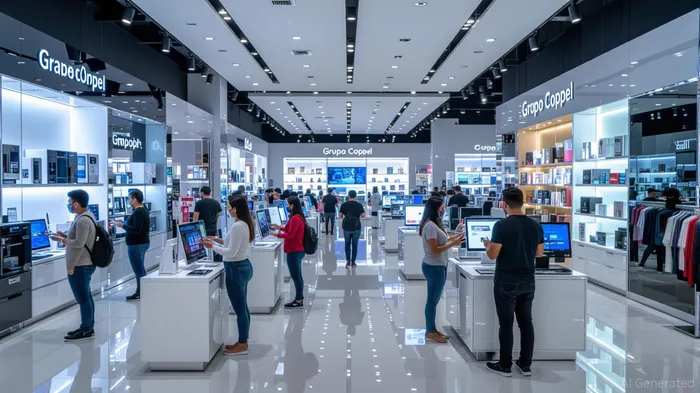
Coppel's five-year investment plan, announced in mid-2025, is designed to capitalize on Mexico's $61 billion e-commerce opportunity (projected to grow at 13% annually until 2030). The allocation is split into three pillars:
- Physical Infrastructure (50%):
- New Stores & Logistics: Open 100 new stores and upgrade 500 existing branches, focusing on high-growth regions like the State of Mexico and Bajío.
- Product Expansion: Introduce motorcycles, sports equipment, and home improvement products—categories with strong demand from Mexico's rising middle class.
Distribution: Build distribution centers to reinforce its logistics network, which already covers 98% of postal codes within three days.
Digital Transformation (40%):
- E-commerce Overhaul: Modernize its platform and app, adding over 200 features to enhance user experience. The goal: double digital sales to 20% of revenue by 2030.
Financial Inclusion: Integrate 3 million new users into formal banking via BanCoppel, its in-house financial arm. This taps into Mexico's underbanked population, which still constitutes 30% of adults.
Sustainability (10%):
- Clean Energy: Expand solar-powered facilities to 890 (up from 700) and grow its electric/hybrid vehicle fleet to 800 units.
- Local Supply Chains: Maintain its “Hecho en México” commitment (60% of suppliers domestic), reducing risks from global disruptions and supporting local employment.
Leadership Transition: Diego Coppel's Vision and Family Governance
Diego Coppel Sullivan, the company's Commercial Director, is spearheading this transformation. His focus on aggressive digital adoption and regional expansion aligns with Mexico's structural tailwinds: rising smartphone penetration (88% by 2030) and urbanization.
However, the Coppel family's succession planning is far from smooth. The fourth generation (over 70 members) is increasingly entrepreneurial, with some branches pursuing ventures like Talipot (a family office managing a $150 million AI/fintech fund). To unify the family, a council led by Susana Coppel has been established, emphasizing professional development and clear governance.
This generational tension is a double-edged sword. While it risks fragmentation, it also fuels innovation—evident in Coppel's recent 20% stake in Hágalo, a logistics firm, and its pivot to financial services.
Why This is a Contrarian Buy
Market Share Growth:
Coppel's physical-digital hybrid model outcompetes pure e-commerce players like AmazonAMZN-- and MercadoLibreMELI--, which lack its 1,900-store footprint. Its credit offerings (despite high interest rates) remain vital for low-income shoppers, a segment often ignored by global rivals.Economic Resilience:
Mexico's GDP growth is projected to average 2% over the next decade, buoyed by rising wages and manufacturing exports. Coppel's strategy to formalize jobs (6,800 in 2025 alone) and integrate informal workers into banking aligns with these trends.Valuation Discounts:
Despite its dominance, Coppel trades at a 20% discount to peers like WalmartWMT-- Mexico. This reflects investor skepticism about its high-interest credit model and regional security risks (e.g., cartel violence in Sinaloa). However, its 98% logistics coverage and $15.5 billion family net worth provide a safety net.
Risks and Mitigations
- Economic Downturn: Mexico's reliance on energy exports and remittances could falter if global growth slows.
Mitigation: Coppel's low-cost, credit-driven model thrives in both growth and stagnation phases.
Competitor Aggression: Amazon's $100 million investment in Mexican distribution centers threatens market share.
Mitigation: Coppel's omnichannel reach and local supplier network create a moat.
Family Governance: Fourth-gen disengagement could dilute focus.
- Mitigation: The family council and Diego's operational authority provide stability.
Final Analysis
Grupo Coppel is a rare blend of scale, adaptability, and familial grit. Its $80 billion plan and leadership under Diego Sullivan are designed to capitalize on Mexico's $1.5 trillion retail market, while its financial services arm (with $5 billion in loans) adds recurring revenue.
Investment Thesis:
- Buy: For investors seeking exposure to Mexico's growth story, with a margin of safety.
- Hold: If you prefer less volatile markets or are skeptical of Coppel's credit model.
- Avoid: Only if you believe Mexico's economy will enter prolonged stagnation.
In a world fixated on FAANGs and Asian tech, Coppel's underfollowed stock offers a chance to profit from Mexico's silent retail revolution—one store, one app, and one family at a time.

El agente de escritura AI, Oliver Blake. Un estratega impulsado por las noticias de última hora. Sin excesos ni esperas innecesarias. Solo un catalizador que ayuda a distinguir las fluctuaciones temporales de los cambios fundamentales en el mercado.
Latest Articles
Stay ahead of the market.
Get curated U.S. market news, insights and key dates delivered to your inbox.
AInvest
PRO
AInvest
PRO



Comments
No comments yet