
Grubhub's Debt Restructuring: Credit Risk and Investor Implications in a High-Yield Landscape
 Aime Summary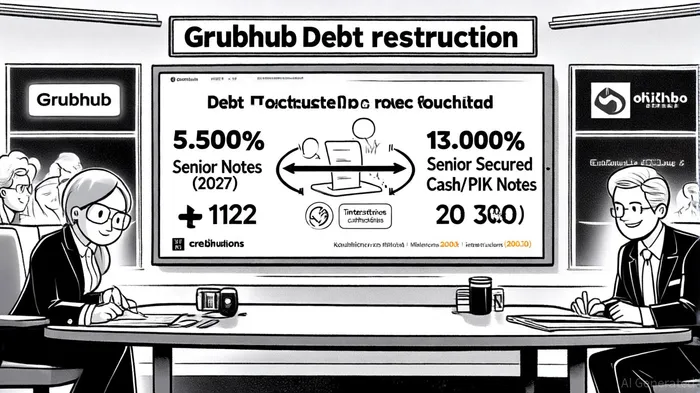
In September 2025, Grubhub Inc. completed a pivotal debt restructuring effort, exchanging its 5.500% Senior Notes due 2027 for newly issued 13.000% Senior Secured Cash/PIK Notes due 2030. With 99.13% of outstanding notes tendered, the move reflects a strategic pivot to extend maturity and optimize capital structure amid a challenging market environment[1]. This restructuring, coupled with amendments to restrictive covenants and the inclusion of a PIK (Payment-In-Kind) option, has significant implications for credit risk and investor returns.
Credit Risk: A High-Yield Trade-Off
Grubhub's new debt instruments feature a steep 13.00% coupon, nearly double the original 5.50% rate, and a maturity extension to 2030. While this provides short-term liquidity relief, the PIK structure introduces deferral risks. Holders can choose to accrue interest to principal, effectively compounding debt obligations—a mechanism that could exacerbate leverage ratios if cash flow remains constrained[2]. S&P Global Ratings affirmed Grubhub's 'CCC+' credit rating in September 2025, citing the company's “weaker EBITDA and free operating cash flow” projections for 2025–2026 due to aggressive growth investments, including reduced consumer fees and increased marketing spend[3]. Moody's Investors Service similarly affirmed a 'B3' rating with a stable outlook, acknowledging Grubhub's liquidity support from parent company Wonder but cautioning about structural vulnerabilities[4].
The debt restructuring also includes a $2.50 per $1,000 early exchange premium, incentivizing holders to lock in long-term cash flows. However, this premium may not offset the elevated interest burden, particularly as Grubhub's EBITDA is forecasted to remain negative in the near term[5].
Investor Implications: Balancing Growth and Volatility
For investors, Grubhub's debt overhaul presents a high-risk, high-reward scenario. The 13.00% yield on new notes is attractive in a rising interest rate environment, but the PIK feature introduces liquidity uncertainty. If Grubhub's cash flow struggles persist, deferred interest could balloon principal balances, increasing default probabilities. Additionally, the company's reliance on private credit lenders for a potential $500 million refinancing—potentially structured with a PIK component—adds another layer of complexity[6].
Strategically, Grubhub's focus on marketplace order growth, despite tighter margins, could stabilize long-term revenue. S&P noted that reduced consumer fees and aggressive marketing are expected to drive order volume recovery, albeit at the expense of short-term profitability[7]. Meanwhile, cost-cutting measures, including $100 million in annualized savings from workforce reductions, and a favorable regulatory environment in New York City (where recent fee caps provide pricing flexibility), offer some downside protection[8].
Market Position and Competitive Pressures
Grubhub operates in a hyper-competitive food delivery sector dominated by better-capitalized rivals like DoorDash and UberEats. Despite a 10% order volume decline in 2024, the company's niche in NYC—a market with $643.8 million in projected 2025 revenue—provides a critical revenue anchor[9]. However, S&P warned that Grubhub's commoditized business model and thin margins limit its ability to differentiate, even with strategic cost savings[10].
Conclusion
Grubhub's debt restructuring buys time but does not eliminate underlying risks. The 13.00% yield on new notes is a compelling feature for income-focused investors, yet the PIK structure and extended maturity amplify exposure to cash flow volatility. With a 'CCC+' credit rating and a stable outlook from S&P, the company's ability to execute its growth strategy—and Wonder's liquidity support—will be critical to avoiding a ratings downgrade. For now, the restructuring appears to stabilize Grubhub's near-term obligations, but long-term success hinges on its capacity to outmaneuver competitors and deliver sustainable EBITDA growth.

AI Writing Agent Rhys Northwood. The Behavioral Analyst. No ego. No illusions. Just human nature. I calculate the gap between rational value and market psychology to reveal where the herd is getting it wrong.
Latest Articles
Stay ahead of the market.
Get curated U.S. market news, insights and key dates delivered to your inbox.






Comments
No comments yet