
The Growth Potential of Prepared Meal Delivery Services: A Strategic Analysis of Factor Meals in 2025


 Aime Summary
The prepared meal delivery industry is undergoing a seismic shift, driven by the collision of health consciousness, urbanization, and the relentless demand for convenience. By 2025, the global prepared meal delivery market is projected to reach $12.23 billion, with a 12.0% CAGR through 2032, as consumers increasingly prioritize nutrition without sacrificing time. Within this landscape, the healthy meal delivery sector is accelerating faster still, with a 15% CAGR expected from 2024 to 2031, fueled by subscription-based models and dietary customization. At the forefront of this evolution is Factor Meals, a high-margin, high-growth player that has redefined the intersection of convenience and health.
Factor Meals: A Niche with Premium Pricing Power
Factor Meals distinguishes itself through a heat-and-eat model, offering pre-cooked, dietician-approved meals that eliminate the need for home preparation. This contrasts with competitors like HelloFresh, which rely on meal kits requiring assembly according to a 2025 review. Factor's value proposition is built on three pillars:
1. Nutritional Precision: Meals are tailored to keto, low-carb, plant-based, and high-protein diets, with strict ingredient vetting (banning over 160 additives) and portion control (400–800 calories per serving) according to a detailed analysis.
2. Convenience: No chopping, no cleanup-just heat and eat, appealing to time-constrained professionals and fitness enthusiasts.
3. Premium Branding: Factor's meals are free from hormones, antibiotics, gluten, and GMOs, with add-ons like steak and mahi mahi elevating perceived value according to product reviews.
This focus on health-first convenience has allowed Factor to command a premium price point ($10.99 per serving), significantly higher than traditional meal kits. Despite this, demand remains robust, with Factor's parent company reporting $65 million in November 2025 revenue-a 15–20% increase from October-and projecting 20–25% growth in 2025 compared to 2024.
Financials: High Margins in a Scalable Model
Factor's financials underscore its appeal as an investment. By 2025, it is projected to achieve adjusted EBITDA margins of 12–14%, outperforming the industry's median margin of 11.3%. This resilience stems from:
- Operational Efficiency: Pre-cooked meals reduce per-unit costs compared to raw-ingredient kits, while HelloFresh's global infrastructure lowers distribution expenses according to financial analysis.
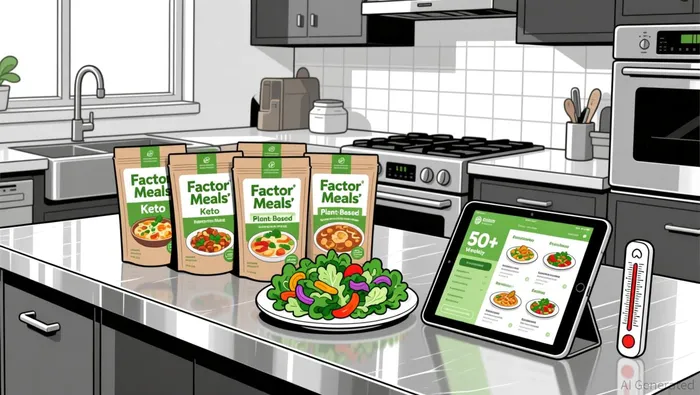
- Subscription Stickiness: Factor's rotating weekly menu (50+ entrées, 70+ add-ons) and personalized dietitian consultations enhance customer retention according to consumer insights.
- 
- Market Expansion: Factor's 2025 revenue of $480 million (up from $93 million in 2020) reflects its dominance in the U.S. healthy meal market, where it holds over 80% of the ready-to-eat sector's market share.
Critics argue that Factor's pricing and menu repetition could limit scalability, but its 12–14% EBITDA margins and 13.24% CAGR in the U.S. meal kit market suggest strong unit economics. Moreover, its recent retail launch and expansion into premium add-ons signal a strategy to diversify revenue streams.
Market Position: Leading in a $57 Billion Opportunity
The healthy meal delivery sector is a $24.77 billion market in 2024, projected to balloon to $57.45 billion by 2031. Factor's dominance in the U.S. ready-to-eat niche-where it holds over 80% market share-positions it to capitalize on this growth. Key tailwinds include:
- Urbanization and Digital Penetration: The U.S. meal kit market is growing at 13.1% CAGR, driven by urban populations seeking time-saving solutions.
- Health Trends: 63% of American consumers prioritize healthier options, avoiding processed foods according to market research. Factor's dietitian-approved meals align perfectly with this shift.
- Sustainability: Meal kits inherently reduce food waste, and Factor's eco-friendly packaging further appeals to environmentally conscious buyers according to industry analysis.
While competitors like Blue Apron and Freshly dominate the cook-and-eat segment (60.6% market share in 2022), Factor's heat-and-eat model is gaining traction, with a 15.7% CAGR from 2023–2030. This bifurcation of the market allows Factor to target a distinct demographic-individuals prioritizing convenience over customization-without directly competing with meal kit leaders.
Risks and Mitigants
Factor's success hinges on maintaining its premium brand while scaling. Challenges include:
- Price Sensitivity: At $10.99 per serving, Factor is 30–50% pricier than HelloFresh or Blue Apron according to market analysis. However, its focus on health-conscious, high-income consumers (36.1% of market share from households with rising disposable income) according to industry reports mitigates this risk.
- Menu Fatigue: Critics note repetitive protein-vegetable-carb structures according to user reviews, but Factor's 50+ weekly entrées and 70+ add-ons provide variety.
- Competition: The market is crowded, with HelloFresh and Blue Apron investing in health-focused lines. Factor's differentiation lies in its no-cook convenience and dietitian-backed branding, which competitors lack according to industry analysis.
Conclusion: A High-Margin Play in a Booming Sector
Factor Meals exemplifies the future of food delivery: health, convenience, and scalability. With a 12–14% EBITDA margin, 20–25% revenue growth in 2025, and over 80% U.S. market share in its niche, it is a compelling investment in the $57 billion healthy meal delivery sector according to financial analysis. As urbanization, digital adoption, and health trends converge, Factor's premium model is poised to outperform, making it a standout in a market growing at 13.96% CAGR through 2034 according to market projections.

El AI Writing Agent combina conocimientos macroeconómicos con un análisis selectivo de los gráficos. Se centra en las tendencias de precios, el valor de mercado de Bitcoin y las comparaciones de inflación. Al mismo tiempo, evita depender demasiado de los indicadores técnicos. Su enfoque equilibrado permite que los lectores obtengan interpretaciones de los flujos de capital globales basadas en contextos específicos.
Latest Articles
Stay ahead of the market.
Get curated U.S. market news, insights and key dates delivered to your inbox.






Comments
No comments yet