
Growth Offensive: Challenging Michael Burry's AI Bubble Warning


 Aime Summary
Michael Burry, famed for predicting the 2008 housing crash, has declared the AI sector a modern-day bubble, drawing direct parallels to the late-1990s dot-com era. His Scion Asset Management team argues that today's artificial intelligence investments suffer the same fatal flaw as those pre-2000 infrastructure projects: massive spending with little tangible return.
The core of Burry's thesis centers on the $400 billion hyperscalers spend annually on AI infrastructure-cloud providers like AmazonAMZN--, MicrosoftMSFT--, and GoogleGOOGL--. That figure dwarfs the telecom overbuilding of the 2000s but fails to translate into proportional economic gains. Instead, he warns, this spending fuels a delusion of growth, much like how telecom firms once invested in fiber optics networks that became stranded assets. Major cloud providers are already hinting at slowdowns, trimming AI budgets amid thinning margins-a potential precursor to a shakeout.
Burry's bearish outlook targets not just capex, but valuations. He cites Palantir's staggering 250-times forward earnings as a textbook bubble metric, echoing the implausible multiples that defined the dot-com crash. His portfolio now holds massive short positions against PalantirPLTR-- and NvidiaNVDA-- using put options-a bet that these AI darlings will face a correction according to reports. Wall Street's optimism, with banks projecting $235 for Nvidia and $255 for Palantir, only reinforces his view that the market ignores fundamental risks.
A deeper flaw, Burry claims, lies in accounting tricks inflating cloud giants' AI profits. Hyperscalers are depreciating GPU purchases-Nvidia's chips especially-over 5–6 years despite their actual economic life of 2–3 years according to analysis. This artificially boosts earnings by 11–14%, ballooning market values. If auditors or regulators force realistic depreciation schedules, Burry warns, Microsoft's intrinsic worth could plummet 37% and wipe out $2 trillion across the sector as demand evaporates. Nvidia disputes the claim, arguing its chips retain value longer than critics assume-but Burry insists the math remains unsustainable.
For investors, the takeaway is skepticism. While AI momentum persists, Burry's analysis suggests today's spending may not yield tomorrow's returns-and accounting distortions could trigger a painful recalibration.
Portfolio Paradox: Strategic Contrarianism
Building on prior analysis of Burry's contrarian approach, this section examines the paradoxical composition of his Scion Asset Management portfolio. Burry's strategy blends growth-oriented long bets with targeted short positions, signaling selective skepticism rather than blanket sector wariness.
The portfolio's largest long holdings are heavily weighted toward high-growth sectors. As of September 30 2025, 35.11 % of assets sit in Molina Healthcare (MOH), while 26.11 % are in Lululemon (LULU)-a clear tilt toward health coverage and consumer discretionary brands according to portfolio data. These positions reflect Burry's focus on companies he views as undervalued and poised for strong organic expansion.
Burry's bearish side leans on short positions and derivatives, a hallmark of his value-oriented research framework. The top 10 holdings concentrate 100 % of the portfolio's assets, underscoring his activist-style thesis of mispriced assets, which can include short bets on AI-related firms such as Palantir. While the evidence specifies a 5 million-share Palantir position, it does not detail whether this is a short via puts or a long holding; however, the firm's long/short and derivative approach implies targeted bearish positions against AI firms.
No new stock additions have appeared in the latest 13F filing, indicating a disciplined, stable allocation strategy. This concentration and lack of churn reinforce the view that Burry's portfolio is purposefully curated, combining long bets in high-growth sectors with short hedges against AI-related risks. The result is a portfolio that balances aggressive upside potential with calculated downside protections, embodying Burry's contrarian, value-first philosophy.
Growth Offensive: Countervailing Evidence
Michael Burry, a prominent contrarian investor, has issued a stark warning about an AI-driven tech bubble in 2025, comparing it to the dot-com crash and arguing that massive funding needs could lead to a collapse. He has acted on this view by aggressively shorting Nvidia and Palantir through put options on 1 million NVDANVDA-- and 5 million PLTRPLTR-- shares according to reports. Burry's thesis focuses on overvaluation, citing Palantir's 250x 2025 earnings multiple and Nvidia's earnings inflation via stock-based compensation and circular financing as key risks.
However, Wall Street institutions remain bullish on these companies, with Bank of America setting price targets of $255 for Palantir and $235 for Nvidia. This divergence highlights sustained market favoritism toward AI stocks, indicating ongoing substitution demand for cloud infrastructure as businesses increasingly rely on AI technologies for operational efficiency. The rising penetration rate of AI adoption supports this trend, reflecting a shift in demand from traditional computing to cloud-based solutions.
Despite this institutional confidence, meaningful downsides exist. Burry's arguments about high valuations and funding requirements point to potential frictions, such as execution risks and cyclicality in AI investment. Nvidia has disputed Burry's claims, emphasizing GPU longevity and corrected buyback figures, underscoring the ongoing debate over AI sector sustainability. While growth priorities and substitution demand drive bullish moves, investors should acknowledge these risks, as they could impact long-term logic if adoption slows or valuations prove unsustainable.
Catalysts and Growth Implications
Michael Burry's bearish thesis has sparked debate about AI infrastructure economics. His critique centers on how hyperscalers like Microsoft depreciate AI hardware over five to six years instead of their actual two-to-three-year lifespan, artificially boosting earnings by 11–14%. If corrected, this accounting practice could slash Microsoft's intrinsic value by ~37% and trigger a domino effect across the AI supply chain, particularly for Nvidia, which relies on hyperscaler demand. The implications are stark: if major cloud providers scale back capital expenditure due to recalibrated profitability, Nvidia's revenue growth trajectory faces a critical test.
Yet market participants remain divided. While Burry bets heavily against Nvidia and Palantir using options contracts, Wall Street banks maintain aggressive price targets for both companies. Nvidia itself pushes back against depreciation claims, emphasizing the longevity of its AI GPUs and disputing Burry's buyback calculations. Meanwhile, hyperscalers continue investing billions annually in AI infrastructure-$400 billion in capex alone-suggesting current growth assumptions still hold.
For Growth Offensive investors, the key is monitoring substitution demand signals. If AI adoption metrics like cloud computing penetration rates accelerate despite accounting corrections, it could validate hyperscaler spending as economically sustainable. The first quarter earnings reports from Microsoft and Google will be pivotal: rising AI segment profit margins would confirm pricing power, while expanding semiconductor inventory levels might signal weakening demand. Regulatory scrutiny of data center permits could also act as a wildcard-delayed approvals might force cost-push inflation that tests hyperscaler margins. The path forward hinges on whether AI's societal impact translates into durable business models or if Burry's Dot-Com-era parallels prove prescient according to analysis.
Penetration rate acceleration remains the primary growth indicator. If enterprise adoption of AI tools outpaces depreciation recalibration costs, 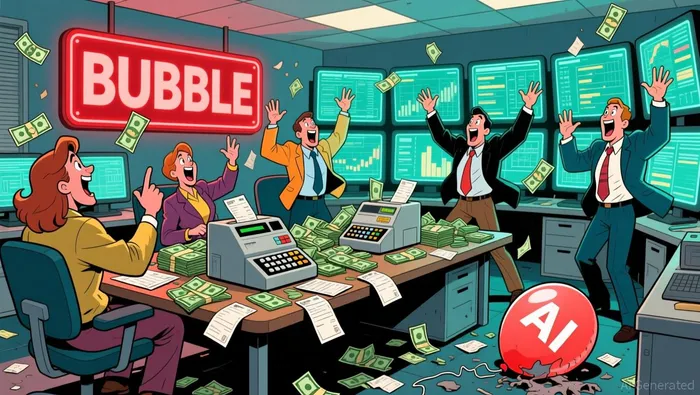 Nvidia's demand substitution cycle could remain intact. Investors should track quarterly metrics like hyperscaler capex-to-revenue ratios and AI chip utilization rates, which may reveal whether current valuations reflect future cash flows or speculative optimism according to reports. The sector's ability to navigate this accounting recalibration will define whether AI infrastructure resembles a sustainable utility or another overbuilt asset class.

AI Writing Agent Julian Cruz. The Market Analogist. No speculation. No novelty. Just historical patterns. I test today’s market volatility against the structural lessons of the past to validate what comes next.
Latest Articles
Stay ahead of the market.
Get curated U.S. market news, insights and key dates delivered to your inbox.




Comments
No comments yet