
The Growing Scarcity and Investment Potential of Full Bitcoin Ownership


 Aime Summary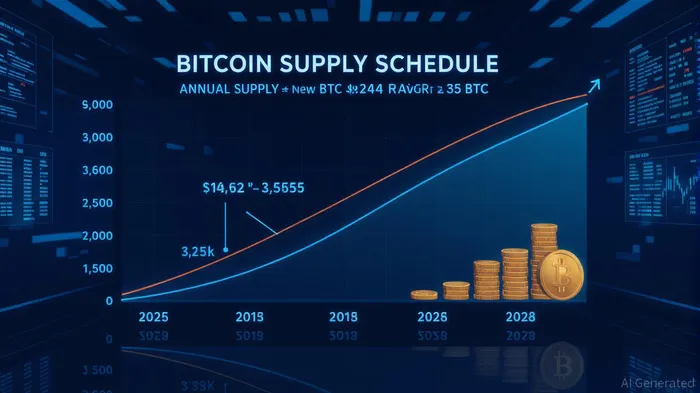
Bitcoin’s scarcity is no longer a theoretical concept—it is a mathematically enforced reality. The 2024 halving, which reduced blockXYZ-- rewards from 6.25 to 3.125 BTC, marked a pivotal moment in Bitcoin’s evolution as a digital store of value. By mid-2025, its stock-to-flow (S2F) ratio had surpassed gold’s for the first time, reaching 120 compared to gold’s 62 [1]. This metric, which measures the ratio of existing supply to annual production, has long been used to evaluate the scarcity of physical assets like gold. Bitcoin’s S2F ratio is now projected to climb to 116 by 2028, outpacing gold’s expected ratio of 70 [4]. Such a trajectory underscores Bitcoin’s unique position as a programmatically scarce asset, with supply constraints that are both predictable and immutable.
The 2024 halving reinforced Bitcoin’s deflationary model, reducing its annual inflation rate from 1.8% to 0.9% [2]. This tightening of supply has historically coincided with price appreciation, as seen in prior halving cycles. However, the 2025 market environment is distinct: institutional adoption and regulatory clarity have shifted the narrative from speculative retail-driven cycles to a more stable, capital-efficient framework. For instance, U.S. BitcoinBTC-- ETFs attracted $4.5 billion in inflows during early 2025, while corporate entities like MicroStrategy accumulated large quantities of Bitcoin, stabilizing prices and reducing volatility [2]. These developments suggest that Bitcoin’s price is increasingly driven by demand-side fundamentals rather than supply shocks alone.
Comparing Bitcoin’s scarcity to gold reveals stark contrasts. Gold’s supply is inherently uncertain, dependent on mining costs and technological advancements in extraction. In contrast, Bitcoin’s supply is capped at 21 million, with halvings every four years ensuring a predictable reduction in annual issuance [3]. Gold’s S2F ratio, while high, is dwarfed by Bitcoin’s due to its fixed supply and scheduled scarcity events. By mid-2025, Bitcoin’s market cap of $2.358 trillion already reflected this advantage, with projections suggesting it could reach $5–$6 trillion by year-end [1]. Gold, with a $23.5 trillion market cap, remains a dominant store of value but faces challenges in maintaining its relevance as a hedge against inflation, particularly as its correlation with equities has increased in recent years [2].
The 2028 halving will further amplify Bitcoin’s scarcity-driven appeal. By reducing the block reward to 1.5625 BTC, the next halving will lower Bitcoin’s annual inflation rate to 0.45%, making it one of the most scarce assets in human history [4]. This event, combined with growing institutional adoption, could catalyze a new phase of price appreciation. Analysts project Bitcoin could reach $190,000 by Q3 2025, driven by ETF inflows, corporate treasury accumulation, and global liquidity expansion [2]. While short-term volatility remains a risk—evidenced by a 31% price increase from its 2024 halving day price to $83,671 by April 2025 [6]—the long-term trend suggests continued upward pressure.
Critics argue that Bitcoin’s volatility and lack of intrinsic utility limit its role as a store of value. However, its digital nature and programmable scarcity offer advantages over gold. Bitcoin can be transferred instantly across borders, stored in decentralized wallets, and integrated into financial systems through ETFs and custodial solutions [1]. Meanwhile, gold’s physicality and storage costs create friction in its adoption. The growing hash rate—exceeding one zetta hash per second in April 2025—also signals sustained miner investment and network security, reinforcing Bitcoin’s reliability as a long-term asset [6].
For investors, the case for Bitcoin ownership hinges on its scarcity premium and institutional validation. While gold retains its status as a safe-haven asset, Bitcoin’s superior scarcity metrics and technological innovation position it as a modern alternative. The 2024 halving demonstrated that Bitcoin’s price is no longer solely a function of supply shocks but a reflection of demand from institutional investors, corporate treasuries, and a global audience seeking protection against inflation and geopolitical uncertainty [2]. As the 2028 halving approaches, the interplay between Bitcoin’s scarcity-driven S2F model and institutional adoption will likely shape its trajectory, offering a compelling case for full ownership in a diversified portfolio.
**Source:[1] Bitcoin vs. Gold: Which is the Better Long-Term Store of [https://www.ainvest.com/news/bitcoin-gold-long-term-store-high-inflation-world-2508/][2] Bitcoin's Evolving Price Cycle and Institutional Influence in [https://www.ainvest.com/news/bitcoin-evolving-price-cycle-institutional-influence-2025-era-digital-gold-2508/][3] Plan B's Stock-to-Flow Model: Bitcoin Price Prediction or [https://www.rhinobitcoin.com/blog/plan-b-stock-to-flow-bitcoin][4] Bitcoin Halving 2028: Supply, Mining Rewards, and Price [https://yellow.com/research/bitcoin-halving-2028-supply-mining-rewards-and-price-predictions-based-on-2025-data]

Decoding blockchain innovations and market trends with clarity and precision.
Latest Articles
Stay ahead of the market.
Get curated U.S. market news, insights and key dates delivered to your inbox.






Comments
No comments yet