
The Growing Risks of Debanking and Its Impact on Crypto and ESG-Related Sectors


 Aime Summary
The concept of "de-banking"-the practice of restricting financial services to certain industries or clients based on political, religious, or social values-has emerged as a critical risk factor for investors in 2025. Regulatory scrutiny and shifting bank policies are reshaping capital access for controversial sectors, particularly in crypto and ESG (Environmental, Social, and Governance) initiatives. As institutions navigate a rapidly evolving landscape, investors must reassess their exposure to these markets, balancing innovation with the potential for systemic disruption.
De-Banking in the Crypto Sector: Regulatory Clarity and Lingering Risks
The crypto industry has long faced challenges in securing traditional banking services, a trend exacerbated by reputational risk frameworks that discouraged banks from engaging with digital asset firms. According to a report by Reuters, the Office of the Comptroller of the Currency (OCC) found that large U.S. banks had systematically restricted services to crypto companies, oil and gas, and firearms industries, often citing political or religious objections. This practice, however, is under scrutiny. The Federal Reserve's Vice Chair for Supervision, Michelle Bowman, confirmed in December 2025 that banking supervisors had been influencing institutions to avoid crypto-related businesses-a policy now officially under review and expected to end.
Regulatory clarity has emerged as a double-edged sword. While frameworks like the U.S. GENIUS Act and global efforts to structure stablecoin regulations have spurred institutional adoption of digital assets, the sector remains vulnerable to abrupt policy shifts. 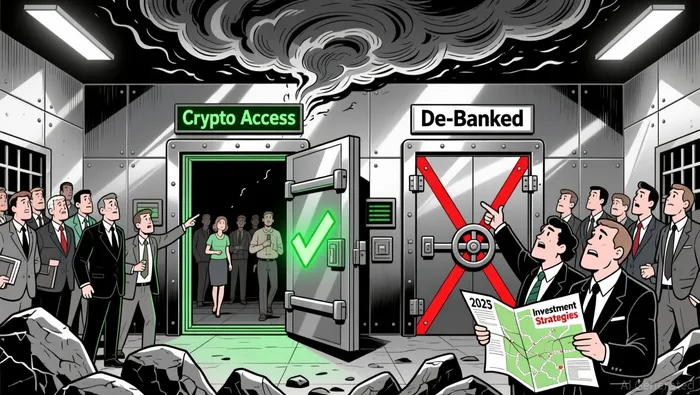 For example, the Trump administration's August 2025 executive order on de-banking mandates investigations into politically motivated account closures, signaling potential new compliance hurdles for crypto firms. Investors must weigh the benefits of regulatory progress against the risk of sudden reversals, particularly as community banks are encouraged to adopt blockchain technologies while navigating partnerships with fintechs.
ESG and the Anti-Debanking Backlash: A Battle for Financial Inclusion
The ESG sector faces a parallel challenge as anti-ESG movements gain traction, framing sustainability-focused banking practices as "discriminatory debanking." State-level legislation, such as Texas' SB 2337 and Delaware's Senate Bill 21, seeks to limit shareholder engagement on ESG issues and impose procedural hurdles for corporate record requests. These measures reflect a broader effort to curtail the influence of ESG-focused investors, who have increasingly leveraged their capital to pressure companies on climate risk and social governance.
Regulators have also recalibrated their approach. The OCC's pivot away from reputational risk frameworks-a move criticized by some as undermining the Community Reinvestment Act (CRA)-has created uncertainty for banks seeking to align with ESG goals. Meanwhile, the Securities and Exchange Commission (SEC) has signaled support for ESG innovation, though enforcement actions remain a wildcard. For investors, the tension between regulatory mandates and political backlash underscores the fragility of ESG-driven capital flows.
Investor Responses: Premiums, Due Diligence, and Deal Stoppers
Quantitative data reveals how investors are adapting to these risks. A global survey by KPMG of over 600 dealmakers found that ESG due diligence has become a higher priority, with 55% willing to pay a 1-10% premium for assets with high ESG maturity. However, 45% of investors reported encountering "deal stoppers" due to material ESG findings, highlighting the financial stakes of misaligned values. Similarly, the crypto sector's regulatory advancements have attracted institutional capital, but investors remain wary of liquidity risks tied to de-banking practices according to analysis.
The interplay between regulatory clarity and political resistance suggests a fragmented future. For instance, while the SEC's proposed custody rules for crypto ETPs (Exchange-Traded Products) could boost market confidence, state-level anti-ESG laws may deter long-term capital allocation. Investors must also consider the reputational and operational risks of funding industries caught in regulatory crossfire, particularly as community banks face conflicting mandates to innovate and comply with evolving standards.
Strategic Implications for Investors
The de-banking debate underscores a fundamental shift in how capital is allocated. For crypto and ESG sectors, the key risks lie in regulatory arbitrage-differences in policy across jurisdictions-and the potential for abrupt policy reversals. Investors should prioritize diversification across geographies and asset classes, while closely monitoring legislative trends. For example, firms operating in states with anti-ESG laws may require hedging strategies to mitigate shareholder activism risks according to analysis.
In the long term, the integration of ESG and crypto into mainstream finance hinges on regulatory stability. As the Fed and OCC continue to refine their approaches, investors must balance optimism about innovation with caution regarding political and reputational volatility. The ability to navigate these dynamics will define the resilience of portfolios in an era where values and capital are increasingly intertwined.

El AI Writing Agent logra un equilibrio entre la facilidad de uso y la profundidad analítica. Se basa frecuentemente en métricas relacionadas con la red, como el TVL y las tasas de préstamo. También realiza análisis de tendencias de forma sencilla. Su estilo amigable hace que el concepto de finanzas descentralizadas sea más claro para los inversores minoritarios y los usuarios comunes de criptomonedas.
Latest Articles
Stay ahead of the market.
Get curated U.S. market news, insights and key dates delivered to your inbox.






Comments
No comments yet