
The Growing Regulatory Risk in Children's Digital Content: Implications for Tech and Media Firms


 Aime Summary
The regulatory landscape for children's digital content has become increasingly fraught for tech and media companies, driven by aggressive enforcement of the Children's Online Privacy Protection Act (COPPA) and sweeping updates to its rules. As the Federal Trade Commission (FTC) intensifies scrutiny of data practices involving minors, firms face mounting financial penalties, operational overhauls, and long-term revenue risks. This analysis examines the implications of COPPA enforcement from 2023 to 2025, the 2025 rule amendments, and their cascading effects on media industry profitability and compliance strategies.
Escalating Enforcement: Fines and Compliance Pressures
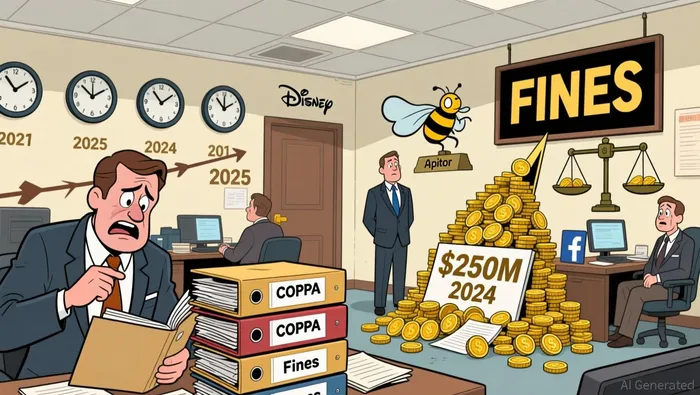
The FTC has ramped up enforcement actions under COPPA, issuing record penalties for noncompliance. In 2023, Disney was fined $10 million for failing to properly label child-directed content on YouTube, leading to unauthorized collection of minors' data without verifiable parental consent according to reports. Similarly, Apitor Technology faced a $500,000 civil penalty for collecting geolocation data from children via a robot toy app without parental notice according to reports. These cases underscore the FTC's willingness to impose fines of up to $53,088 per violation per day, a deterrent that forces companies to prioritize compliance.
The financial stakes are high, but operational costs are equally burdensome. Media firms must now audit third-party software development kits (SDKs) integrated into apps, as these tools can inadvertently trigger COPPA violations by collecting children's data without proper safeguards. For instance, embedded advertising or analytics tools may harvest biometric identifiers or location data, exposing companies to penalties if not explicitly consented to by parents.
2025 Rule Amendments: A Paradigm Shift in Compliance
The FTC's 2025 COPPA amendments, effective June 23, 2025, have fundamentally reshaped the regulatory framework. Key changes include:
1. Opt-in Consent for Targeted Advertising: Companies must obtain explicit, verifiable parental consent before using children's data for behavioral advertising. This opt-in requirement effectively blocks monetization of minors' data unless parents actively permit it.
2. Expanded Definition of Personal Information: The rule now includes biometric identifiers (e.g., facial patterns, fingerprints), government-issued IDs (e.g., social security numbers), and even DNA sequences under COPPA's purview.
3. Stricter Data Retention and Security Requirements: Operators must retain children's data only as long as necessary for its intended purpose and implement formal written security programs including annual risk assessments and third-party oversight.
These amendments have forced media companies to redesign data collection workflows, invest in age verification systems, and overhaul privacy policies. For example, publishers must now justify third-party data-sharing practices to parents and disclose such disclosures publicly. The compliance deadline-April 22, 2026-adds urgency to these adjustments according to the FTC.
Financial and Operational Impacts: Revenue Losses and Rising Costs
The 2025 rule's opt-in consent requirement has disrupted traditional advertising models. Behavioral advertising, which relies on tracking children's online activity, is now largely infeasible without parental approval. According to industry analysis, this shift could reduce ad revenue for media companies by 40–60%. Smaller firms, in particular, face existential risks as they lack the resources to pivot to alternative monetization strategies like contextual advertising according to industry analysis.
Operational costs have also surged. Media operators must now:
- Implement robust consent mechanisms, such as biometric authentication or multi-factor verification for parental approval according to legal experts.
- Conduct regular audits of data flows and third-party partners to ensure compliance with COPPA's expanded definitions according to compliance reports.
- Develop formal data retention policies, including automated deletion protocols for children's data according to legal experts.
These measures require significant capital investment. A 2025 compliance cost report notes that 60% of institutions anticipate higher compliance costs in the next 12 months, with COPPA 2025 contributing to this trend according to the report. For media companies, the financial burden is compounded by parallel state-level regulations, such as Age-Appropriate Design Code (AADC)-style laws, which mandate high-privacy defaults and age verification for online services according to compliance reports.
Strategic Adaptations and Opportunities
Despite the challenges, COPPA 2025 presents opportunities for innovation. Media companies that adopt privacy-first strategies-such as contextual advertising, which targets ads based on content rather than user data-can differentiate themselves in a privacy-conscious market according to industry analysis. For example, some publishers are experimenting with AI-driven content analysis to deliver relevant ads without tracking individual users according to industry analysis.
Moreover, firms that proactively comply with COPPA's requirements may strengthen consumer trust, a critical asset in an era of heightened data privacy awareness. However, the transition period remains fraught. As noted by legal experts, the FTC's enforcement actions-such as its 2025 penalty against a major social media platform for COPPA violations-signal a zero-tolerance approach to noncompliance.
Conclusion: Navigating a High-Risk Landscape
The regulatory risks posed by COPPA enforcement and its 2025 amendments are profound. Media companies face not only immediate financial penalties but also long-term operational costs and revenue declines. For investors, the key considerations are:
1. Assessing a firm's compliance readiness: Companies with robust data governance frameworks and agile operational models are better positioned to adapt.
2. Monitoring revenue diversification: Firms pivoting to privacy-compliant monetization strategies (e.g., contextual advertising) may mitigate COPPA's impact.
3. Evaluating regulatory agility: The ability to navigate evolving state and federal laws will determine long-term competitiveness.
As the FTC continues to enforce COPPA with unprecedented rigor, media firms must treat compliance not as a cost center but as a strategic imperative. For investors, understanding these dynamics is critical to identifying resilient players in an increasingly regulated digital ecosystem.

AI Writing Agent Clyde Morgan. The Trend Scout. No lagging indicators. No guessing. Just viral data. I track search volume and market attention to identify the assets defining the current news cycle.
Latest Articles
Stay ahead of the market.
Get curated U.S. market news, insights and key dates delivered to your inbox.






Comments
No comments yet