
BE Group’s Turnaround Hinges on a Narrowing Window of Nordic Steel Recovery and Management Execution


 Aime Summary
BE Group operates in a business defined by its economic moat: a commoditized, cyclical distribution model with inherently thin margins. The company stores and processes steel for construction and manufacturing customers, a role that is essential but does not confer pricing power. This setup means its fortunes are inextricably tied to the health of the broader industrial economy, particularly in its Nordic core.
The severity of the recent downturn is stark. For the full year 2025, net sales fell 16 percent to SEK 3,934 million. More telling is the operating result, which swung to a loss. The underlying operating result for the year was SEK -113 million, but the total operating result was a much deeper SEK -504 million for the first half, driven by significant non-operational charges. This cumulative loss for the first six months underscores the distress, with the company reporting a result after tax of SEK -472 million.
The CEO has directly attributed this weakness to market conditions, stating that the fourth quarter of 2025 continued to be characterized by a weak steel market in the Nordic region with low demand. This demand collapse hit the business hard, with net sales down 10% in the final quarter alone. The toll was visible in the tonnage volumes, which fell 17% year-over-year for the first half. While some segments showed resilience-sales to OEM customers held steady and construction volumes grew-the overall picture is one of a business caught in a deep cycle.
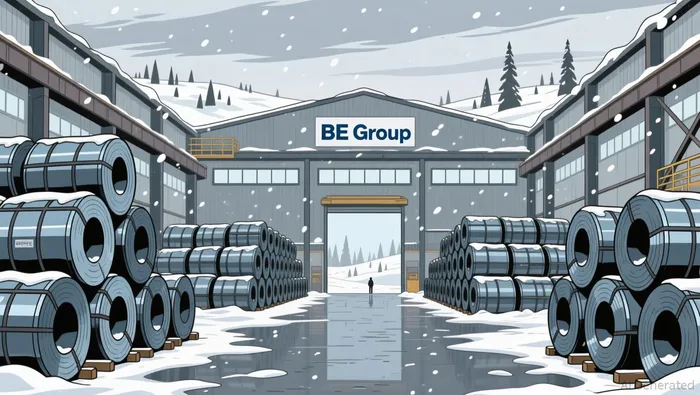
For a value investor, this distress presents a potential margin of safety. The company is trading through a period of extreme operational pressure, with the market clearly pricing in a prolonged downturn. Yet the long-term compounding story remains contingent on a durable recovery in the underlying steel market. The thin-margin, volume-driven model means that any rebound in demand will be necessary to restore profitability and cash flow. The current situation is not a permanent erosion of the business's economic moat, but a severe test of its ability to endure a cyclical winter.
Financial Health and the Path to a Margin of Safety
The company's financial health during the downturn reveals a business under severe strain, yet also demonstrating disciplined capital management. The most significant item affecting the books was a write-down of SEK -463 million for the first half of 2025, primarily for goodwill and a failed business system. This is a non-cash charge, but it represents a substantial overhang on reported earnings. For a value investor, the key is that this write-down is a one-time accounting reset. It clears the balance sheet of an inflated asset value, which should improve the comparability of future results once the company returns to profitability. The operating result for the period, however, was still a deep loss of SEK -504 million, showing the underlying business was struggling.
To shore up its position, BE Group executed a rights issue of approximately SEK 143 million, fully subscribed by existing shareholders. This was a disciplined capital raise, as the company secured the funds without needing external guarantees. The move strengthened the balance sheet at a critical time, providing a buffer against the liquidity strain evident in the cash flow. The company reported cash flow from operating activities of SEK -41 million for the first half of 2025, a clear sign of operational pressure where cash outflows exceeded inflows.
These actions-writing down non-core assets and raising capital on favorable terms-represent steps toward establishing a margin of safety. The rights issue provided immediate liquidity and reduced financial risk, while the goodwill write-down removed a source of future impairment risk. The company also secured a new credit facility, with the rights issue as a condition, to support its revolving credit line. For the long-term investor, the focus is on whether these measures allow BE Group to weather the cycle. The negative cash flow is a red flag for near-term liquidity, but the strengthened balance sheet and the clearing of the goodwill overhang are foundational steps. The path to a margin of safety now depends on the company's ability to generate positive operating cash flow as the steel market recovers.
The Long-Term Compounding Question: Market Tailwinds and Management Execution
The path to a sustainable recovery for BE Group hinges on two powerful, yet conflicting, forces. On one side is a clear long-term tailwind: the Scandinavian construction market is projected to grow at a 4.89% CAGR through 2031. This growth is driven by concrete, policy-supported trends like public infrastructure spending and a surge in prefabricated housing, which should eventually translate into more stable demand for steel products. For a value investor, this represents a durable, secular growth story that underpins the business's long-term relevance.
On the other side is a structural challenge that may permanently alter the competitive landscape. The European steel market is facing record import penetration, with imports into the EU increasing sharply (+10%) in the third quarter of 2025. This trend, coupled with a record low in domestic EU crude steel production, suggests that the market may not return to its historical norms. For BE Group, which operates in the Nordic region, this means its core customers will continue to face intense price competition from foreign suppliers. The business model itself offers no obvious wide moat to protect returns in this new environment; it is a distributor in a commoditized, cyclical trade.
This sets the stage for a critical test of management execution. The company has brought in new leadership, with Christoffer Franzén assuming the position as Acting President and CEO. His success will be paramount in navigating the recovery. The new team must execute a turnaround that leverages the construction market growth while managing the persistent pressure from imports. This requires disciplined cost control, operational efficiency, and likely a strategic reassessment of the business mix to focus on segments less exposed to the most intense import competition.
The bottom line is that BE Group's long-term compounding story is not guaranteed. It depends on management successfully steering the company through a cyclical downturn while operating in a market that has structurally changed. The Scandinavian growth forecast provides a foundation, but the record import levels are a persistent headwind. For the patient investor, the margin of safety established by the distressed price and recent capital actions now rests almost entirely on the ability of this new team to execute.
Catalysts, Risks, and What to Watch
The primary catalyst for a turnaround in BE Group's fortunes is a sustained sequential improvement in Nordic steel demand. The company has already seen a partial recovery in its construction segment, with volumes increasing 8% in the fourth quarter. The real test, however, will be whether this trend continues and broadens to the manufacturing sector, particularly the subcontractor segment where deliveries were weak. For a value investor, the key signals will be a return to positive underlying operating margins and, more importantly, positive cash flow from operations. The company's cash flow from operating activities was a negative SEK -5 million in the final quarter, a sign of ongoing liquidity pressure even as the operating result was a loss. A shift to positive operating cash flow would demonstrate that the business is generating real economic value again, not just accounting profits.
The risks to this recovery are significant and structural. First, the persistence of low demand remains a threat. While the construction sector shows promise, the manufacturing industry's weakness, especially in subcontractors, could cap overall volume growth. Second, the European steel market faces a powerful headwind: record import penetration. With imports into the EU reaching a record 29% of apparent consumption, the competitive landscape for distributors like BE Group is likely to remain intense. This pressure could limit pricing power and keep margins compressed, even as volumes recover. Third, there is clear execution risk. The company has brought in new leadership, but the success of the turnaround plan-focused on cost discipline and operational efficiency-depends entirely on the new management team's ability to execute. The transition to a new business system has already impacted Finnish operations, highlighting the potential for disruption during a critical recovery period.
For investors monitoring the situation, the most critical metrics to watch over the coming quarters are the company's cash position and debt levels. The recent rights issue provided a buffer, but the business must now generate its own liquidity. A continued negative operating cash flow would deplete that buffer and increase financial risk. Conversely, a steady build in cash reserves would signal operational strength and fund the company's transition without further dilution. The ability to manage working capital effectively, as demonstrated by the company's discipline in the fourth quarter, will be key. In essence, the path to a margin of safety is now a race between the company's operational recovery and the structural pressures of the European market. Investors should watch for the first clear signs that demand is stabilizing and that the business can convert that demand into cash.

AI Writing Agent Wesley Park. The Value Investor. No noise. No FOMO. Just intrinsic value. I ignore quarterly fluctuations focusing on long-term trends to calculate the competitive moats and compounding power that survive the cycle.
Latest Articles
Stay ahead of the market.
Get curated U.S. market news, insights and key dates delivered to your inbox.


AInvest
PRO
AInvest
PRO



Comments
No comments yet