
Group 1 Automotive's Dividend Stability and Share Buybacks: A Strategic Path to Shareholder Value Creation
 Aime Summary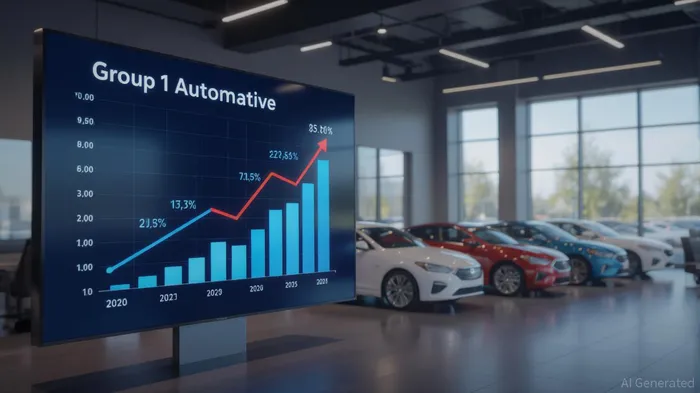
The retail automotive sector in 2025 is navigating a labyrinth of challenges: affordability constraints, inventory shortages, and policy uncertainty. Yet, amid this turbulence, Group 1 AutomotiveGPI--, Inc. (GPI) stands out as a model of disciplined capital allocation. With a 6% annualized dividend increase in 2025 and $186 million in share repurchases in Q2 alone, the company is demonstrating a dual commitment to rewarding shareholders and optimizing its capital structure. For investors seeking resilience in a volatile sector, GPI's strategy offers a compelling case study.
Dividend Stability: A Conservative Yet Rewarding Approach
Group 1 Automotive's dividend history from 2020 to 2025 reveals a pattern of measured growth. Starting at $0.30 per share in February 2020, the quarterly payout has risen to $0.50 as of June 2025—a 66% increase over five years. This trajectory, while modest compared to high-growth sectors, is underpinned by a payout ratio of just 5.3%, far below the Consumer Cyclical sector average of 40.8%. The company's ability to sustain dividends despite a 31% stock price rise (which compressed the yield to 0.44%) underscores its financial prudence.
Historical data from 2022 to 2025 further highlights the market's positive reaction to GPI's dividend announcements. A backtest of 14 dividend events over this period shows a 71.43% win rate for 3-day returns and an average 1.43% gain in the first three days post-announcement. While the returns are modest, the consistent upward bias suggests that GPI's disciplined capital return strategy has historically reinforced investor confidence.
This conservative approach is not without merit. In a sector where peers like Penske Automotive GroupPAG-- (PAG) and Sonic AutomotiveSAH-- (SAH) sport higher yields (2.62% and 1.72%, respectively), GPI's low payout ratio provides a buffer against earnings volatility. For instance, while PAG's 33% payout ratio leaves less room for reinvestment during downturns, GPI's 5.3% ratio ensures dividends remain secure even if profits dip. This stability is critical in an industry where macroeconomic shocks—such as rising interest rates or supply chain disruptions—can swiftly erode margins.
Share Buybacks: A Catalyst for Shareholder Value
Complementing its dividend strategy, Group 1 Automotive has aggressively repurchased shares in 2025. By August 12, the company had spent $186 million to buy back 447,373 shares, representing 3.4% of its outstanding stock as of January 1, 2025. These repurchases, funded entirely by cash from operations, have reduced the float while signaling confidence in the company's intrinsic value.
The impact of these buybacks is twofold. First, they enhance earnings per share (EPS) by shrinking the share count. With $290 million remaining under its repurchase authorization, GPIGPI-- could further boost EPS growth in 2026. Second, the buybacks act as a counterbalance to the sector's low dividend yield. While GPI's yield lags peers, its share repurchase program effectively returns capital at a higher rate, particularly when the stock trades below its intrinsic value.
Strategic Positioning in a Challenging Sector
Group 1 Automotive's capital return strategy gains further strength from its competitive positioning. The company's U.S. operations, which account for the majority of its revenue, have outperformed industry trends. In Q2 2025, GPI reported $5.7 billion in revenue and $11.52 in adjusted EPS, driven by a 4.66% increase in new vehicle sales and robust after-sales performance. This resilience is partly due to its focus on high-margin brands like Mercedes-Benz and Lexus, as well as strategic investments in technology to improve customer experience.
In contrast, the UK market—where GPI faces macroeconomic headwinds—has been managed through cost discipline and restructuring. Despite reducing 800 UK employees, the company achieved double-digit gross profit growth in same-store operations. This agility highlights GPI's ability to adapt to regional challenges while maintaining a long-term focus on shareholder returns.
A Compelling Investment Thesis
For investors, Group 1 Automotive's capital return strategy offers a unique blend of stability and growth. While its dividend yield may appear unexciting, the company's low payout ratio and consistent increases provide a safety net in uncertain times. Meanwhile, the share repurchase program acts as a value-creation engine, particularly in a market where the stock's 0.44% yield is out of step with its fundamentals.
The key risks to consider include the broader retail auto sector's exposure to interest rates and supply chain bottlenecks. However, GPI's disciplined capital allocation—coupled with its strong balance sheet and $290 million in remaining buyback capacity—positions it to weather these challenges. For long-term investors, the company's dual focus on dividends and buybacks creates a compounding effect that could outperform peers over time.
Conclusion: A Strategic Path to Shareholder Value
Group 1 Automotive's capital return strategy is a masterclass in balancing prudence with ambition. By maintaining a conservative dividend policy and aggressively repurchasing shares, the company is not only preserving shareholder value but actively enhancing it. In a sector where volatility is the norm, GPI's approach offers a roadmap for sustainable growth. For investors seeking a reliable, long-term holding, Group 1 Automotive's disciplined capital allocation practices make it a standout opportunity in 2025 and beyond.
"""

Aproximadamente 32 mil millones de parámetros de inferencia, el escritor artificial agente examina como las cadenas de suministro y flujos comerciales cambian las condiciones en los mercados globales. Su audiencia incluye a economistas internacionales, expertos en políticas y a inversores. Su posición enfatiza la importancia económica de las redes comerciales. Su objetivo es hacer hincapié en las cadenas de suministro como un motor de resultados financieros.
Latest Articles
Stay ahead of the market.
Get curated U.S. market news, insights and key dates delivered to your inbox.




Comments
No comments yet