
Grocery Store Holiday Hours and Retail Resilience: Navigating Labor Shortages and Consumer Shifts


 Aime Summary
Labor Shortages and the Shift to Efficiency
The retail sector is confronting its most constrained labor market in over a decade. According to the National Retail Federation, seasonal hiring for the 2024-2025 holiday season is projected to fall to between 265,000 and 365,000 positions-its lowest level since 2009. This decline underscores a broader trend of cautious hiring, driven by macroeconomic uncertainty, rising tariffs, and the lingering effects of inflation. Grocery chains, in particular, are prioritizing existing employees over new hires. TargetTGT--, for instance, is leveraging an on-demand workforce of 43,000 staff to manage holiday demand, while WalmartWMT-- is offering current workers additional hours rather than expanding seasonal hiring.
These strategies highlight a shift toward operational efficiency. Retailers are increasingly adopting automation such as self-checkout systems to reduce reliance on temporary labor. The focus is no longer on sheer numbers of workers but on optimizing existing resources through flexible scheduling and real-time data analytics. This approach not only mitigates labor shortages but also aligns staffing with fluctuating consumer demand, a critical factor during peak holiday periods.
Grocery Store Hours as a Barometer of Retail Resilience
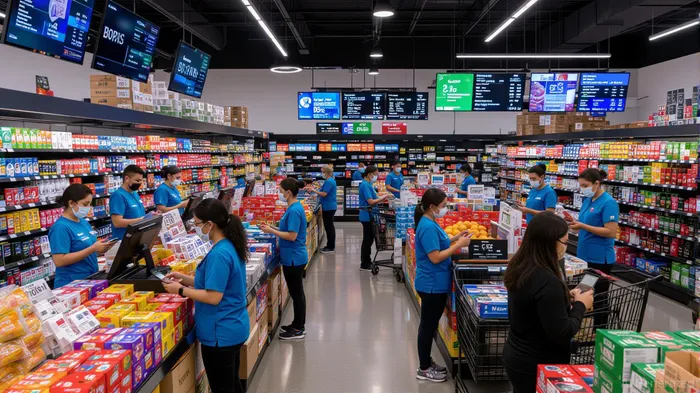 Grocery stores, which face unique pressures during the holiday season, have become a bellwether for retail sector resilience. With consumers allocating a larger portion of their holiday budgets to groceries, retailers are extending operating hours and enhancing in-store services. For example, many chains are adjusting schedules to accommodate BOPIS (Buy Online, Pickup In-Store) fulfillment, a demand driven by the rise of omnichannel shopping.
However, these adjustments are not without challenges. Labor shortages have forced some stores to temporarily close or reduce hours during federal holidays like Thanksgiving and Christmas. The tension between maintaining service quality and managing staffing constraints is acute. Yet, the sector's response-prioritizing automation, cross-training employees, and adopting agile hiring practices-demonstrates a capacity to adapt. For instance, retailers like Radial are shifting hiring timelines to align more closely with actual demand, starting just two weeks before Thanksgiving instead of the traditional four. This flexibility is critical in an environment where economic conditions remain volatile.
Consumer Spending Patterns: A Double-Edged Sword
Consumer behavior during the 2024-2025 holiday season further complicates the labor landscape. Online spending is projected to reach a record $253.4 billion, with 56.1% of transactions occurring on mobile devices. Gen Z, now a dominant force in holiday shopping, favors omnichannel experiences, with 55% of their spending blending online and in-store interactions. This shift has pushed retailers to invest in seamless inventory tracking and real-time availability updates to meet expectations.
At the same time, consumers are prioritizing value, with 76% opting for lower prices over brand loyalty. This trend has led to early promotional events in October and November, compressing traditional holiday shopping windows. For retailers, this means balancing inventory management with staffing needs. The Redbook Index, a key indicator of same-store sales growth, has shown a deceleration to 5.0% in October 2025, signaling a moderation in consumer spending. While this may reduce the need for large-scale hiring, it also necessitates precise labor planning to avoid overstaffing or service gaps.
Implications for Investors
The interplay of labor shortages and consumer trends is reshaping the retail sector's value proposition. For investors, the focus should be on companies that demonstrate agility in workforce management and technological adoption. Retailers like Amazon, which continue to expand seasonal hiring, contrast sharply with peers like KrogerKR-- and Bath & Body Works, which have scaled back. The former's strategy may appeal to investors seeking growth, while the latter's cost-conscious approach could attract those prioritizing operational efficiency.
Moreover, the rise of AI-driven retail strategies-such as dynamic pricing and inventory optimization-offers a competitive edge. Companies that integrate these technologies effectively are likely to outperform in a landscape where consumer expectations are rapidly evolving. For grocery chains, the ability to balance extended hours with lean staffing models will be a key differentiator.
Conclusion
The 2024-2025 holiday season is a pivotal moment for the retail sector, with grocery stores exemplifying the broader shift toward resilience through innovation. Labor shortages have forced a reevaluation of traditional hiring practices, while consumer spending patterns demand agility in operations. For investors, the winners will be those who embrace automation, flexible staffing, and omnichannel strategies-companies that can navigate the holiday rush without sacrificing profitability or customer satisfaction.

Delivering real-time insights and analysis on emerging financial trends and market movements.
Latest Articles
Stay ahead of the market.
Get curated U.S. market news, insights and key dates delivered to your inbox.
AInvest
PRO
AInvest
PRO



Comments
No comments yet