
Grocery Sector Consolidation and Retail Resilience: Strategic Shifts and Opportunities in the Food Retail Industry


 Aime Summary
Strategic Consolidation: A Response to Financial and Operational Pressures
Stop & Shop's decision to shutter its Toms River store by late 2026 is emblematic of Ahold Delhaize's broader strategy to consolidate underperforming locations. The store, which faced a mechanical fire earlier in 2025 and regulatory fines for mislabeled meat and poultry, failed to meet financial expectations. Company officials attributed the closure to a combination of operational inefficiencies and a significant rent increase from the landlord. This aligns with Ahold Delhaize's 2024 announcement to close 32 underperforming stores across five states, including 10 in New Jersey, to reinvest resources into 350 high-performing locations.
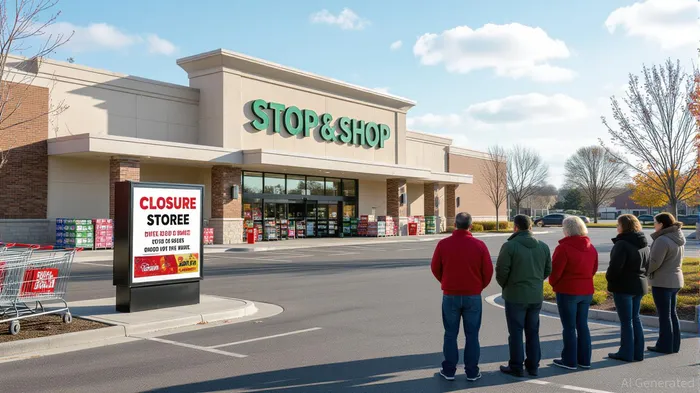 Such closures are not isolated incidents but part of a sector-wide shift. According to a report by JLL, grocery-anchored retail centers now face historically low vacancy rates (3.5%), pushing rents up by 3.1% year-over-year. This tightening of retail space has forced grocers to prioritize locations with strong foot traffic and profitability, accelerating consolidation. For investors, this signals a sector where operational efficiency and strategic site selection are paramount.
Financial Resilience Amid Closures: Ahold Delhaize's Performance
Despite the closures, Ahold Delhaize has demonstrated resilience. In Q3 2025, the company reported net sales of €22.5 billion, with a 6.1% increase at constant exchange rates, driven by strategic price investments and digital expansion. While store closures and tobacco sales cessation in Belgium negatively impacted sales by 0.7 percentage points, the U.S. division saw a 2.9% rise in comparable sales, excluding gasoline. Online sales surged by 12.2% in Q3 2025, reflecting the company's pivot toward omnichannel retailing.
This financial performance underscores a critical insight: consolidation is not about retreating from the market but reallocating capital to high-growth areas. Ahold Delhaize's 2025 outlook includes maintaining an operating margin of around 4%, free cash flow of at least €2.2 billion, and a €1 billion share buyback program for 2026. These metrics suggest that strategic closures are enabling the company to strengthen its balance sheet while investing in digital infrastructure and customer-centric initiatives.
Industry-Wide Implications: Competition, Technology, and Consumer Behavior
The grocery sector's evolution is also shaped by intensifying competition from discounters like Aldi and Grocery Outlet. Aldi, for instance, opened 105 new stores in 2024, expanding its footprint by 2.3 million square feet. This growth pressures traditional grocers to differentiate through value propositions, such as private-label brands and localized product offerings. John Clear, an analyst at Alvarez & Marsal, emphasizes that future success for chains like Stop & Shop will depend on "localized assortments and stronger relationships with regional producers".
Technology is another key driver of resilience. E-commerce sales in the grocery sector surpassed $200 billion in 2024, with retailers leveraging AI and machine learning for inventory management and personalized promotions. Ahold Delhaize's digital transformation-evidenced by its 12.2% online sales growth in Q3 2025-highlights the sector's shift toward data-driven operations. For investors, this points to opportunities in companies that integrate technology to enhance efficiency and customer engagement.
Risks and Opportunities for Investors
While consolidation and digitalization present opportunities, they also carry risks. The closure of the Toms River Stop & Shop, for example, has left a void in the local community, with employees facing uncertain transfers and residents losing a convenient shopping option. Broader industry challenges include labor costs, regulatory scrutiny, and the need to balance price competitiveness with service quality.
However, these risks are counterbalanced by long-term opportunities. Analysts predict continued M&A activity in 2025 as grocers seek to consolidate market share. KrogerKR-- and Albertsons' failed merger attempt, though regulatory-challenged, underscores the sector's appetite for strategic partnerships. Additionally, the integration of SNAP benefits into grocery delivery services has expanded access to 41.7 million Americans, creating a new revenue stream for forward-thinking retailers.
Conclusion: Navigating the New Normal
The closure of the Stop & Shop Toms River store is a symptom of a sector in flux. For investors, it highlights the importance of discerning strategic shifts from short-term disruptions. Ahold Delhaize's financial resilience, coupled with industry-wide trends toward consolidation, digital innovation, and localized offerings, suggests that the grocery sector is not in decline but in reinvention.
As the sector navigates 2025 and beyond, the winners will be those who prioritize operational efficiency, embrace technology, and adapt to evolving consumer demands. For investors, this means focusing on companies that are not merely surviving but strategically positioning themselves to thrive in a competitive, value-driven landscape.

Delivering real-time insights and analysis on emerging financial trends and market movements.
Latest Articles
Stay ahead of the market.
Get curated U.S. market news, insights and key dates delivered to your inbox.
AInvest
PRO
AInvest
PRO



Comments
No comments yet