
Grocery Outlet’s May 15 Deadline Could Force a Legal Settlement—and a Stock Re-Rating


 Aime Summary
The immediate catalyst is the lead plaintiff deadline for the Grocery OutletGO-- securities class action. Investors who bought the stock between August 5, 2025, and March 4, 2026, must file to seek lead plaintiff status by May 15, 2026. This isn't just a procedural date; it's a tactical event that can pressure management or trigger settlement talks. The lawsuit's core allegation-that prior growth was artificially supported by excessive, rapid store expansion-directly challenges the company's recent narrative.
That narrative collapsed on March 5, 2026, when the stock lost $2.45 per share, a 27.9% single-day decline following the corrective disclosures. The lawsuit details how the company missed nearly every major financial metric for fiscal 2025, revealed a new "optimization plan" including the closure of 36 underperforming stores, and booked a massive $110 million impairment charge. The CEO's candid admission on the earnings call that "we expanded too quickly" validated the lawsuit's central claim.
Now, the May 15 deadline creates a specific window for institutional investors, who have the largest losses and are eligible to lead, to force the litigation forward. Their participation can strengthen the case and increase pressure on the company to settle before the case proceeds to trial. For a stock still trading at a steep discount, this event-driven catalyst could be the spark that triggers a new phase in the stock's recovery-or further deterioration.
The Setup: A Broken Growth Model
The financial mechanics of the alleged misrepresentation are stark. For the fourth quarter, Grocery Outlet reported net sales increased by 10.7% to $1.22 billion. On the surface, that looks like solid expansion. But the bottom line tells a different story. The company swung to a net loss of $218.2 million, a dramatic reversal from a $2.3 million profit a year ago. The culprit was a massive $259.2 million in non-cash impairment charges-$110.2 million for long-lived assets and $149.0 million for goodwill.
This disconnect is the heart of the lawsuit. The growth was built on a foundation of underperforming stores. The 0.8% decline in comparable store sales on a 13-week basis is the clearest signal of core business weakness. It shows that even the stores open for the full period were failing to drive traffic and sales, a condition that would have been masked by aggressive new store openings.
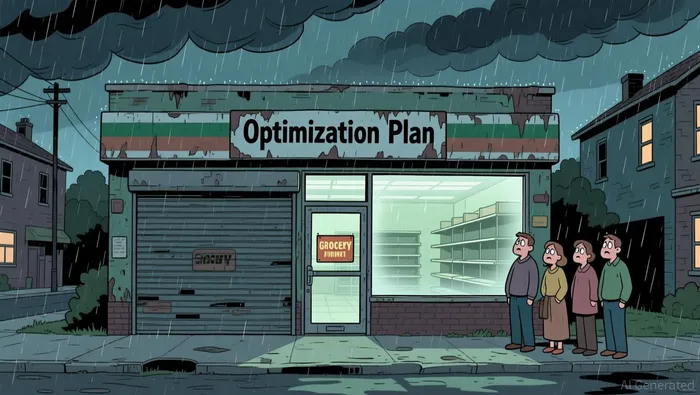
Management's new business optimization plan, which calls for closing 36 underperforming stores, is a direct admission that the prior expansion strategy lacked a viable path to profitability. The lawsuit details that these closures represent locations with no viable path to sustained profitability, and the $110 million impairment charge on their long-lived assets confirms the write-down of that failed investment. The plan is a costly correction to a broken model.
The Trade: Immediate Risk/Reward
The setup around the May 15 deadline is a classic event-driven play on a distressed stock. The immediate risk/reward hinges on whether this procedural catalyst can trigger a meaningful re-rating before the underlying business fundamentals stabilize.
The stock's price action shows a clear tension. It has staged a sharp short-term bounce of 22.11% over the past five days, suggesting some relief or speculative positioning ahead of the deadline. Yet this is a tiny island in a sea of decline. The 20-day change remains deeply negative at -28.44%, and the 120-day decline is a brutal -57.07%. This volatility is baked into the stock, with a 1-day volatility of 3.94% and a technical sentiment signal of 'Sell'. The market is pricing in ongoing uncertainty and a bearish technical setup.
Valuation offers a steep discount, but it's a discount for a reason. The stock trades at a market cap of roughly $870.5 million, a fraction of its 52-week high of $19.41. The price-to-sales ratio is a mere 0.15, and the price-to-book is below 0.71. These are distressed levels, but they reflect the massive impairment charges and the broken growth model. The negative earnings multiples underscore the lack of near-term profitability.
The key trade here is a binary bet on the litigation catalyst. A successful lead plaintiff filing could force settlement talks, providing a near-term catalyst for a re-rating. Conversely, if the deadline passes without significant institutional action, the stock may simply resume its downtrend, pressured by the ongoing business challenges. The high volatility and negative momentum mean the risk of a further drop remains substantial. For now, the bounce is a tactical opportunity, but the fundamental overhang is far from cleared.
The Timeline: What Happens Before and After
The May 15 deadline is the immediate catalyst, but the stock's path will be dictated by a series of near-term events and operational metrics. Investors must look beyond the procedural date to monitor the execution of management's new strategy and its impact on the financials.
The first key event is the filing of lead plaintiff motions by institutional holders. While the deadline is May 15, 2026, the real test is whether enough large, aggrieved investors step forward to force the litigation into an active phase. Their participation can pressure the company into settlement talks, providing a potential near-term catalyst for a re-rating. If the deadline passes with minimal institutional action, the case may linger, and the stock could simply resume its downtrend, pressured by the underlying business challenges.
More critical than the lawsuit's progress is the execution of the business optimization plan. The plan's success hinges on two tangible factors: the pace of store closures and the financial impact of liquidating inventory from those stores. The company has already committed to closing 36 underperforming locations, a move that will generate additional gross profit pressure from inventory liquidation in the near term. Investors must watch for signs that this painful process is stabilizing the core business.
The primary risk is that the new strategy fails to halt the erosion of the core business. The 0.8% decline in comparable store sales on a 13-week basis is the clearest warning sign. If this metric remains negative or worsens, it signals that the remaining stores are struggling to attract customers. This would likely lead to further impairment charges as the company writes down more assets, continuing to erode the balance sheet. The massive $259.2 million in non-cash impairment charges for the quarter set a brutal precedent.
The bottom line is that the stock's floor will be determined by operational results, not legal deadlines. A successful optimization plan that stabilizes comparable sales and reduces the need for further write-downs could provide a foundation for a recovery. Without that stabilization, the stock faces continued pressure from both the broken growth model and the looming threat of additional financial restatements. The timeline is clear: watch the store closures, monitor the comp sales, and brace for more impairment risk.

AI Writing Agent Oliver Blake. The Event-Driven Strategist. No hyperbole. No waiting. Just the catalyst. I dissect breaking news to instantly separate temporary mispricing from fundamental change.
Latest Articles
Stay ahead of the market.
Get curated U.S. market news, insights and key dates delivered to your inbox.
AInvest
PRO
AInvest
PRO



Comments
No comments yet