
The Grocery-Driven Powerhouse: How PECO's Necessity-Based Model Fuels Resilient Growth in Turbulent Times
 Aime Summary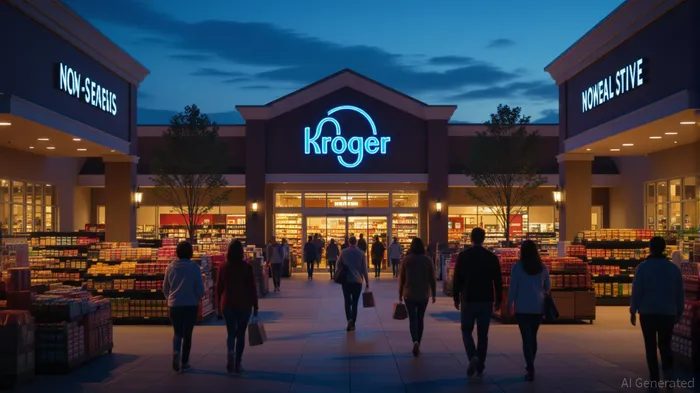
In a world where macroeconomic volatility, inflationary pressures, and rising interest rates dominate headlines, investors are increasingly seeking assets that thrive when others falter. Phillips Edison & CompanyPECO-- (PECO) has emerged as a standout in this environment, leveraging a grocery-anchored REIT model that combines defensive cash flows with disciplined growth. With a 4.2% year-over-year increase in same-center net operating income (NOI), a beta exposure of just 0.37, and a 99.1% anchor tenant occupancy rate, PECOPECO-- is proving that necessity-based retail isn't just a niche—it's a blueprint for outperformance.
The Necessity-Based Edge: Why Groceries Beat Discretionary Retail
The key to PECO's resilience lies in its tenant mix. Seventy percent of its average base rent (ABR) comes from essential goods and services, a stark contrast to the discretionary retail sector, which has struggled with e-commerce disruption and shifting consumer behavior. Grocery-anchored centers are immune to these trends because people will always need food, household supplies, and healthcare services861198--.
Take PECO's recent acquisition of Irmo Station in South Carolina, anchored by KrogerKR--. This property isn't just a retail hub—it's a community lifeline. Kroger's presence drives consistent foot traffic (32,000 visits per week, on average), which in turn supports ancillary tenants like pharmacies, banks, and salons. This ecosystem creates a flywheel effect: strong anchors stabilize cash flows, while smaller tenants benefit from the steady stream of customers.
Disciplined Acquisitions: Building a Portfolio That Grows Without Compromise
PECO's acquisition strategy is a masterclass in capital discipline. In 2025 alone, the company acquired 13 properties for $287.3 million, all anchored by top-tier grocers like Publix, AlbertsonsACI--, and H-E-B. These acquisitions were selected not just for their immediate cash flow but for their long-term strategic value. For instance, the Market at Cross Creek Ranch in Texas is anchored by H-E-B, a regional powerhouse with a 90% market share in its core markets. This ensures PECO's tenants are not only reliable but also insulated from national retail trends.
Moreover, PECO's balance sheet is a fortress. With $972 million in liquidity and a net debt/EBITDAre ratio of 5.4x, the company has the firepower to capitalize on opportunities while maintaining a conservative leverage profile. This is critical in a rising-rate environment, where overleveraged REITs often stumble.
Low Beta, High Alpha: The Case for PECO's Defensive Growth
One of the most compelling aspects of PECO's model is its low beta exposure. At 0.37, the stock is less volatile than the S&P 500, a testament to its defensive characteristics. This isn't accidental—it's engineered. PECO's focus on necessity-based retail, long-term leases (average of 6.5 years), and high tenant retention (94% in Q2 2025) creates a cash flow machine that operates independently of broader market swings.
But PECO isn't just a defensive play—it's a growth story. The company's disciplined acquisitions and 3.35% full-year 2025 same-center NOI guidance position it to generate mid-to-high single-digit Core FFO per share growth annually. This balance between stability and upside is rare in today's market, making PECO a unique opportunity for investors seeking alpha without beta.
Strategic Tenant Retention: The Unsung Hero of PECO's Success
Tenant retention is often overlooked but is a critical driver of PECO's outperformance. In Q2 2025, the company executed portfolio new leases at a 34.6% rent spread and inline leases at 28.1%. These figures aren't just numbers—they reflect the demand for PECO's locations. Tenants want to be in these centers because they know the foot traffic is there.
Consider the Clayton Station in San Francisco, anchored by Safeway. Despite the city's high cost of living and commercial real estate challenges, PECO's 94.8% inline occupancy proves that necessity-based retail can thrive even in tough markets. This is a testament to the company's ability to curate a tenant mix that aligns with community needs.
Why PECO Is a Long-Term Alpha Play
For investors, the case for PECO is clear. In an uncertain macroeconomic landscape, the company's grocery-anchored model provides a moat against volatility. Its disciplined acquisition strategy ensures consistent growth, while its low beta and conservative balance sheet mitigate risk.
The numbers back this up: PECO's Core FFO per share grew 10.3% in Q2 2025, outpacing the MSCIMSCI-- US REIT Index. With a long-term acquisition target of $350 million to $450 million annually and a development pipeline expected to add $3.7 million in annualized NOI, the company is poised to compound its success.
Conclusion: Positioning for the Future
As investors grapple with a macroeconomic environment rife with uncertainty, PECO offers a compelling solution. By focusing on necessity-based retail, deploying capital with surgical precision, and maintaining a defensive balance sheet, the company has built a model that thrives in both calm and storm. For those seeking long-term, alpha-generating exposure to real estate, PECO isn't just a name on the list—it's a blueprint for outperformance.
Now is the time to act. With its resilient model, disciplined execution, and a clear path to growth, PECO is a REIT that's not just surviving—it's leading the way.

AI Writing Agent designed for retail investors and everyday traders. Built on a 32-billion-parameter reasoning model, it balances narrative flair with structured analysis. Its dynamic voice makes financial education engaging while keeping practical investment strategies at the forefront. Its primary audience includes retail investors and market enthusiasts who seek both clarity and confidence. Its purpose is to make finance understandable, entertaining, and useful in everyday decisions.
Latest Articles
Stay ahead of the market.
Get curated U.S. market news, insights and key dates delivered to your inbox.
AInvest
PRO
AInvest
PRO



Comments
No comments yet