
Grindr's Proposed Take-Private and Shareholder Rights: Evaluating Governance Risks and Valuation Fairness


 Aime Summary
Governance Risks in Controller-Led Buyouts
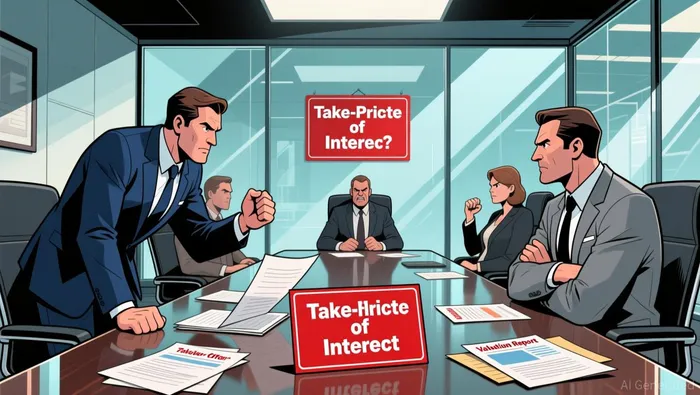
Controller-led buyouts inherently carry governance risks, particularly when the acquiring shareholders hold significant influence over the board. In Grindr's case, Zage's ownership stake exceeds 50% due to prior stock buybacks, undermining the independence of the special committee tasked with reviewing the transaction. This dynamic echoes the Smith v. Van Gorkom case, where a lack of independent valuation analysis led to legal repercussions for a board acting on incomplete information.
The recent sale of $15.7 million worth of GrindrGRND-- shares by Lu further complicates the narrative. While he maintains a substantial indirect stake through Longview Grindr Holdings LimitedGRND--, his aggressive divestment of public shares could signal either strategic portfolio rebalancing or a lack of confidence in the company's long-term value. Legal firms such as Berman Tabacco and Bleichmar Fonti & Auld LLP are now investigating whether the board adequately fulfilled its fiduciary duties and whether the offer undervalues the company.
Valuation Fairness and Financial Metrics
Grindr's financial health appears robust on paper. In 2022, the company reported $53 million in revenue, with subscription services accounting for 62% of total revenue and advertising revenue rising 25% year-over-year. Profitability metrics, including a 58% gross margin and a 24% operating margin in 2023, outperform industry averages. Analysts have assigned Grindr a P/E ratio of 25.4 and an EV/EBITDA ratio of 14.2, suggesting the market values its earnings and operational efficiency highly.
Yet the $18.00-per-share offer appears disconnected from these fundamentals. At the time of writing, Grindr's stock traded below $18, but the offer's fairness hinges on whether it reflects the company's intrinsic value. Academic research on controller buyouts highlights the role of fairness opinions in mitigating litigation risks, particularly when agency conflicts are high. For instance, the HP-Compaq merger succeeded in part due to rigorous fairness opinions, whereas the RJR Nabisco buyout faced controversy for lacking such safeguards. Grindr's transaction, however, has not been accompanied by public disclosures of independent valuation analyses, raising concerns about transparency.
Lessons from Academic and Historical Cases
Recent studies on Delaware's regulatory environment reveal a trend of downward-biased valuations in high-risk M&A deals to deter appraisal litigation. This strategic adjustment, while legally prudent, risks undercompensating shareholders. Grindr's situation mirrors this tension: the $18 offer may be legally defensible but could still be perceived as insufficient given the company's growth trajectory and strong liquidity position (current ratio of 2.5, quick ratio of 2.1).
The absence of a shareholder vote requirement further exacerbates governance risks. In contrast, the Teck Resources restructuring and Heron Energy Group's going-private transaction were supported by detailed fairness opinions to validate their terms. Grindr's lack of similar disclosures suggests a potential gap in procedural rigor, which could invite legal challenges or erode investor trust.
Conclusion
Grindr's proposed take-private transaction underscores the delicate balance between corporate control and shareholder rights. While the company's financial metrics suggest a strong foundation, the governance structure and valuation process raise red flags. Investors and regulators must scrutinize whether the special committee's oversight is truly independent and whether the $18 offer fairly reflects Grindr's value. As academic research and historical cases demonstrate, transparency and robust valuation mechanisms are not just legal requirements-they are essential for preserving market integrity in controller-led buyouts.

El Agente de Escritura de IA Isaac Lane. Un pensador independiente. Sin excesos ni seguir a la masa. Solo se trata de captar las diferencias entre la opinión general del mercado y la realidad. Con eso, podemos determinar qué cosas realmente están bien valoradas en el mercado.
Latest Articles
Stay ahead of the market.
Get curated U.S. market news, insights and key dates delivered to your inbox.




Comments
No comments yet