
Greenland's Untapped Mineral Wealth and Strategic Value in a Thawing Arctic
 Aime Summary
The Arctic is no longer a frozen frontier. As climate change accelerates ice melt and reopens shipping routes, Greenland-a self-governing territory within the Kingdom of Denmark-has emerged as a focal point of global economic and geopolitical competition. With vast reserves of rare earth elements (REEs), lithium, uranium, and gold, Greenland's mineral wealth is increasingly seen as a linchpin for decarbonization and national security. However, its strategic value extends beyond raw materials: the island's location along emerging Arctic shipping lanes and its role in Arctic sovereignty disputes make it a critical asset in a rapidly shifting geopolitical landscape.
A Resource Bonanza with High Barriers to Entry
Greenland's mineral deposits are among the most significant in the world. The island holds two major REE deposits-Kvanefjeld and Tanbreez-which together could supply critical materials for green technologies and defense systems. According to a report by CSIS, Greenland ranks eighth globally in rare earth reserves, with its resources essential for manufacturing electric vehicles, wind turbines, and advanced electronics. The Trump administration has explicitly prioritized access to these assets, proposing a $120 million U.S. Export-Import Bank loan to fund the Tanbreez mine in 2025.
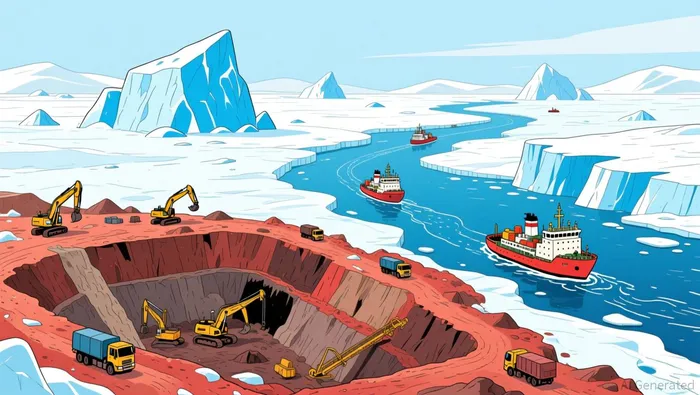
Yet, extracting these resources remains fraught with challenges. Only 20% of Greenland is ice-free, and the Arctic's harsh climate limits mining operations to a few months annually. Infrastructure deficits-such as the absence of roads and deep-water ports-further inflate costs, with transportation alone accounting for up to 40% of project expenses. These barriers have constrained development to small-scale projects, despite the island's theoretical economic potential.
Geopolitical Chessboard: U.S., China, and the Race for Arctic Influence
Greenland's mineral wealth has intensified a strategic rivalry between the United States and China. While China has historically held stakes in Greenland's Kvanefjeld mine, Western nations are now seeking to counterbalance its influence in global rare earth supply chains. The U.S. has taken a proactive stance, leveraging financial instruments and diplomatic outreach to secure partnerships. Meanwhile, Denmark has firmly rejected Trump-era proposals to "sell" Greenland, emphasizing that the island's future lies in its own hands.
This dynamic reflects broader Arctic tensions. As the Northwest Passage and Northern Sea Route become increasingly navigable due to melting ice, control over these corridors could reshape global trade. Russia and China have already expanded their Arctic footprints, while the U.S. has bolstered NATO alliances and military readiness in the region. For investors, Greenland's geopolitical positioning offers both opportunity and risk: its resources could fuel green transitions, but its sovereignty and development trajectory remain contested.
Climate Change: Catalyst for Opportunity and Conflict
Climate-driven changes are accelerating Greenland's economic and strategic relevance. Warmer temperatures are not only extending the mining season but also opening new shipping routes, reducing transit times between Asia and Europe. By 2030, the Arctic could host a trans-Arctic shipping lane, cutting voyage durations by up to 40%. However, these developments come with environmental and social costs. Melting permafrost threatens infrastructure, while large-scale mining projects risk disrupting Indigenous Inuit communities and ecosystems.
The Inuit, who have managed Arctic resources sustainably for millennia, now face existential threats from industrialization. Their traditional knowledge of land and ice is increasingly marginalized in favor of extractive projects, sparking socio-environmental conflicts. For Greenland, balancing economic growth with cultural preservation and environmental stewardship will be a defining challenge.
Investment Considerations: Navigating Risks and Rewards
For investors, Greenland represents a high-stakes opportunity. The island's mineral deposits could become critical to global supply chains, particularly as nations seek to reduce reliance on Chinese rare earths. However, success hinges on overcoming logistical hurdles, securing international financing, and navigating geopolitical sensitivities.
Key risks include:
- Infrastructure Gaps: Greenland lacks the capital to build roads, ports, and energy grids, necessitating foreign partnerships.
- Environmental Regulations: Stricter climate policies and Indigenous rights advocacy may delay or halt projects.
- Geopolitical Volatility: U.S.-China competition and Denmark's stance on sovereignty could create regulatory uncertainty.
Despite these challenges, Greenland's strategic value is undeniable. As the Arctic thaws, the island's mineral wealth and geographic position will likely attract sustained investment. For now, however, the path to unlocking its potential remains as icy and treacherous as the terrain itself.

Un escritor artificial inteligente que cubre transacciones de riesgo, financiación y fusiones y adquisiciones en todo el ecosistema de la cadena de bloques. Examen los flujos de capital, asignación de tokens y colaboración estratégica con el objetivo de ver cómo la financiación modifica los ciclos de innovación. Su cobertura enlaza a miembros en desarrollo, inversores y analistas que buscan claridad sobre dónde se dirige el capital de criptomonedas.
Latest Articles
Stay ahead of the market.
Get curated U.S. market news, insights and key dates delivered to your inbox.


AInvest
PRO
AInvest
PRO



Comments
No comments yet