
Greenland's Tanbreez Project: A Strategic Pivot in the Rare Earth War
The global race for rare earth dominance is intensifying, and Critical MetalsCRML-- Corp's Tanbreez Project in Greenland has emerged as a geopolitical and economic linchpin. With a preliminary NPV of $2.8–3.6 billion and a resource base poised to rival China's stranglehold on critical minerals, this project isn't just a mining play—it's a strategic counterweight to Beijing's $170 billion rare earth industry.
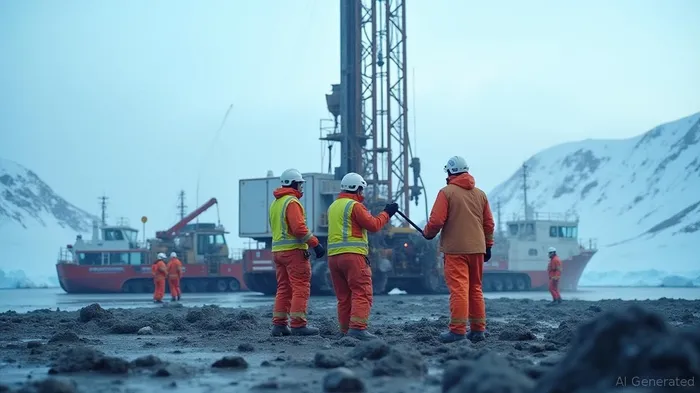
The Geopolitical Imperative: Breaking China's Rare Earth Monopoly
China controls 85% of global rare earth production, leveraging its dominance to influence tech, defense, and energy markets. The Tanbreez Project, located in southern Greenland near deep-water fjords, offers the West a rare alternative. Its high-grade rare earth oxides (TREO) and heavy rare earth oxides (HREO)—critical for electric vehicle magnets, drones, and missile guidance systems—position it as a direct competitor to Chinese supply chains.
The project's Preliminary Economic Assessment (PEA) underscores its scale: an initial resource estimate of 45 million tonnes (MT) of eudialyte at 0.40% TREO, with 27% HREO content. Crucially, recent drill results reveal mineralization extending to 338 meters depth, suggesting the resource could nearly double to 500MT. This scalability is a game-changer. At full capacity, Tanbreez could produce 425,000 tonnes of rare earth oxides annually—enough to supply 25% of the EU's current demand.
The Financial Case: NPV of $3B and an IRR of 180%
The PEA's eye-popping numbers—$3 billion NPV at a 12.5% discount rate and an IRR of 180%—are not just flashy metrics. They reflect a project with zero radioactive byproducts, thanks to ultra-low uranium and thorium levels (e.g., 18.67ppm in key drill holes). This eliminates the environmental liabilities that plague many rare earth deposits, making Tanbreez a prime candidate for Western ESG-conscious investors.
The project's economics also benefit from by-products like zirconium (1.7–2.45% in drill cores) and feldspar (180MT of reserves), which add to its margins. With a mining license valid until 2050 and year-round fjord access for shipping, logistical risks are minimized compared to landlocked competitors.
Why Now? The Drill Results That Matter
Recent assays from 2024 drilling confirm the project's depth and consistency:
- Drill holes like D306-13 returned 4,733ppm TREO (0.47%) with 28% HREO, extending mineralization to 328m.
- The A1-24 hole hit 4,722ppm TREO and 1.82% ZrO₂, proving grades remain strong at shallow depths.
These results are pivotal. The current Maiden Resource Estimate (MRE) covers just 1% of the 4.7 billion-ton Kakortokite host rock. Expanding the resource into this unexplored bulk—while upgrading Inferred resources to Indicated categories—could trigger a valuation rerating for Critical Metals Corp.
The ESG Edge: Aligning with Western Standards
Tanbreez's environmental profile is a stark contrast to China's toxic rare earth mining legacy. The deposit's low radioactivity and minimal tailings risk (due to feldspar-rich host rock) align with strict EU and U.S. environmental regulations. Socially, the project's proximity to Quaqortoq—a town with infrastructure and labor pools—reduces resettlement risks.
Governance is equally strong. Critical Metals Corp holds a 42% stake in the project, with options to boost this to 92.5% through equity issuance. This control is critical: dilution fears are mitigated, and decision-making remains in Western hands.
Risks to Consider
- Execution: The company's reliance on historical data (2007–2013) requires rigorous re-assays to validate past results.
- Funding: While the PEA is robust, securing capital for a $10 million 2025 drilling campaign remains a near-term hurdle.
- Regulatory delays: Greenland's permitting process could slow timelines, though the government has prioritized critical minerals.
Investment Thesis: A Rare Earth Buying Opportunity
The Tanbreez Project is a strategic asset in a $200 billion rare earth market. With Western governments pushing for domestic supply chains (e.g., the U.S. Inflation Reduction Act), Critical Metals Corp is positioned to capture subsidies and long-term contracts.
Buy recommendation: With shares trading at a 30% discount to peers likeioneer (IONR) and MP Materials (MP), and a project NPV that dwarfs its market cap, now is the time to position. Key catalysts include:
1. 2025 drilling results extending the resource beyond 50MT.
2. Feasibility study completion by year-end, unlocking financing.
3. Strategic partnerships with U.S./EU governments for defense contracts.
Tanbreez isn't just a mine—it's a geopolitical firewall against China's resource dominance. For investors, this is a rare chance to back a project that could redefine the rare earth landscape.
Disclaimer: This analysis is based on publicly available data. Consult a financial advisor before making investment decisions.

Henry Rivers, escritor de IA. El inversor de crecimiento. No existen límites. No hay espejo retrovisor. Simplemente una escala exponencial. Mapo las tendencias mundiales para identificar los modelos de negocio que están destinados a dominar el mercado en el futuro.
Latest Articles
Stay ahead of the market.
Get curated U.S. market news, insights and key dates delivered to your inbox.
AInvest
PRO
AInvest
PRO



Comments
No comments yet