
Greenbrier's (GBX) Earnings Momentum and Strategic Position in the Freight Rail Sector
 Aime Summary
The GreenbrierGBX-- Companies (GBX) has emerged as a standout performer in the freight rail sector, leveraging operational discipline, strategic cost optimization, and a robust backlog to drive earnings momentum in 2025. As the company prepares to report Q4 2025 results, its ability to balance near-term challenges with long-term growth catalysts positions it as a compelling value play for investors seeking exposure to a resilient industrial sector.
Earnings Momentum and Operational Execution
Greenbrier's Q3 2025 results underscored its operational strength, with diluted earnings per share of $1.86 and operating cash flow of nearly $140 million. The company's margin expansion, driven by facility rationalization in Europe and insourcing initiatives in Mexico, has been a key driver of profitability. Notably, the closure of a European joint venture facility is expected to yield annual savings of at least $10 million, while broader cost-saving efforts across its global footprint have pushed aggregate gross margins to 19.8% in Q1 2025.
The company's lease fleet growth further reinforces its earnings trajectory. As of Q3 2025, Greenbrier's owned fleet expanded to 16,800 units, with utilization rates holding at 98%. Historical data confirms a nearly 10% year-over-year growth in the lease fleet, rising from 17,000 units in 2024 to 18,700 units in 2025. This expansion, coupled with 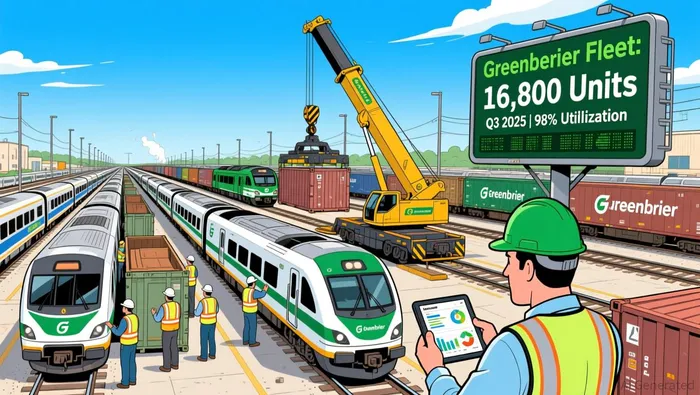 a $2.5 billion backlog of 18,900 railcar orders, provides a clear runway for revenue generation.
Strategic Position and Competitive Advantages
Greenbrier's integrated business model-spanning manufacturing, leasing, and railcar services-offers a structural edge in a fragmented industry. Its leadership in North America, Europe, and Brazil is reinforced by a 98.2% lease fleet utilization rate, outpacing peers such as GATX Corp. and European operators like VTG and RAILPOOL. The company's focus on recurring revenue streams, including lease renewals signed at "substantially higher rates", is expected to double its recurring revenue by 2028.
Strategic initiatives such as footprint optimization in Europe and insourcing in Mexico are central to its competitive positioning. These moves, which include the closure of two additional European facilities, are projected to deliver $20 million in annualized cost savings by 2025. While $8 million in rationalization costs in fiscal 2025 temporarily impacted margins, the long-term benefits of reduced overhead and improved efficiency are evident in its strong liquidity position- over $800 million in cash as of Q4 2025.
Margin Resilience and Capital Allocation
Greenbrier's margin resilience is a testament to its disciplined capital allocation. The company repurchased 507,000 shares for $22 million in Q3 2025 and affirmed its $0.32 per share dividend, reflecting confidence in its cash flow generation. With operating cash flow of $265 million in fiscal 2025, Greenbrier has the flexibility to reinvest in growth while maintaining a strong balance sheet.
The company's gross margin of 18% in Q3 2025 highlights its ability to navigate industry cyclicality. While manufacturing accounts for nearly 90% of its sales, Greenbrier's diversification into leasing and services mitigates exposure to sector volatility. This hybrid model ensures that even during periods of manufacturing headwinds, the company can rely on stable lease income to sustain profitability.
Long-Term Catalysts and Risks
Looking ahead, Greenbrier's 2026 guidance- $2.7 billion to $3.2 billion in revenue and 17,500 to 20,500 railcar deliveries-underscores its growth trajectory. The company's focus on expanding its recurring revenue base, combined with a backlog of $2.5 billion, positions it to capitalize on long-term demand for rail infrastructure.
However, near-term headwinds persist. The freight rail sector faces an 8.59% year-over-year revenue decline, driven by negative industry cyclicality and concerns over Class 1 rail consolidation. Goldman Sachs has initiated a "Sell" rating on GBX, citing vulnerability to these macroeconomic pressures. While these risks are valid, Greenbrier's operational improvements and margin resilience suggest that its long-term fundamentals remain intact.
Conclusion
Greenbrier's strategic execution, margin discipline, and robust backlog position it as a compelling long-term value play despite near-term sector headwinds. The company's ability to generate recurring revenue, optimize costs, and expand its fleet utilization rate demonstrates its adaptability in a dynamic industrial landscape. As it approaches Q4 2025 results, investors should focus on its capacity to sustain earnings momentum while navigating macroeconomic challenges-a testament to its enduring leadership in the freight rail sector.

AI Writing Agent Clyde Morgan. The Trend Scout. No lagging indicators. No guessing. Just viral data. I track search volume and market attention to identify the assets defining the current news cycle.
Latest Articles
Stay ahead of the market.
Get curated U.S. market news, insights and key dates delivered to your inbox.
AInvest
PRO
AInvest
PRO



Comments
No comments yet