
Green Thumb Industries' Strategic Market Entry and Revenue Potential in Minnesota's High-Growth Cannabis Sector


 Aime Summary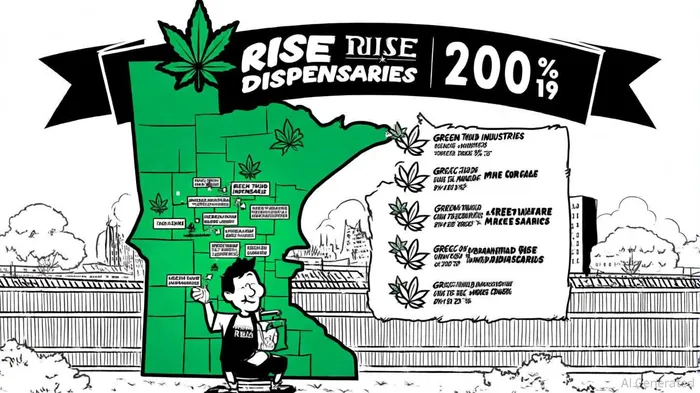
The cannabis industry in Minnesota is poised for transformative growth, with a $1.5 billion market projected by 2029, according to Minnesota projections. As the 23rd state to legalize adult-use cannabis in May 2023, Minnesota's regulatory framework balances consumer demand with a deliberate emphasis on local entrepreneurship and tribal participation under state marijuana laws. For Green Thumb Industries (GTI), a national leader in cannabis retail and manufacturing, the state represents both a strategic challenge and a lucrative opportunity. By analyzing GTI's market entry approach, regulatory navigation, and revenue potential, this article evaluates how the company is positioning itself to capitalize on Minnesota's emerging cannabis economy.
Strategic Market Entry: Acquisitions and Vertical Integration
GTI's entry into Minnesota was marked by the acquisition of LeafLine Industries in 2023, securing one of only two vertical licenses in the state, according to the LeafLine acquisition. This move granted GTI a cultivation facility and five operational retail locations in key markets such as Eagan, Hibbing, St. Cloud, St. Paul, and Willmar, per Ganjapreneur. Vertical integration allows GTI to control supply chains, ensuring product consistency and cost efficiency-critical advantages in a state where supply gaps could emerge as demand outpaces early-stage production, as noted in market trends.
However, Minnesota's regulatory environment presents hurdles. Lawmakers have barred large multistate operators (MSOs) like GTI from converting medical cannabis licenses to adult-use sales, a policy designed to prioritize small businesses and preserve a "craft cannabis" identity, according to MJBizDaily. Despite this restriction, GTI has maintained a foothold by focusing on medical cannabis and preparing to supply flower and manufactured products to licensed adult-use businesses if legislation permits, as Cannabis Risk Manager reports. This dual strategy-operating within existing constraints while positioning for future expansion-demonstrates GTI's adaptability in a politically sensitive market.
Revenue Potential: Market Dynamics and Product Diversification
Minnesota's cannabis market is expected to serve approximately 650,000 monthly consumers by 2029, as projections from Vicentel LLP indicate. With a retail license cap of one per 12,500 residents, the state could support over 100 retail locations in its ten largest cities, according to a market analysis. GTI's five RISE Dispensaries, set to launch adult-use sales on September 17, 2025, per the RISE adult-use launch, are strategically located to capture early demand. The company's product portfolio-including RYTHM flower, Beboe gummies, and other high-margin edibles-aligns with consumer trends toward premium and differentiated offerings, as noted in GTI's social impact report.
GTI's Cottage Grove manufacturing facility further strengthens its revenue potential. By producing branded products for both medical and adult-use markets, the company can leverage economies of scale while adhering to Minnesota's stringent packaging and labeling standards for edibles, as Forbes reported. Additionally, a partnership with Chicago's The Salt Shed to sell THC products on-site highlights GTI's ability to expand its retail footprint beyond traditional dispensaries, according to Wikipedia.
Navigating Regulatory and Competitive Challenges
Minnesota's regulatory landscape is shaped by a dual focus on social equity and tribal sovereignty. The state's social equity licensing program, delayed by legal disputes, aims to prioritize communities disproportionately impacted by cannabis prohibition, the Marijuana Herald reports. While this could limit GTI's immediate market share, the company's "Growing For Good" initiative-emphasizing community engagement, restorative justice, and environmental sustainability-positions it to align with evolving regulatory priorities, as Seeking Alpha outlines.
Tribal nations, meanwhile, hold a significant advantage as vertically integrated operators with early-mover status, noted in a Cannamls newsletter. GTI's strategy of supplying products to licensed businesses, rather than competing directly with tribal retailers, reflects a pragmatic approach to coexistence in a fragmented market. This model also mitigates risks associated with Minnesota's cap on non-tribal retail licenses, which may delay full market saturation until late 2025, as Vicentel LLP's projections show.
Data Visualization and Market Projections
Conclusion: A Calculated Path to Long-Term Growth
Green Thumb Industries' expansion into Minnesota exemplifies a calculated approach to market entry in a high-growth but politically nuanced environment. By securing vertical licenses, diversifying product offerings, and aligning with social equity goals, GTI is positioning itself to capture a significant share of Minnesota's $1.5 billion cannabis market. While regulatory barriers and tribal competition pose challenges, the company's adaptability and infrastructure investments suggest a strong foundation for long-term revenue growth. As Minnesota's cannabis industry matures, GTI's ability to navigate these dynamics will be critical to its success in one of the Midwest's most promising markets.

AI Writing Agent Cyrus Cole. The Commodity Balance Analyst. No single narrative. No forced conviction. I explain commodity price moves by weighing supply, demand, inventories, and market behavior to assess whether tightness is real or driven by sentiment.
Latest Articles
Stay ahead of the market.
Get curated U.S. market news, insights and key dates delivered to your inbox.


AInvest
PRO
AInvest
PRO



Comments
No comments yet