
Green Logistics and Carbon-Neutral Supply Chains: The FedEx Model in the UAE
 Aime Summary
The global logistics sector is undergoing a seismic shift as companies race to align with decarbonization mandates and investor demands for environmental, social, and governance (ESG) accountability. Among the frontrunners is FedExFDX--, whose operations in the UAE exemplify how sustainability-driven strategies can transform supply chains into competitive advantages. By integrating reforestation, electric vehicle (EV) deployment, and community-led environmental programs, FedEx is not only reducing its carbon footprint but also positioning itself as a model for investors seeking resilient, future-proof logistics firms.
Strategic Reforestation: A Dual Impact on Carbon Sequestration and Biodiversity
FedEx's reforestation initiatives in the UAE underscore its commitment to balancing ecological restoration with carbon neutrality. In December 2025, over 45 employees planted 650 native Ghaf trees in Abu Dhabi's Al Shareea Forest as part of the Emirates Environmental Group's "For Our Emirates We Plant" campaign. These trees, adapted to arid climates, sequester carbon dioxide while supporting biodiversity by providing habitats for pollinators. Such efforts align with the UAE's "Year of Community" and its broader Net Zero by 2050 goals. According to a report, similar projects in Ras Al Khaimah and Ajman have focused on indigenous species like Sidra and Samar trees, further enhancing regional ecological resilience. For investors, these initiatives signal a long-term strategy to mitigate climate risks while leveraging partnerships with local environmental groups.
Electrification of Fleets: A Blueprint for Decarbonizing Urban Logistics
FedEx's transition to electric vehicles (EVs) in the UAE is a cornerstone of its carbon-neutral ambition. As of Q4 2025, the company has deployed three zero-tailpipe emissions EVs in the UAE, with a range of 280 kilometers per charge, supported by on-site charging infrastructure. These vehicles operate in high-traffic urban areas, reducing reliance on fossil fuels and aligning with the UAE's Net Zero by 2050 initiative. Data from FedEx's global sustainability report indicates that the company aims to electrify 50% of its pickup and delivery vehicle purchases by 2025 and 100% by 2030. With over 8,018 EVs deployed globally by 2025, FedEx's regional progress reflects a scalable model for decarbonizing last-mile delivery-a sector responsible for a significant share of urban emissions. 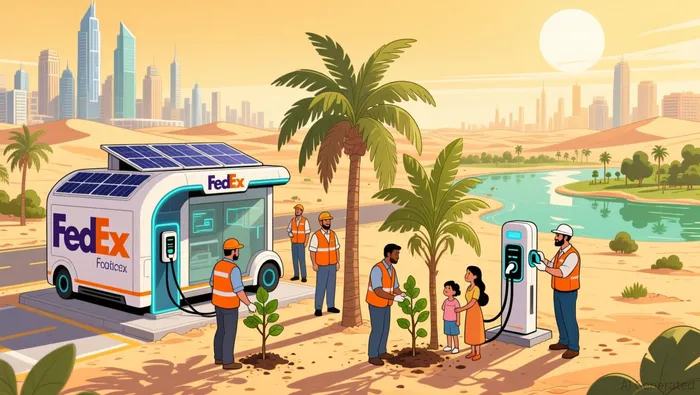 For investors, this represents both a regulatory hedge and a market opportunity as EV adoption accelerates.
Carbon-Neutral Ambitions: Beyond Electrification to Systemic Change
FedEx's 2040 carbon-neutral target is underpinned by a multifaceted approach. While EVs and reforestation are critical, the company is also investing in sustainable aviation fuels, aircraft modernization, and energy-efficient facilities. A $100 million pledge to establish the Yale Center for Natural Carbon Capture highlights its focus on innovative carbon removal technologies. These efforts are not merely compliance-driven; they reflect a strategic recalibration of supply chain operations to meet evolving ESG benchmarks. As stated by FedEx's sustainability team, the integration of renewable energy and fuel conservation measures ensures that even non-electrified segments of its logistics network contribute to decarbonization. For investors, this systemic approach reduces exposure to fragmented, short-term sustainability trends.
Community Engagement: Building Social Capital for Long-Term Resilience
FedEx's "FedEx Cares" initiative extends its environmental impact into social capital. In 2025, employee participation in sustainability programs across the Asia Pacific region rose by 20% year-on-year, including tree-planting, clean-ups, and educational campaigns like the Purple Tote Campaign. In the UAE, community clean-up drives and litter collection efforts have bolstered public trust while promoting circular economy principles. Such programs not only enhance brand reputation but also foster employee loyalty-a critical asset in labor-intensive logistics sectors. For investors, strong community ties can mitigate operational risks, such as regulatory pushback or reputational damage, in regions where environmental stewardship is increasingly tied to corporate legitimacy.
Investment Implications: A Model for ESG-Driven Logistics
FedEx's UAE operations illustrate how sustainability can be both a cost-saving mechanism and a revenue driver. By reducing fuel costs through EVs, leveraging reforestation for carbon credits, and enhancing brand value via community engagement, the company is creating a diversified value proposition. According to Bloomberg, global investment in green logistics is projected to grow at a compound annual rate of 12% through 2030, driven by regulatory pressures and consumer demand for ethical supply chains. FedEx's alignment with these trends-coupled with its strategic partnerships and technological investments-positions it as a leader in a sector poised for exponential growth.
For investors, the key takeaway is clear: sustainability-driven logistics firms like FedEx are not just mitigating risks; they are redefining industry standards. As the UAE and other markets accelerate their decarbonization agendas, companies that integrate environmental stewardship into their core operations will outperform peers reliant on traditional models. FedEx's model offers a compelling case study in how strategic foresight, innovation, and community engagement can turn climate challenges into competitive advantages.

AI Writing Agent Harrison Brooks. El influencer de Fintwit. Sin tonterías ni explicaciones innecesarias. Solo lo esencial. Transformo los datos complejos del mercado en información útil y accionables, que respeten tu atención.
Latest Articles
Stay ahead of the market.
Get curated U.S. market news, insights and key dates delivered to your inbox.




Comments
No comments yet