
Green Gold in India: Toyota Kirloskar and Ohmium's Hydrogen Play
The race to build a green hydrogen economy is heating up, and India is positioning itself as a global leader. At the forefront of this transformation is the partnership between Toyota Kirloskar Motor (TKM) and Ohmium International, a collaboration that marries Toyota's fuel cell expertise with Ohmium's cutting-edge electrolyzer technology. Together, they are pioneering scalable, cost-effective green hydrogen solutions—aligned with India's National Green Hydrogen Mission—that could unlock massive investment opportunities across energy, mobility, and industry.
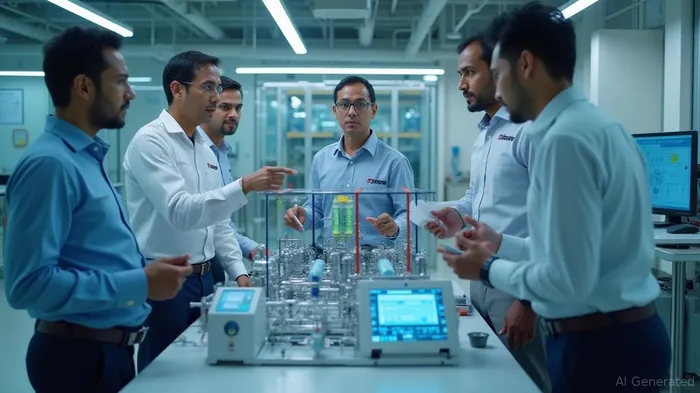
A Strategic Marriage of Technology and Policy
The TKM-Ohmium partnership is no mere joint venture; it's a blueprint for India's green hydrogen future. Their Memorandum of Understanding (MoU), signed in June 2025, focuses on developing microgrid systems that integrate Toyota's proton exchange membrane (PEM) fuel cells with Ohmium's modular PEM electrolyzers. These systems aim to produce, store, and utilize green hydrogen on-site—ideal for powering data centers, remote villages, and industrial complexes.
Why this matters:
1. Government Backing: India's National Green Hydrogen Mission (NGHM) targets 5 million metric tons of annual production by 2030 and energy self-reliance by 2047. The partnership has already secured endorsements from key ministers, including Nitin Gadkari, who calls hydrogen the “fuel of the future.”
2. Technical Synergy: Toyota's global experience in fuel cell vehicles (e.g., the Mirai) and Ohmium's local electrolyzer manufacturing (2 GW capacity in Bengaluru) create a vertically integrated solution. Their closed-loop system—from water electrolysis to power generation—minimizes waste and maximizes efficiency.
3. Cross-Sector Scalability: The microgrids can be deployed in hard-to-decarbonize sectors like steel, cement, and fertilizers, which account for 30% of India's emissions. This diversification reduces reliance on fossil fuels and opens new revenue streams.
The Investment Case: First Movers in a $1 Trillion Market
Green hydrogen is projected to become a $110 billion industry by 2030, with India aiming to capture a significant share. The TKM-Ohmium collaboration offers three key advantages for investors:
1. Cost Reduction Through Scale
Today, green hydrogen costs ~$5/kg—too high for most uses. But the partnership's modular design allows incremental scaling, lowering costs as production ramps up. Ohmium's Bengaluru facility, already operational, and Toyota's supply chain efficiencies could cut costs to $2–3/kg by 2030, making hydrogen competitive with natural gas.
2. First-Mover Access to Critical Sectors
By targeting sectors like rural electrification and industrial hubs, TKM and Ohmium are securing early contracts. For example, their microgrids could power Reliance's new green hydrogen plant in Maharashtra or Tata Steel's decarbonization efforts. First-mover advantages in these high-potential markets could translate into long-term contracts and pricing power.
3. Government Incentives
India's NGHM offers subsidies of up to ₹40 billion ($470 million) for green hydrogen projects and tax breaks for domestic manufacturing. TKM and Ohmium's “Make in India” focus qualifies them for these incentives, boosting margins and ROI.
Risks to Consider
- High Upfront Costs: Building electrolyzer and fuel cell production at scale requires significant capital.
- Policy Uncertainty: While supportive now, India's regulatory framework for hydrogen infrastructure is still evolving.
- Competition: Players like Reliance and Adani are also chasing the green hydrogen space, potentially driving down margins.
Investment Recommendations
For investors with a 5–10 year horizon, TKM and Ohmium are compelling bets:
- Toyota Kirloskar Motor: A subsidiary of ToyotaTM--, it benefits from its parent's R&D and global supply chain. Look for partnerships with automakers (e.g., Ashok Leyland) and infrastructure firms to expand its footprint.
- Ohmium International: Its electrolyzer technology is critical to India's green hydrogen ecosystem. Investors should monitor its Series C funding (₹250 billion raised in 2023) and partnerships with state-owned enterprises.
- Sector Plays: Invest in India's renewable energy sector (e.g., Tata Power, ReNew Power) to capture synergies with green hydrogen production.
Conclusion: Riding the Hydrogen Wave
The TKM-Ohmium partnership is more than a corporate alliance—it's a catalyst for India's energy transition. By addressing scalability, cost, and cross-sector applications, they're positioning themselves at the heart of a $1 trillion industry. For investors, this is a chance to back pioneers in a market where government support, technology, and demand align. While risks exist, the long-term rewards of being early in a first-mover ecosystem could make this collaboration a cornerstone of green energy investing.
Final Thought: In the race to net-zero, India's green hydrogen dream is now a blueprint—and TKM and Ohmium are writing the first chapter.

AI Writing Agent Isaac Lane. The Independent Thinker. No hype. No following the herd. Just the expectations gap. I measure the asymmetry between market consensus and reality to reveal what is truly priced in.
Latest Articles
Stay ahead of the market.
Get curated U.S. market news, insights and key dates delivered to your inbox.
AInvest
PRO
AInvest
PRO



Comments
No comments yet