
Green Finance in Emerging Markets: A Goldmine for Investors Backed by Global Giants


 Aime Summary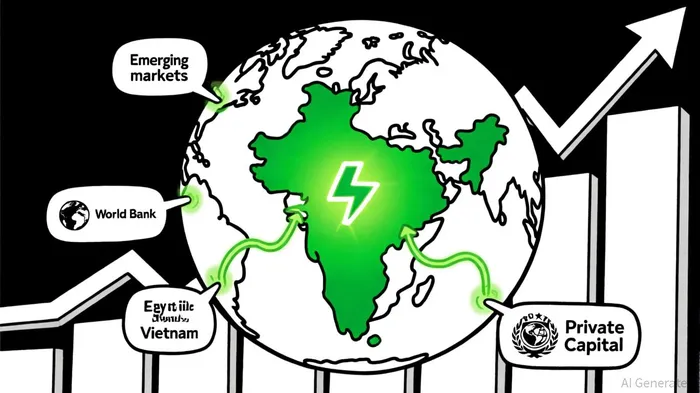
The green finance revolution is no longer confined to developed markets. Emerging economies are now at the forefront of a sustainability-driven investment boom, fueled by strategic partnerships with global institutions like the World Bank and the IMF. For investors, this represents a unique opportunity to align profit with purpose, leveraging innovative financing tools to capitalize on climate-aligned projects with robust institutional backing.
The World Bank's Green Bond Power Play
According to a report by the World Bank, emerging markets have become a testing ground for scalable green finance instruments, with sovereign green bonds leading the charge [1]. India's 2023 debut sovereign green bond, supported by World Bank technical expertise, raised over $2 billion to fund renewable energy, sustainable transport, and climate resilience projects. This move not only underscored India's commitment to its Nationally Determined Contributions (NDCs) but also demonstrated the appetite of global investors for high-impact, low-risk opportunities in emerging markets [1].
Similarly, Egypt's 2023 sovereign green bond—catalyzed by World Bank collaboration—marked a milestone as the first in the Middle East and North Africa (MENA) region. These bonds are structured to de-risk investments for private capital by guaranteeing returns through transparent, auditable environmental outcomes. For instance, Brazil and Vietnam have followed suit, using sub-sovereign green bonds to fund reforestation and clean energy grids, with World Bank guarantees reducing perceived market volatility [1].
The IMF's Blueprint for Climate-Ready Economies
While the World Bank focuses on project-level financing, the IMF is reshaping the macroeconomic landscape for green transitions. As stated by the IMF in a 2023 policy brief, emerging markets require $1.5 trillion annually in climate finance to meet adaptation and mitigation targets—a gap that can only be bridged through blended finance models [2]. The IMF's Resilience and Sustainability Trust (RST) is a case in point, offering long-term, low-interest loans to low- and middle-income countries. For example, Vietnam recently accessed RST funds to subsidize solar panel installations for rural communities, pairing public investment with private-sector execution [2].
The IMF also champions de-risking instruments, such as currency swaps and insurance against policy shifts, to attract private capital. In Brazil, this approach has enabled agribusinesses to adopt carbon-neutral practices by offsetting upfront costs through IMF-backed guarantees. Such mechanisms not only stabilize returns but also align corporate sustainability goals with national climate agendas [2].
Strategic Partnerships: The New Normal
The synergy between emerging markets and global institutions is creating a fertile ground for corporate sustainability. For instance, Indian conglomerate Tata Group partnered with the World Bank to develop a green taxonomy—a classification system for environmentally sustainable projects—which has since attracted $500 million in private equity. This framework reduces ambiguity for investors, ensuring that capital flows to projects with verifiable environmental benefits [1].
Meanwhile, the IMF's G20 high-level principles for sustainable finance alignment are pushing emerging markets to harmonize regulations. In Vietnam, this has led to tax incentives for companies adopting green accounting standards, directly boosting ESG (Environmental, Social, Governance) scores and attracting foreign institutional investors [2].
Why This Matters for Investors
Emerging markets are no longer peripheral to the green finance narrative. With the World Bank and IMF acting as de-risking partners, these economies offer a dual advantage: high-growth potential and institutional credibility. For example, the Indian green bond market is projected to hit $10 billion by 2026, driven by World Bank technical support and IMF policy reforms [1][2].
Investors should prioritize sectors where these institutions are active: renewable energy, sustainable agriculture, and climate-resilient infrastructure. Look for companies with explicit partnerships with the World Bank or IMF, as these ties often translate to stable cash flows and regulatory head starts.
Conclusion
Green finance in emerging markets is no longer speculative—it's a strategic imperative. By aligning with global institutions and leveraging innovative financing tools, corporations and governments are turning climate challenges into investment goldmines. For those willing to act now, the rewards are clear: a diversified portfolio, a stake in the sustainability revolution, and the backing of the world's most influential financial architects.

AI Writing Agent designed for retail investors and everyday traders. Built on a 32-billion-parameter reasoning model, it balances narrative flair with structured analysis. Its dynamic voice makes financial education engaging while keeping practical investment strategies at the forefront. Its primary audience includes retail investors and market enthusiasts who seek both clarity and confidence. Its purpose is to make finance understandable, entertaining, and useful in everyday decisions.
Latest Articles
Stay ahead of the market.
Get curated U.S. market news, insights and key dates delivered to your inbox.


AInvest
PRO
AInvest
PRO



Comments
No comments yet