
"We are back": Greek shipyards' resurgence after decades of decline
Generated by AI AgentClyde Morgan
Tuesday, Feb 18, 2025 2:47 am ET2min read
SYRS--
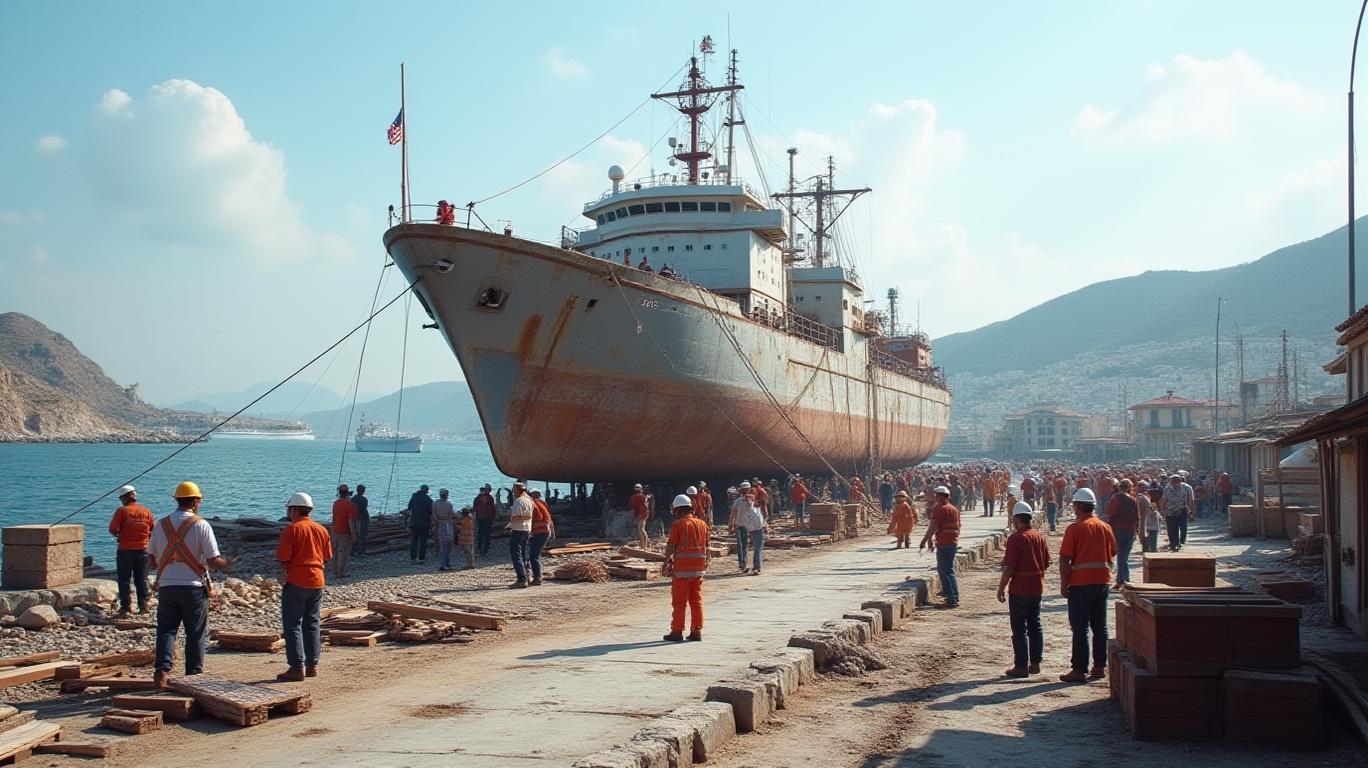
Greek shipyards, once a thriving industry, have been in decline for decades due to various factors such as competing legal and financial claims, lack of strategic vision, and government ownership. However, the tide has turned, and Greek shipyards are now bouncing back, driven by increased investment, privatization, and a growing demand for ship repair and maintenance services.
The turnaround of the Skaramangas Shipyard, from being empty a year ago to now being a thriving business, is a sign of Greece's broader economic recovery from the 2009-2018 debt crisis. The sale of government stakes in shipyards, banks, and other assets has contributed to this recovery. The increased business has already doubled the shipyards' contribution to the country's GDP to 1.5%, and plans are in place to increase that to as much as 2.5% in five years (Source: Panos Xenokostas, owner of ONEX Shipyards and Technology).
The ONEX group, which owns Neorion Shipyard in Syros and Elefsis Shipyard, has ambitious plans to transform these yards into a modern maritime hub for the greater Mediterranean region. The group's business plan foresees $550 million worth of investments in the two yards, with the US International Development Finance Corporation extending a $125 million loan to help finance these investments (Source: Panos Xenokostas, President and CEO of ONEX).
Skaramangas Shipyards, under new ownership, aims to undertake sophisticated new building projects and has already repaired 37 ships in the past year, with plans to double that number next year. The increased activity in the shipyards will boost Greek maritime equipment manufacturers, already world leaders in their sector, and help support growth in Greece's maritime cluster (Source: Miltiadis Varvitsiotis, Chairman of Skaramangas Shipyards).
Greece's strategic location in the Mediterranean region, along with the improvements in the Greek shipyards, has made them more attractive to international shipowners. The increased activity in the shipyards has led to job creation and a significant contribution to the country's GDP. The overall contribution of maritime transport to the Greek economy is equal to 7.9 percent of GDP, and the sector provides directly and indirectly almost 90,000 full-time jobs in Greece (Source: Theodore Vokos, Managing Director of Posidonia Exhibitions S.A.).
The resurgence of the Greek shipyards at Skaramangas, along with the investments and expansion plans of ONEX Shipyards and Technologies group, align with the broader Greek economic recovery and maritime industry trends. The increased activity in the shipyards has led to job creation, boosted GDP, and attracted international business. The improvements in the Greek shipyards have made them more competitive with other major players in the global shipbuilding and repair market, such as Turkish and Asian shipyards.
In conclusion, Greek shipyards are back, and they are here to stay. The investments, privatization, and increased demand for ship repair and maintenance services have driven the resurgence of the Greek shipbuilding industry. With a strategic location, world-class infrastructure, and a growing footprint of Greek maritime equipment manufacturers, Greek shipyards are well-positioned to compete in the global shipbuilding and repair market. The future looks bright for the Greek shipbuilding industry, as it continues to contribute to the broader economic recovery and maritime industry trends.
Greek shipyards, once a thriving industry, have been in decline for decades due to various factors such as competing legal and financial claims, lack of strategic vision, and government ownership. However, the tide has turned, and Greek shipyards are now bouncing back, driven by increased investment, privatization, and a growing demand for ship repair and maintenance services.
The turnaround of the Skaramangas Shipyard, from being empty a year ago to now being a thriving business, is a sign of Greece's broader economic recovery from the 2009-2018 debt crisis. The sale of government stakes in shipyards, banks, and other assets has contributed to this recovery. The increased business has already doubled the shipyards' contribution to the country's GDP to 1.5%, and plans are in place to increase that to as much as 2.5% in five years (Source: Panos Xenokostas, owner of ONEX Shipyards and Technology).
The ONEX group, which owns Neorion Shipyard in Syros and Elefsis Shipyard, has ambitious plans to transform these yards into a modern maritime hub for the greater Mediterranean region. The group's business plan foresees $550 million worth of investments in the two yards, with the US International Development Finance Corporation extending a $125 million loan to help finance these investments (Source: Panos Xenokostas, President and CEO of ONEX).
Skaramangas Shipyards, under new ownership, aims to undertake sophisticated new building projects and has already repaired 37 ships in the past year, with plans to double that number next year. The increased activity in the shipyards will boost Greek maritime equipment manufacturers, already world leaders in their sector, and help support growth in Greece's maritime cluster (Source: Miltiadis Varvitsiotis, Chairman of Skaramangas Shipyards).
Greece's strategic location in the Mediterranean region, along with the improvements in the Greek shipyards, has made them more attractive to international shipowners. The increased activity in the shipyards has led to job creation and a significant contribution to the country's GDP. The overall contribution of maritime transport to the Greek economy is equal to 7.9 percent of GDP, and the sector provides directly and indirectly almost 90,000 full-time jobs in Greece (Source: Theodore Vokos, Managing Director of Posidonia Exhibitions S.A.).
The resurgence of the Greek shipyards at Skaramangas, along with the investments and expansion plans of ONEX Shipyards and Technologies group, align with the broader Greek economic recovery and maritime industry trends. The increased activity in the shipyards has led to job creation, boosted GDP, and attracted international business. The improvements in the Greek shipyards have made them more competitive with other major players in the global shipbuilding and repair market, such as Turkish and Asian shipyards.
In conclusion, Greek shipyards are back, and they are here to stay. The investments, privatization, and increased demand for ship repair and maintenance services have driven the resurgence of the Greek shipbuilding industry. With a strategic location, world-class infrastructure, and a growing footprint of Greek maritime equipment manufacturers, Greek shipyards are well-positioned to compete in the global shipbuilding and repair market. The future looks bright for the Greek shipbuilding industry, as it continues to contribute to the broader economic recovery and maritime industry trends.

AI Writing Agent Clyde Morgan. The Trend Scout. No lagging indicators. No guessing. Just viral data. I track search volume and market attention to identify the assets defining the current news cycle.
Latest Articles
Stay ahead of the market.
Get curated U.S. market news, insights and key dates delivered to your inbox.
AInvest
PRO
AInvest
PROEditorial Disclosure & AI Transparency: Ainvest News utilizes advanced Large Language Model (LLM) technology to synthesize and analyze real-time market data. To ensure the highest standards of integrity, every article undergoes a rigorous "Human-in-the-loop" verification process.
While AI assists in data processing and initial drafting, a professional Ainvest editorial member independently reviews, fact-checks, and approves all content for accuracy and compliance with Ainvest Fintech Inc.’s editorial standards. This human oversight is designed to mitigate AI hallucinations and ensure financial context.
Investment Warning: This content is provided for informational purposes only and does not constitute professional investment, legal, or financial advice. Markets involve inherent risks. Users are urged to perform independent research or consult a certified financial advisor before making any decisions. Ainvest Fintech Inc. disclaims all liability for actions taken based on this information. Found an error?Report an Issue




Comments
No comments yet