
Greek CPI Rises to 2.7% — Inflation Lingers Despite Cooling Eurozone
 Aime Summary
Greece's CPI (YoY) rose to 2.7% in March 2026 from 2.5% in the prior period. The increase suggests inflationary pressures remain above pre-pandemic levels, albeit within the European Central Bank's tolerance range. Greece’s role as a net energy importer makes it particularly vulnerable to global oil and gas price movements. The current inflation trajectory may impact ECB monetary policy and Greek currency stability. Investors should watch for related data such as retail sales, employment, and central bank statements.
Greece’s Consumer Price Index (CPI) rose by 0.2 percentage points in March 2026, with the year-over-year rate hitting 2.7%. This is the latest data in a sequence of moderate inflationary trends that have persisted through the post-pandemic period. Although the increase appears modest, it reinforces the idea that underlying inflationary pressures in the country remain above the pre-crisis trend, even as broader Eurozone inflation cools. For investors, this data point is significant given Greece’s structural vulnerability to energy price shocks and its role as a gateway to the Eastern Mediterranean.
What the Greek CPI Data Reveals
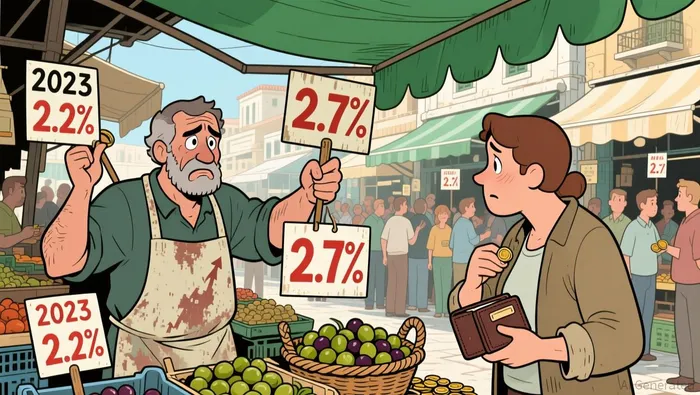
The Greek CPI is a critical barometer for the country’s inflation environment. Measured year-over-year, the index captures the average price change for a basket of goods and services consumed by households. A 2.7% increase in March 2026 indicates that the cost of living continues to rise at a pace that could have implications for both monetary policy and household spending behavior.
One of the key factors influencing Greece’s inflation profile is its position as a net importer of energy goods. As a result, global oil and gas price movements can have a direct and immediate effect on domestic inflation. With energy prices still elevated in 2026, the Greek economy remains exposed to potential volatility, especially as geopolitical tensions in the Middle East remain a point of concern.
How the March 2026 Reading Compares to Previous Months
This 0.2 percentage point increase from the previous month’s 2.5% suggests a continuation of a moderate but persistent inflation trend. Unlike the sharp price spikes seen during the early stages of the pandemic or the 2022 energy crisis, the current inflation in Greece has been more gradual and consistent.
This trajectory is in line with broader Eurozone trends, where core inflation has remained stubbornly elevated despite cooling headline inflation. For the European Central Bank, this could mean that the inflation normalization path in the region is slower than expected. Greece’s small economy and high exposure to external factors make it a useful bellwether for understanding how global inflationary pressures are being transmitted within the Eurozone.
Why the CPI Trend Matters for Greek Markets and Investors
For investors, Greek CPI data is important because it helps frame expectations about future ECB monetary policy. If inflation remains persistently above the ECB’s 2% target, the central bank may be reluctant to ease monetary policy, which could have implications for interest rates and bond yields in the periphery markets.
Furthermore, rising inflation can squeeze consumer spending, especially in a country where a significant portion of the population is still recovering from the financial crisis. If the cost of essentials like housing, transportation, and utilities continues to rise, this could dampen economic momentum and delay the full recovery of the Greek labor market.
For those looking to invest in Greece or hedge against its economic exposure, this CPI data provides a useful snapshot of inflationary pressures and potential risks. However, it is also important to note that Greece’s structural reforms and economic resilience have made it more resistant to external shocks compared to past decades. This means that while the current inflation trend is worth monitoring, it may not necessarily signal a new period of instability.

Stay ahead of the market.
Get curated U.S. market news, insights and key dates delivered to your inbox.


AInvest
PRO
AInvest
PRO



Comments
No comments yet