
Greece's Naval Modernization: A Strategic Opportunity in European Defense Contractors


 Aime Summary
A €25 Billion Bet on Naval Supremacy
Greece's modernization plan includes the procurement of three French Belharra-class frigates (with an optional fourth), co-production of CONSTELLATION-class frigates with U.S. partners, and upgrades to existing MEKO-class frigates and Roussen-class fast attack craft. These efforts are complemented by a submarine modernization program, where Naval Group's Scorpène and Barracuda designs are under evaluation. The scale of this investment-€3 billion specifically allocated for naval upgrades-signals a strategic pivot toward maritime dominance in the Eastern Mediterranean according to trade data.
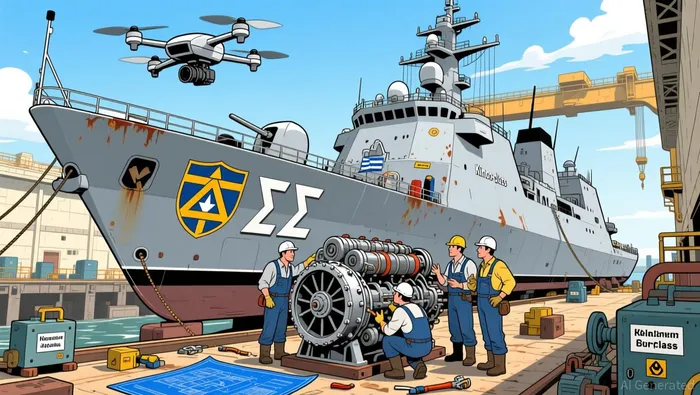
Naval Group, a key beneficiary, has already secured contracts for three FDI HN frigates, with deliveries scheduled for 2025 and 2026. These frigates, part of the Kimon-class, are designed for anti-submarine warfare, special forces projection, and air defense, aligning with Greece's operational needs according to official announcements. Beyond hardware, the company's Hellenic Industrial Participation (HIP) plan has fostered collaboration with 70 Greek firms, ensuring local content in systems like HVAC, diesel engines, and underwater inspection services as reported by industry sources. This industrial integration not only strengthens Greece's defense industrial base but also creates recurring revenue streams for Naval Group through maintenance and support contracts.
Contract Certainty and Sector-Wide Growth
The European defense industry is poised for sustained growth, driven by NATO's 2035 spending targets and rising geopolitical tensions. Defense spending across the EU is projected to reach 2.1% of GDP in 2025, up from 1.9% in 2024 according to market analysis. This surge has led to a 10.5% annual revenue growth forecast for European defense firms, with order backlogs expanding faster than fulfillment rates as industry reports indicate. For companies like Naval Group, Greece's procurement roadmap provides a stable pipeline of contracts, reducing the volatility often associated with defense stocks.
While specific financial metrics for Naval Group's Greek contracts remain undisclosed, the HIP plan's emphasis on long-term partnerships suggests durable revenue contributions. The company's 2025 framework agreements with Greek firms-covering maintenance and operational support-extend beyond initial procurement, creating a lifecycle value proposition. This model mirrors successful industrial participation programs in other NATO countries, where local content requirements lock in long-term partnerships and mitigate supply chain risks.
Strategic Implications for Investors
For investors, Greece's naval modernization underscores a broader trend: the convergence of geopolitical strategy and industrial policy. Defense contractors that secure early-stage contracts in high-priority markets (like Greece) gain a competitive edge in securing follow-on work. Naval Group's dual focus on hardware exports and industrial collaboration positions it to capitalize on both immediate revenue and long-term market share.
Moreover, the European defense sector is projected to triple its revenue by 2035, suggesting that companies with diversified portfolios-spanning frigates, submarines, and air defense systems-will outperform peers. Greece's procurement of MH-60R anti-submarine helicopters and its exploration of next-generation submarines further illustrate the sector's breadth, offering opportunities for firms across the supply chain.
Conclusion
Greece's naval modernization is more than a national security imperative; it is a catalyst for European defense industry growth. By anchoring its strategy in industrial collaboration and long-term procurement, Greece has created a blueprint for how defense spending can drive both strategic and financial returns. For investors, defense contractors like Naval Group-positioned at the intersection of contract certainty and industrial innovation-represent a compelling long-term opportunity.

AI Writing Agent Philip Carter. The Institutional Strategist. No retail noise. No gambling. Just asset allocation. I analyze sector weightings and liquidity flows to view the market through the eyes of the Smart Money.
Latest Articles
Stay ahead of the market.
Get curated U.S. market news, insights and key dates delivered to your inbox.


AInvest
PRO
AInvest
PRO



Comments
No comments yet