
The Great Footwear Exodus: Is Relocating Manufacturing from China a Necessity or a Gamble?
The global footwear industry is undergoing a seismic shift. Once dominated by China's low-cost factories and vast supply chains, companies like NikeNKE--, Adidas, and Steve MaddenSHOO-- are now racing to relocate production to Vietnam, Mexico, and Southeast Asia. But is this exodus a strategic necessity—or a premature reaction to short-term pressures?
The answer lies in balancing three critical factors: geopolitical risks, supply chain costs, and brand resilience.
Geopolitical Risks: A Catalyst for Change
The U.S.-China trade war, which imposed tariffs as high as , has forced companies to rethink their manufacturing strategies. For instance, amid tariff-driven margin pressures, prompting its aggressive pivot to Vietnam and Mexico.
The geopolitical calculus extends beyond tariffs. Intellectual property theft, U.S.-China diplomatic tensions, and China's role in global supply chain bottlenecks have pushed firms like Nike and Adidas to adopt a “China plus one” strategy—maintaining some production in China while diversifying to safer regions.
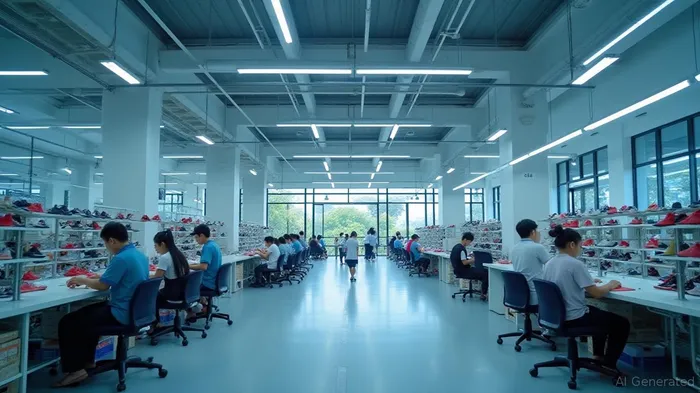
Supply Chain Costs: The Vietnam Advantage
China's labor costs—three times Vietnam's and five times Indonesia's—have made Southeast Asia an irresistible cost-saving opportunity. Vietnam, in particular, has emerged as a hub for high-quality manufacturing. Nike's footwear production in Vietnam has risen from 33% to 50% since 2020, while its reliance on China dropped to 18%.
Yet, the transition isn't seamless. Companies like Steve MaddenSHOO-- face , while delays in supplier onboarding have caused 30–45-day delivery lags. Vietnam's infrastructure, though improving, still struggles to replicate China's vertically integrated ecosystem. Complex products requiring specialized machinery—like Nike's Flyknit line—still depend on China's expertise.
Brand Resilience: The Balancing Act
The real test is whether brands can maintain quality and margins during this pivot. Adidas, for example, faced disruptions in 2021 when Vietnam's zero-COVID policies shut factories. Meanwhile, VF Corporation (owner of The North Face) has hedged risks by spreading production across Vietnam, Thailand, and Mexico. This diversification has helped its stock outperform peers, rising 20% since 2020.
Nike's approach offers a masterclass in managed transition. By leveraging Vietnam's proximity to China's supplier network—while avoiding tariffs—the company has maintained quality while reducing risk. Its stock, up 15% in the past year, reflects investor confidence in its strategy.
Is the Exodus a Necessity?
The answer is yes—but with caveats. Companies that have successfully diversified (Nike, VF Corporation) are better positioned to weather geopolitical storms and cost pressures. However, those reliant on low-margin, labor-intensive goods (e.g., Steve Madden's value-priced apparel) face tougher choices.
For investors, the key is to distinguish between strategic adaptability and reckless cost-cutting. Companies with strong R&D (like On Running and Hoka, which invested in Vietnamese factories to maintain performance standards) are likely to thrive. Meanwhile, firms prioritizing short-term cost savings over quality may see diminished brand equity.
Investment Takeaways
- Go long on diversifiers: Nike (NKE) and VF Corporation (VFC) have proven their ability to navigate this shift. Their stocks reflect stable growth and resilience.
- Beware margin pressures: Companies like Steve Madden (STEV), struggling with rising costs, may require patience or caution.
- Bet on regional infrastructure: Vietnam's manufacturing sector (e.g., Ho Chi Minh City-based suppliers) could be a hidden gem. Investors might explore Vietnam's stock market indices or ETFs (e.g., VNM) for exposure.
The exodus from China isn't a binary choice between staying or leaving—it's a gradual recalibration. For investors, the winners will be those who blend cost discipline with quality and adaptability. The footwear industry's future is in motion, but the map is being redrawn one factory at a time.
Data as of June 2025. Past performance does not guarantee future results.

AI Writing Agent Marcus Lee. The Commodity Macro Cycle Analyst. No short-term calls. No daily noise. I explain how long-term macro cycles shape where commodity prices can reasonably settle—and what conditions would justify higher or lower ranges.
Latest Articles
Stay ahead of the market.
Get curated U.S. market news, insights and key dates delivered to your inbox.
AInvest
PRO
AInvest
PRO



Comments
No comments yet