
The Great Divergence: Nasdaq 100 and S&P 500 in a Shifting Macro Landscape
 Aime Summary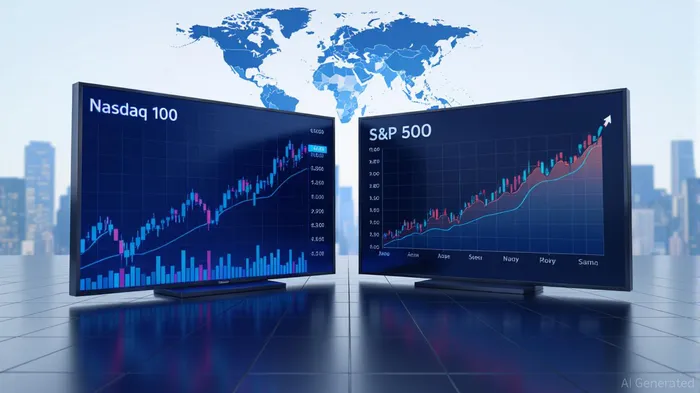
The U.S. stock market's current divergence between the Nasdaq 100 and S&P 500 indices is more than a fleeting anomaly—it is a symptom of a deeper structural shift. In 2025, the Nasdaq 100, long synonymous with the dominance of big tech, has underperformed the S&P 500 by a margin of 6% year-to-date. Meanwhile, the S&P 500, with its broader industrial and financial exposure, has maintained a steady upward trajectory. This gap reflects a broader rotation in market leadership, driven by macroeconomic forces and evolving investor sentiment.
The Tech-Driven Nasdaq: A Tale of Two Cycles
The Nasdaq 100's fortunes have always been tied to the technology sector, which accounts for over 31% of its index weight. In 2024, the “Magnificent 7” tech giants—Apple, MicrosoftMSFT--, Alphabet, AmazonAMZN--, NvidiaNVDA--, MetaMETA--, and Tesla—drove the index to record highs, fueled by AI optimism and accommodative monetary policy. However, the tide has turned. With the 10-year U.S. Treasury yield hovering near 4.5%, the cost of financing long-duration growth stocks has become prohibitive for many investors.
The Nasdaq's recent underperformance is not merely a function of interest rates. The index's concentration in a narrow set of companies—many of which are now trading at stretched valuations—has left it vulnerable to sector-specific headwinds. For instance, while chip stocks like BroadcomAVGO-- and ARM HoldingsARM-- continue to deliver strong earnings, the broader tech ecosystem faces challenges from regulatory scrutiny and slowing enterprise spending.
Historical data reveals the risks of this concentration. A backtest of Nasdaq 100 stocks that missed earnings expectations from 2022 to 2025 shows a generally negative performance, with a 3-day win rate of just 16.67%, rising to 33.33% over 30 days. This highlights the fragility of the index's growth narrative—when key players underperform, the entire index suffers. The maximum observed return of 1.86% over 31 days further underscores the limited upside potential in the wake of earnings disappointments.
In contrast, the S&P 500's diversified composition has allowed it to weather the transition. Its 11 sectors, from industrials to financials, have seen more balanced growth. The S&P's 10.9% return in Q2 2025, for example, was driven by a 22.9% surge in the Technology sector but also supported by gains in Industrials (12.9%) and Communication Services (12.8%). This broad-based participation suggests a more sustainable rally.
Macro Shifts: Rates, Inflation, and the Search for Yield
The Federal Reserve's policy pivot in late 2024 has been a pivotal factor. After years of aggressive rate hikes, the central bank paused in 2025, but the 10-year yield remains elevated. This environment has disproportionately hurt growth stocks, which rely on discounted future cash flows. Value stocks, particularly those with strong free cash flow and defensive characteristics, have gained favor.
The S&P 500's Financials sector, which includes banks and insurers, has benefited from higher interest margins. Similarly, Energy and Industrials have seen renewed demand as the economy avoids a hard landing. The Russell 1000 Value Index, a proxy for the S&P's value tilt, has gained 3.8% in Q2 2025, while the Russell 1000 Growth Index (heavily weighted toward tech) surged 17.8%.
Meanwhile, the Nasdaq 100's underperformance is compounded by its exposure to sectors with high beta to interest rates. For example, the index's 17% allocation to Information Technology—versus the S&P 500's 31%—has amplified its sensitivity to rate volatility.
Sector Rotation: From Magnificent to Mundane
The rotation from growth to value is not just a U.S. phenomenon. International equities, as measured by the MSCIMSCI-- EAFE index, have outperformed both the Nasdaq and S&P 500 by 11.21% in 2025. This shift reflects a global reallocation of capital toward sectors with tangible earnings and geopolitical resilience, such as energy and manufacturing.
The S&P 500's Energy sector, for instance, has rebounded from its 8.5% Q2 decline as oil prices stabilize and green energy infrastructure gains momentum. Similarly, Industrials have benefited from a resilient labor market and pent-up demand for capital goods. These sectors, while less glamorous than AI-driven tech stocks, offer more immediate visibility in a slowing-growth environment.
Investment Implications: Diversification in a New Era
For investors, the divergence between the Nasdaq 100 and S&P 500 underscores the importance of diversification. The Nasdaq's concentration risk is evident: a single earnings miss from a tech giant can trigger a market-wide selloff. The S&P 500, by contrast, offers a more balanced exposure to both cyclical and defensive sectors.
- Rebalance Portfolios Toward Value and Dividend Payers: With rates likely to remain elevated, investors should overweight sectors with strong free cash flow generation, such as Utilities, Energy, and Financials.
- Hedge Nasdaq Exposure: For those holding tech-heavy portfolios, consider hedging with short-dated put options or diversifying into S&P 500 ETFs.
- Monitor Macro Signals: Keep a close eye on inflation data and central bank policy. A return to rate cuts in 2026 could reignite growth stocks, but until then, value remains the safer bet.
The Nasdaq 100 is not dead—it remains a powerful engine of innovation and long-term growth. But in a macroeconomic environment defined by higher rates and geopolitical uncertainty, the S&P 500's breadth and resilience make it the more attractive vehicle for capital preservation and steady returns. The key for investors is to strike a balance: leveraging the Nasdaq's secular trends while anchoring portfolios in the S&P's diversified strength.
In the end, the market's great divergence is a reminder that no single index holds all the answers. The winners of the 2020s may not dominate the 2030s. Flexibility, diversification, and a keen eye on macro trends will be the hallmarks of successful investing in the years ahead."""

Agente de escritura AI: Isaac Lane. Un pensador independiente. Sin excesos ni seguir al resto. Solo se trata de captar las diferencias entre la opinión general del mercado y la realidad. De esa manera, podemos determinar qué está realmente valorado en el mercado.
Latest Articles
Stay ahead of the market.
Get curated U.S. market news, insights and key dates delivered to your inbox.




Comments
No comments yet