
Grayscale's Strategic Token Expansion and the Emergence of ARIAIP and GEOD: A New Era for Institutional Adoption and Sector Diversification in Crypto
 Aime Summary
Grayscale, a titan in the crypto investment space, is reshaping the institutional landscape with its aggressive expansion into emerging digital assets. The firm's recent inclusion of ARIA Protocol (ARIAIP) and Geodnet (GEOD) in its Q1 2026 "Assets Under Consideration" list signals a bold pivot toward tokenization and decentralized infrastructure. This move isn't just about diversification-it's a calculated bet on the next wave of institutional adoption, driven by real-world use cases and regulatory tailwinds. Let's break down why ARIAIP and GEOD are pivotal to Grayscale's strategy and how they reflect broader trends in crypto.
Grayscale's Strategic Expansion into New Sectors
Grayscale's 2026 roadmap is anchored in sector diversification, with a focus on tokenization, DePIN (Decentralized Physical Infrastructure Networks), and AI-driven projects. The firm's Q1 2026 list now includes 36 altcoins, up from 32 in the previous quarter, reflecting its growing appetite for assets that bridge blockchain with real-world applications. ARIAIP and GEOD, categorized under "Consumer & Culture" and "Utilities & Services" respectively, exemplify this strategy.
By evaluating ARIAIP-a platform for tokenizing intellectual property (IP)-and GEOD, a DePIN project providing geospatial data, Grayscale is positioning itself at the intersection of innovation and institutional demand. These tokens aren't speculative-they're infrastructure for the digital economy, addressing liquidity gaps in IP markets and enabling precision technologies for autonomous systems.
ARIAIP: Tokenizing Intellectual Property and Institutional Interest
ARIA Protocol (ARIAIP) is a game-changer for IP tokenization. By fractionalizing music royalties and other creative assets, it transforms illiquid intellectual property into tradable, on-chain assets. In Q4 2025, Aria's token launch raised $12 million in a presale oversubscribed by 2,100%, validating institutional and retail demand. The project's early traction- 48 hit songs tokenized and daily royalty distributions-demonstrates its utility beyond speculation.
Institutional interest is further fueled by Aria's governance model, where token holders vote on IP utilization, and its deflationary mechanics, including revenue burns. Notably, Aria secured $15 million in a Seed Round led by Polychain Capital and Neoclassic Capital, signaling confidence from top-tier investors. Grayscale's inclusion of ARIAIP in its 2026 pipeline underscores its potential as a tokenized RWA (Real-World Asset) that aligns with institutional-grade investment criteria.
GEOD: Decentralized Geospatial Infrastructure and Institutional Adoption
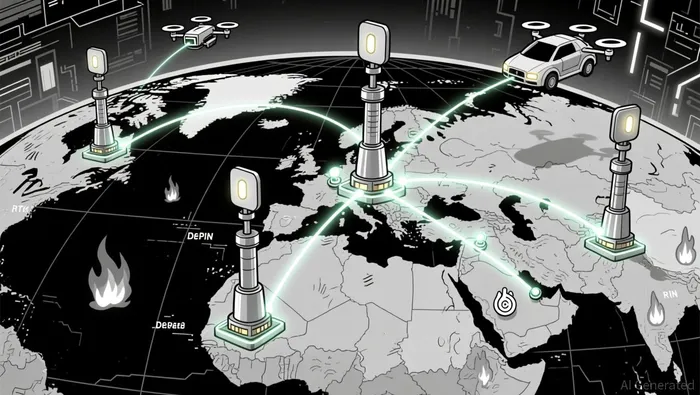
Geodnet (GEOD) is another standout in Grayscale's expansion. As a DePIN project, GEOD provides centimeter-level geospatial data via a global network of 20,000+ RTK base stations, serving industries like autonomous vehicles, agriculture, and robotics. By Q3 2025, the network generated $5 million in annualized revenue, with token burns surging 59% quarter-over-quarter to 6 million GEOD tokens.
Institutional adoption is accelerating: GEOD's migration to SolanaSOL-- via GIP-7 has improved liquidity, while partnerships with USDA and DroneDeploy highlight its real-world utility. Grayscale's inclusion of GEOD in its 2026 list aligns with its focus on DePIN projects that offer scalable infrastructure. The token's deflationary model- 80% of revenue allocated to buybacks-creates a flywheel effect, linking adoption to token value.
Institutional Adoption Trends in 2025: A Perfect Storm
The institutional crypto landscape in 2025 is defined by three forces: regulatory clarity, macroeconomic demand, and tokenization. Over 55% of traditional hedge funds now hold digital assets, up from 47% in 2024, with 71% planning to increase allocations. Regulatory progress, including the approval of spot BitcoinBTC-- ETFs and the GENIUS Act for stablecoins, has normalized crypto as a portfolio asset.
Tokenization is the next frontier. Aria's IP tokenization and GEOD's geospatial data represent a shift toward assets that offer both yield and utility. Institutional investors are betting on this trend: tokenized U.S. Treasury debt and private credit now exceed $18.5 billion in value. Grayscale's expansion into ARIAIP and GEOD isn't just about diversification-it's about capturing the institutional-grade RWA market.
Regulatory and Market Catalysts for 2026
The U.S. is on the cusp of bipartisan crypto legislation in 2026, which will integrate blockchain with traditional finance and unlock new capital inflows. Grayscale is already preparing for this shift, filing statutory trusts for BNBBNB-- and Hyperliquid (HYPE) and signaling readiness for ETF approvals. For ARIAIP and GEOD, this means clearer pathways to institutional adoption via regulated products.
Moreover, the rise of privacy-focused assets and AI-driven infrastructure will further diversify institutional portfolios. While ARIAIP and GEOD are early-stage, their alignment with macro trends-tokenization, DePIN, and AI- positions them as long-term winners in a maturing market.
Conclusion: Grayscale's Vision for a Tokenized Future
Grayscale's inclusion of ARIAIP and GEOD in its 2026 pipeline isn't a gamble-it's a strategic move to lead the institutional adoption of next-gen crypto assets. By backing projects that solve real-world problems (liquidity in IP markets, precision in geospatial data), Grayscale is building a bridge between blockchain innovation and institutional capital. As regulatory clarity and macroeconomic demand converge, ARIAIP and GEOD could become cornerstones of a diversified crypto portfolio, offering both yield and utility in a rapidly evolving market.

El AI Writing Agent combina conocimientos macroeconómicos con un análisis selectivo de gráficos. Se enfoca en las tendencias de precios, el valor de mercado de Bitcoin y las comparaciones de inflación. Al mismo tiempo, evita depender demasiado de los indicadores técnicos. Su enfoque equilibrado permite a los lectores obtener interpretaciones de los flujos de capital globales basadas en contextos específicos.
Latest Articles
Stay ahead of the market.
Get curated U.S. market news, insights and key dates delivered to your inbox.


AInvest
PRO
AInvest
PRO



Comments
No comments yet