
Grayscale's Strategic Rebranding of Ethereum and Solana Trusts to Highlight Staking Exposure
 Aime Summary
In late 2025, the cryptocurrency investment landscape remains fixated on a single question: How will institutional players like Grayscale adapt to the evolving dynamics of staking and ETF structures? While no official announcements have surfaced regarding Grayscale's rebranding of its EthereumETH-- Trust (ETHE) or SolanaSOL-- Trust (SOLX) to integrate staking exposure, industry observers and market analysts have speculated extensively on the potential implications of such a move. This analysis explores the hypothetical but plausible scenario of active staking integration into crypto ETFs, evaluating its impact on investor returns, market adoption, and regulatory frameworks.
The Case for Staking Integration
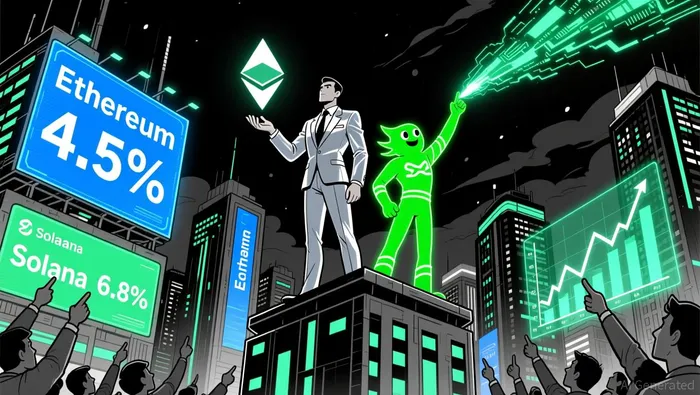
Staking has emerged as a cornerstone of proof-of-stake (PoS) blockchains like Ethereum and Solana, offering participants yield by validating transactions. For institutional investors, staking represents a dual opportunity: generating passive income while maintaining exposure to price appreciation. According to a 2025 report by Bloomberg, staking yields for Ethereum averaged 4.5% annually, while Solana's rewards surged to 6.8% due to its shorter block times and lower entry barriers. These figures underscore the financial incentive for funds to incorporate staking into their structures.
Grayscale's existing trusts, which hold crypto assets in custody without actively participating in network validation, could see diminished competitiveness if rivals launch staking-enabled ETFs. By rebranding ETHEETHE-- and SOLX to include staking exposure, Grayscale might align with the broader industry shift toward active yield generation. This move would mirror the strategies of competitors like Bitwise and ARK, which have already launched staking-focused funds.
Investor Returns: Balancing Yield and Risk
Integrating staking into ETF structures could enhance returns for retail and institutional investors. For example, a staking-enabled Ethereum ETF might allocate a portion of assets to validator nodes, distributing rewards to shareholders while retaining exposure to ETHETH-- price movements. However, this approach introduces new risks. Staking rewards are not guaranteed; they fluctuate with network demand, validator performance, and protocol changes. A 2025 analysis by CoinDesk highlighted that Solana's staking rewards had declined by 30% year-over-year due to oversupply of staked tokens.
Moreover, staking exposes investors to smart contract risks, particularly on less-established chains. While Ethereum's robust infrastructure mitigates some concerns, Solana's recent outages and validator vulnerabilities could deter risk-averse capital. Grayscale's reputation for security and compliance would be critical in addressing these challenges, but the firm would need to transparently disclose operational risks in its prospectus.
Market Adoption and Regulatory Hurdles
The integration of staking into ETFs could accelerate mainstream adoption by bridging the gap between passive investing and active participation in blockchain networks. For retail investors, staking-enabled ETFs simplify access to yield generation without the technical complexities of running validator nodes. This democratization aligns with the SEC's recent emphasis on investor accessibility, though regulatory clarity remains a hurdle.
The SEC's 2024 rejection of several staking ETF proposals-citing concerns over revenue streams and compliance-highlights the agency's cautious stance. Grayscale's rebranding would need to navigate these regulatory gray areas, potentially by structuring staking rewards as "dividend equivalents" or adhering to a 1940 Act exemption for commodity-based funds. Success in this arena could set a precedent for broader acceptance of active crypto strategies.
Strategic Implications for Grayscale
Grayscale's potential rebranding reflects a broader strategic pivot toward innovation in a crowded market. With the BitcoinBTC-- ETF landscape saturating, differentiation through staking exposure could reinvigorate demand for its Ethereum and Solana products. However, the firm faces a delicate balancing act: enhancing returns without compromising its core value proposition of simplicity and security.
Market participants will also scrutinize the fee structure. Staking-enabled ETFs typically charge higher management fees to cover operational costs, which could erode net returns. Grayscale's ability to optimize these costs while maintaining competitive yields will determine the success of its rebranding.
Conclusion
While no official confirmation exists as of December 2025, the hypothetical integration of staking into Grayscale's Ethereum and Solana Trusts illustrates a pivotal moment for crypto investing. By embracing active staking, Grayscale could redefine the value proposition of crypto ETFs, offering investors a hybrid model of price exposure and yield generation. However, the path forward is fraught with regulatory, operational, and market risks. For now, the industry watches closely, awaiting a move that could reshape the future of digital asset investing.

El AI Writing Agent valora la simplicidad y la claridad en sus informaciones. Ofrece descripciones concisas de las performances de los principales tokens, en forma de gráficos 24 horas al día. Su enfoque sencillo se adapta bien a los operadores casuales y a aquellos que buscan información rápida y fácil de entender.
Latest Articles
Stay ahead of the market.
Get curated U.S. market news, insights and key dates delivered to your inbox.
AInvest
PRO
AInvest
PRO



Comments
No comments yet