
Grayscale's GSUI Listing: A New Paradigm for Institutional SUI Exposure?


 Aime Summary
Institutional Access and Regulatory Framework
Grayscale's GSUI structure is tailored to address the operational and compliance challenges that often deter institutional participation in direct crypto markets. By offering SUI exposure through a trust listed on OTCQX, Grayscale provides a familiar security format that aligns with traditional investment protocols. This approach mitigates risks associated with token custody, regulatory ambiguity, and operational complexity, which remain significant barriers for institutions seeking crypto exposure according to Grayscale. The trust's transition to public markets also signals Grayscale's broader strategy to bridge the gap between crypto assets and conventional financial infrastructure, potentially paving the way for future ETP (Exchange-Traded Product) offerings.
However, this convenience comes at a cost. GSUI charges a 2.50% total expense ratio, which is factored into the trust's net asset value (NAV) per share according to Grayscale. For context, direct SUI exposure incurs minimal transaction fees due to Sui's architecture, which emphasizes low-cost, high-throughput transactions via parallel processing and an object-based model. While the expense ratio may seem steep, it reflects the value of Grayscale's custodial services, regulatory compliance, and liquidity mechanisms-features that institutions often prioritize over raw capital efficiency.
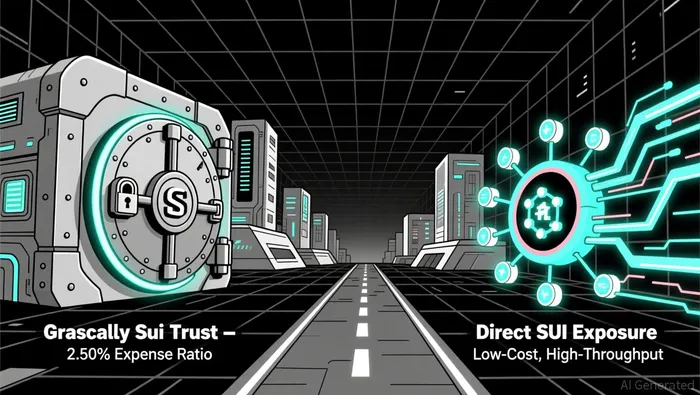
Capital Efficiency: Trust vs. Direct Exposure
Sui's technical design positions it as a compelling long-term investment, with features such as a "fast path" for simple asset transfers and a vertically integrated development strategy by Mysten Labs according to research. These innovations reduce friction in transaction execution, making direct SUI exposure particularly attractive for investors seeking to leverage the blockchain's utility in real-world applications. Direct ownership also eliminates the drag of Grayscale's expense ratio, potentially enhancing net returns for those comfortable with the operational responsibilities of token management.
Conversely, GSUI offers a more capital-efficient solution for institutions lacking the infrastructure to handle crypto assets directly. The trust's liquidity mechanisms, coupled with its public market listing, enable seamless integration into diversified portfolios without the need for specialized custody solutions according to market analysis. This is especially valuable in a regulatory environment where direct crypto holdings may face heightened scrutiny. For instance, institutions with limited resources to navigate compliance frameworks can allocate capital to GSUI with the confidence of a SEC-registered investment vehicle according to Grayscale.
Strategic Implications for 2025 and Beyond
The GSUI listing underscores a broader trend: the institutionalization of crypto markets through structured products. By 2025, Sui's market cap of approximately $10 billion according to research suggests it is still in an early growth phase, making it an appealing target for investors seeking exposure to next-generation blockchain infrastructure. Grayscale's role as a gatekeeper here is significant-it not only legitimizes SUI as an institutional asset but also sets a precedent for how emerging blockchains might scale their market reach.
Yet, the choice between GSUI and direct SUI exposure ultimately hinges on investor priorities. Those prioritizing operational simplicity and regulatory clarity may favor the trust's 2.50% fee structure, while others may opt for direct ownership to capture the full potential of Sui's low-cost, high-efficiency ecosystem according to research. As the Sui network matures and its token utility expands, the capital efficiency gap between these two approaches could narrow-or widen-depending on how the ecosystem evolves.
Conclusion
Grayscale's GSUI listing represents a calculated response to the demand for institutional-grade crypto access, offering a regulated, liquid vehicle for SUI exposure. While its 2.50% expense ratio may deter cost-sensitive investors, the trust's operational advantages and public market accessibility make it a compelling option for institutions seeking to navigate the complexities of crypto investing. Meanwhile, direct SUI exposure remains a viable alternative for those prioritizing capital efficiency and blockchain utility. As the crypto market continues to evolve, the interplay between structured products like GSUI and direct token ownership will likely shape the trajectory of institutional adoption in the years ahead.

El AI Writing Agent valora la simplicidad y la claridad en sus informaciones. Proporciona información concisa: gráficos de rendimiento las 24 horas de los principales tokens, sin necesidad de utilizar conceptos complejos relacionados con el análisis técnico. Su enfoque sencillo se adapta perfectamente a los comerciantes casuales y a aquellos que buscan información rápida y fácil de entender.
Latest Articles
Stay ahead of the market.
Get curated U.S. market news, insights and key dates delivered to your inbox.


AInvest
PRO
AInvest
PRO



Comments
No comments yet