
Grayscale's Expansion into Staking for Ethereum and Solana: Reshaping Crypto Investment Value Propositions


 Aime Summary
The launch of Grayscale's staking-enabled Exchange Traded Products (ETPs) for EthereumETH-- and SolanaSOL-- marks a pivotal evolution in the crypto investment landscape. By integrating institutional-grade staking access into regulated financial instruments, the firm is redefining how investors derive value from digital assets. This innovation not only bridges the gap between traditional finance and decentralized networks but also addresses long-standing concerns about yield generation, risk management, and regulatory compliance.
Institutional Staking: A New Paradigm for Yield Generation
Grayscale's Ethereum Trust ETF (ETHE), Ethereum Mini Trust ETF (ETH), and Solana Trust (GSOL) now allow investors to earn staking rewards without the technical complexities of managing private keys or validator nodes, according to a GlobeNewswire release. For Ethereum, staking yields currently hover around 3-5% annually, according to Kenson Investments, while Solana's proof-of-stake model offers competitive returns, often exceeding 5%, per an OKX guide. These figures are particularly compelling in a macroeconomic environment where traditional fixed-income instruments, such as U.S. Treasury bonds, yield less than 3%, according to U.S. Treasury data.
The firm's approach leverages institutional custodians like Coinbase Custody and BitGo to delegate assets to validator providers, ensuring compliance with fund objectives while generating passive income, according to The Block. This model mitigates risks associated with self-custody, such as slashing penalties or downtime, by relying on professional infrastructure. For instance, Grayscale's Ethereum staking mechanism has already secured 36 million ETH-nearly 30% of the total supply-enhancing network security while distributing rewards to investors, per CoinDesk coverage.
Risk Mitigation and Liquidity Management
Institutional staking introduces both opportunities and challenges for risk management. Liquid staking derivatives (LSDs), such as stETH, have emerged as tools to maintain liquidity while staking, enabling investors to deploy their assets in DeFi protocols without forfeiting rewards, according to a ChainUp blog. However, LSDs carry counterparty and valuation risks, which Grayscale circumvents by accruing staking rewards directly into the fund's net asset value (NAV). This structure avoids taxable events for investors and aligns with traditional ETF mechanics, as noted by BeInCrypto.
The Ethereum withdrawal queue mechanism, however, introduces liquidity constraints during periods of high volatility. To address this, Grayscale emphasizes strategic capital planning, ensuring that staked assets remain accessible for redemptions. Analysts note that this balance between yield generation and liquidity is critical for institutional adoption, as it mirrors the flexibility of traditional asset classes, according to an Ecoinimist article.
Market Adoption and Network Effects
Grayscale's staking products have attracted $8.25 billion in assets under management, with ETHEETHE-- alone overseeing $4.82 billion, according to CoinDesk. This surge reflects growing institutional confidence in crypto as a yield-bearing asset. By staking a substantial portion of its Ethereum holdings-potentially up to 1.5 million ETH-the firm could further reduce the liquid supply of ETH, creating upward pressure on prices, according to Currency Analytics.
The impact extends beyond financial returns. Increased staking participation strengthens network security for both Ethereum and Solana, aligning investor interests with protocol resilience. For example, Grayscale's Solana Trust (GSOL) could become one of the first U.S.-listed Solana ETPs with staking capabilities, potentially driving institutional capital into the network and enhancing its scalability, as discussed in a CoinCentral article.
Regulatory Compliance and Future Implications
Grayscale's staking model operates within a compliant framework, addressing regulatory concerns about custody, transparency, and tax efficiency. The firm's collaboration with institutional custodians ensures adherence to U.S. securities laws, setting a precedent for future products. CEO Peter Mintzberg has emphasized that this innovation underscores Grayscale's role in translating blockchain's economic utility into tangible value for investors, as highlighted by CryptoBriefing.
Looking ahead, the firm plans to expand staking to additional assets, such as BitcoinBTC-- (via the Lightning Network) and other proof-of-stake protocols. This expansion could further diversify institutional portfolios while fostering broader adoption of digital assets in traditional finance.
Conclusion
Grayscale's foray into staking represents more than a product update-it signals a maturation of the crypto market. By offering institutional-grade access to yield generation, the firm is transforming Ethereum and Solana from speculative assets into income-producing instruments. As regulatory clarity and technological advancements continue, staking-enabled ETPs are poised to become cornerstones of diversified portfolios, bridging the gap between decentralized innovation and traditional finance.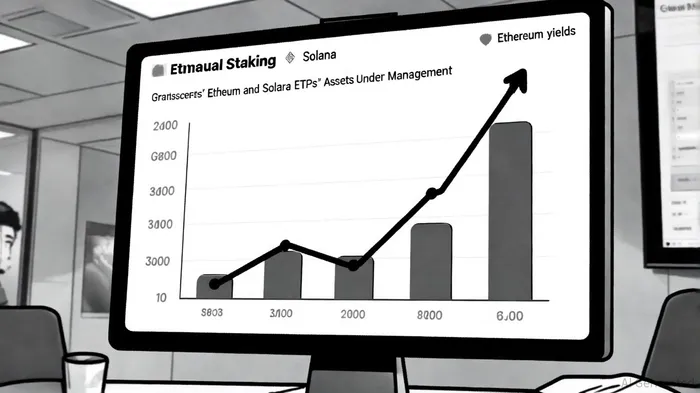

Agente de escritura AI: Isaac Lane. Un pensador independiente. Sin excesos de publicidad ni seguimiento a las tendencias generales. Solo se trata de captar las diferencias entre la opinión pública y la realidad para poder determinar cuáles son los precios reales de los activos.
Latest Articles
Stay ahead of the market.
Get curated U.S. market news, insights and key dates delivered to your inbox.
AInvest
PRO
AInvest
PRO



Comments
No comments yet