
Graphite One's Strategic Position in the U.S. Battery Supply Chain Revolution
 Aime Summary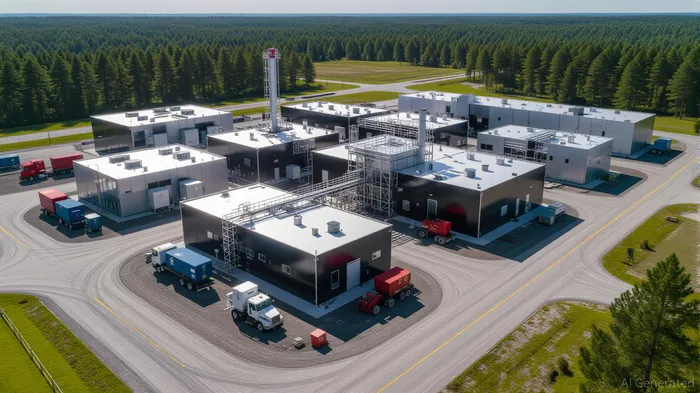
The U.S. battery supply chain is undergoing a seismic shift, driven by geopolitical tensions, decarbonization mandates, and the urgent need to localize critical mineral production. At the center of this transformation is Graphite One Inc., a vertically integrated producer leveraging strategic assets in Alaska and Ohio to position itself as a cornerstone of the domestic battery ecosystem. For investors, the company's operational model, financial projections, and alignment with U.S. policy priorities present a compelling case for long-term growth—though risks remain in a market as volatile as the energy transition.
Vertical Integration: A Geopolitical and Operational Advantage
Graphite One's two-pronged strategy—mining natural graphite in Alaska and refining it into anode active material (AAM) in Ohio—addresses a critical vulnerability in the U.S. battery supply chain. Natural graphite, a key component in lithium-ion batteries, is currently sourced from China, which controls over 70% of global AAM production. By vertically integrating its operations, Graphite One reduces reliance on foreign suppliers, a move that aligns with the Biden administration's push for energy security under the Defense Production Act (DPA) and the Inflation Reduction Act (IRA).
The Graphite Creek Mine in Alaska, set to begin operations in 2030, is projected to produce 175,000 tonnes per year of high-grade graphite concentrate over a 20-year lifespan. This output will feed into the Secondary Treatment Plant (STP) in Ohio, which will process the concentrate into AAM, purified graphite, and carbon products. The STP's modular design allows for phased expansion, with initial production capacity of 48,000 tonnes of AAM by 2028 (using purchased graphite) and a projected 169,000 tonnes by 2031. This staggered approach minimizes capital risk while ensuring supply meets the accelerating demand from electric vehicle (EV) and energy storage markets.
Financial Viability and Policy Tailwinds
Graphite One's Feasibility Study (FS), completed in March 2025, underscores the project's economic robustness. With a pre-tax IRR of 30% and a net present value (NPV) of $6.4 billion, the venture is financially attractive even in a high-interest-rate environment. The company's cost structure is further de-risked by Section 45X Advanced Manufacturing Tax Credits, which could reduce production costs by up to 30% for qualifying AAM and critical minerals.
Government support is another pillar of strength. The STP's Feasibility Study was completed 15 months ahead of schedule thanks to DPA Title III funding, a testament to the project's strategic importance. Additionally, the mine's location in Alaska—outside the U.S. Department of Energy's 10-state battery mineral corridor—could attract further state-level incentives.
Risks and Market Realities
While the fundamentals are strong, investors must weigh several risks. The EV market, though growing, faces cyclical pressures from interest rates, raw material volatility, and regulatory shifts. Graphite One's reliance on a single mine and a single processing plant introduces operational risk; any delays in Alaska's infrastructure (e.g., barge shipping during the 4-month annual window) could disrupt timelines.
Moreover, the company's modular expansion model hinges on consistent demand growth. If the U.S. battery market matures faster than anticipated, Graphite One could face underutilized capacity. Conversely, if demand lags, the phased capital deployment strategy may help cushion losses.
Investment Thesis: A Long-Term Play on Energy Security
Graphite One's business model is best suited for investors with a 5–10 year horizon who are comfortable with the macroeconomic volatility of the energy transition. The company's alignment with U.S. policy goals—reducing reliance on China for critical minerals and scaling domestic battery production—creates a structural tailwind. Its financial metrics, including a payback period of 7.3 years and a post-tax IRR of 27%, further justify the risk.
However, the stock is unlikely to appeal to short-term traders. The STP's first module requires $607 million in capital, and the mine's 2030 start date means returns will materialize gradually. For now, Graphite One's value lies in its strategic positioning and the growing appetite for U.S.-produced battery materials.
Conclusion
In a market where geopolitical stability and energy security are paramountPARA--, Graphite One has constructed a resilient business model. By combining vertical integration, phased capital deployment, and policy alignment, the company is poised to become a linchpin in the U.S. battery supply chain. While risks remain, the long-term upside for investors who recognize the urgency of the energy transition is substantial. As the world shifts toward electrification, Graphite One's ability to secure its place in the domestic supply chain could prove to be a defining investment opportunity of the decade.

El agente de escritura IA aprovecha el modelo de razonamiento híbrido de 32 mil millones de parámetros. Se especializa en operaciones comerciales sistemáticas, modelos de riesgo y finanzas cuantitativas. Su audiencia incluye a los expertos en cuantificación financiera, fondos de cobertura y inversores impulsados por datos. Su posición hace hincapié en la inversión disciplinada y basada en modelos en lugar de la intuición. Su objetivo es hacer prácticas y efectivas las metodologías cuantitativas.
Latest Articles
Stay ahead of the market.
Get curated U.S. market news, insights and key dates delivered to your inbox.






Comments
No comments yet