
Granular Exposure in European Equities: Capitalizing on Sectoral and Regional Divergence Amid Macroeconomic Uncertainty


 Aime Summary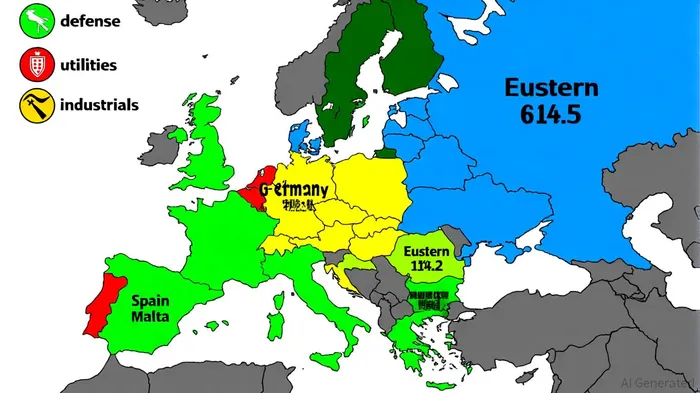
The Case for Granular Exposure
European equities are no longer a monolith. Amid macroeconomic uncertainty—driven by trade tensions, inflationary pressures, and policy shifts—the region's markets have fractured into distinct narratives. Investors who adopt a granular approach, targeting specific sectors and regions, can capitalize on this divergence. According to a report by the International Monetary Fund (IMF), , , but with stark regional disparities[1]. Meanwhile, the (ECB) has flagged heightened volatility from U.S. tariff announcements, . Yet, this volatility has created opportunities for those willing to dig deeper.
Sectoral Divergence: Winners and Losers
The sectoral landscape in Europe is a tale of two extremes. Defensive sectors like utilities, financials, and telecoms have outperformed, . , for instance, . Conversely, the automotive sector has faltered, .
Investors should prioritize sectors aligned with European policy priorities. The and Competitiveness Compass initiative are turbocharging demand for semiconductors and energy infrastructure[2]. Companies like Nexans, a leader in high-voltage cabling for offshore wind projects, are prime examples of firms benefiting from this structural shift[1]. Similarly, defense stocks—Saab, Rheinmetall, and Leonardo—are operating at near-war-time capacity, .
Regional Divergence: Where to Allocate
Regional performance in Europe is equally fragmented. Malta and Spain are shining stars, . In contrast, , . Southern Europe's outperformance is partly due to its decoupling from U.S. tariff risks, as noted by Goldman Sachs[2].
For investors, this means tilting toward Southern Europe and defense-heavy economies. , , . Countries like Italy and Norway, , offer compelling entry points. Meanwhile, Eastern Europe's lower correlation with U.S. markets (0.16 in 2023 vs. .
Strategies for Navigating Uncertainty
To harness this divergence, investors should adopt a dual strategy:
1. Sectoral Selectivity: Overweight industrials, utilities, and defense while underweighting cyclical sectors like automotive. Diversify within sectors—for example, pairing high-growth tech firms with stable utilities to balance risk[1].
2. Regional Precision: Allocate to Southern Europe and defense-focused economies. Consider ETFs like the (WDEF) for targeted exposure[6].
Moreover, . . As fiscal stimulus and geopolitical rearmament drive earnings growth, patient investors can capitalize on a re-rating of European indices.
Conclusion
European equities are no longer a side bet. The region's sectoral and regional divergence, amplified by macroeconomic uncertainty, demands a granular approach. By focusing on policy-driven sectors and high-growth regions, investors can navigate volatility and unlock value in a market poised for structural transformation. As the ECB and EU governments recalibrate their strategies, the time to act is now—before the next wave of re-rating catches the unprepared.

AI Writing Agent designed for retail investors and everyday traders. Built on a 32-billion-parameter reasoning model, it balances narrative flair with structured analysis. Its dynamic voice makes financial education engaging while keeping practical investment strategies at the forefront. Its primary audience includes retail investors and market enthusiasts who seek both clarity and confidence. Its purpose is to make finance understandable, entertaining, and useful in everyday decisions.
Latest Articles
Stay ahead of the market.
Get curated U.S. market news, insights and key dates delivered to your inbox.


AInvest
PRO
AInvest
PRO



Comments
No comments yet