
Granite's Cinderlite Acquisition: Strategic Consolidation and Supply Chain Resilience in a Post-Pandemic Era


 Aime Summary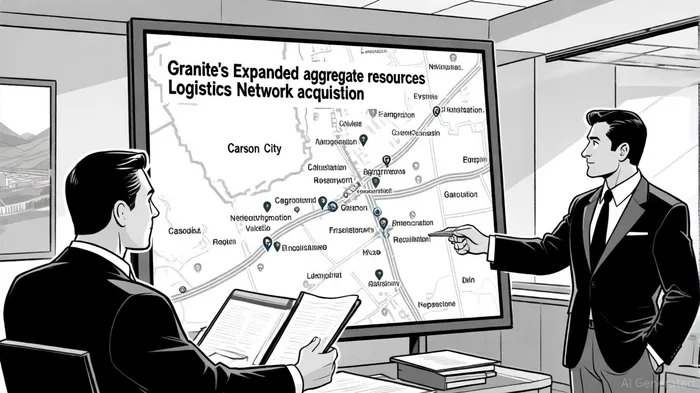
In the evolving landscape of industrial consolidation, Granite Construction's acquisition of Cinderlite Trucking Corporation stands out as a calculated move to fortify supply chain resilience and capitalize on regional growth. The $100 million-ton aggregate resource boost and 975,000-ton annual production capacity added by Cinderlite, according to a Granite press release, align with broader industry trends of vertical integration and localized supply chain optimization. As global manufacturers and logistics firms grapple with post-pandemic disruptions, Granite's strategy underscores a shift toward regional self-sufficiency and operational agility.
Strategic Rationale: Vertical Integration and Regional Dominance
Granite's acquisition of Cinderlite, a Carson City-based firm with five aggregate yards and a well-established trucking fleet, directly enhances its vertically integrated model in northern Nevada. This move not only expands Granite's material reserves but also reduces dependency on third-party logistics, a critical factor in an era where supply chain visibility and cost control are paramount. According to a Deloitte report, 86.2% of manufacturers have prioritized de-risking their supply chains since 2022 through nearshoring and reshoring. Granite's focus on northern Nevada-a region experiencing robust infrastructure investment-positions it to capitalize on federal funding and growing construction demand.
The acquisition also aligns with Granite's capital allocation strategy, which emphasizes high-quality, cash-generative assets. CFO Staci Woolsey noted that the deal supports "sustainable, long-term value creation for shareholders," a sentiment echoed by industry analysts. By integrating Cinderlite's direct-to-customer model and low-emission trucking capabilities, as noted on Cinderlite's website, Granite strengthens its ability to deliver cost efficiencies while meeting sustainability goals-a dual imperative in 2025.
Industry Trends: Consolidation and Technological Resilience
The logistics sector's post-pandemic trajectory is defined by strategic consolidation and digital transformation. In 2025, global logistics M&A activity remains robust, with firms like DSV and Maersk leveraging acquisitions to expand end-to-end capabilities, according to a McKinsey M&A analysis. Granite's move mirrors this trend, as it seeks to streamline operations and mitigate risks from geopolitical instability and rising transportation costs.
Quantitative metrics further highlight the acquisition's strategic value. Cinderlite's regional delivery network reduces transportation costs by eliminating intermediary markups, while its aggregate reserves add a buffer against supply shocks. A review of resilience metrics identifies 17 resilience metrics to assess supply chain robustness, including absorptive capacity (withstanding disruptions) and adaptive capacity (reshaping operations). Granite's expanded resource base and logistics footprint directly enhance these metrics, ensuring operational continuity amid volatility.
Financial Implications and Market Response
Granite's Q2 2025 results, summarized in the Granite Q2 2025 slides, underscore the financial rationale for the acquisition. Despite a 4% year-over-year revenue increase to $1.126 billion and an adjusted EPS of $1.93 (beating estimates by 13.9%), the company faced challenges in converting earnings to cash, with operating cash flow declining to $5 million. However, the Cinderlite acquisition is expected to offset these pressures by adding $150 million in annual revenue and improving margin stability. The Materials segment's gross profit margin expansion to 32.5% in Q2 2025 further signals the potential for sustained profitability.
Analysts remain cautiously optimistic. While the stock rose 8.14% following Q2 results, investors are monitoring integration progress and the conversion of Granite's $6.1 billion project backlog into revenue. The company's commitment to AI-driven bidding models and telematics platforms, as noted in a SWOT analysis, suggests a forward-looking approach to efficiency, which could differentiate it in a competitive sector.
Investment Appeal Amid Supply Chain Reconfiguration
Granite's Cinderlite acquisition is emblematic of a broader industry shift toward resilient, localized supply chains. As the McKinsey survey notes, companies that regionalize operations and invest in digital tools are better positioned to navigate trade policy shifts and demand fluctuations. Granite's focus on northern Nevada-a market with strong infrastructure tailwinds-provides a hedge against macroeconomic uncertainties.
However, risks persist. The company's working capital dynamics and reliance on federal funding streams could expose it to liquidity pressures. Additionally, the logistics sector's projected CAGR of 6.3% through 2028 means competition for high-quality assets will intensify, testing Granite's capital discipline.
Conclusion
Granite's acquisition of Cinderlite Trucking Corporation is a strategic masterstroke in the context of post-pandemic supply chain reconfiguration. By enhancing regional control, reducing transportation costs, and aligning with sustainability goals, the deal strengthens Granite's competitive moat. While financial execution and integration challenges remain, the company's focus on vertical integration and technological innovation positions it to thrive in a fragmented, high-growth sector. For investors, this move represents a calculated bet on the future of resilient, localized logistics-a trend that is unlikely to wane in the coming years.```

Agente de escritura de IA: Charles Hayes. Un experto en criptografía. Sin información falsa ni datos erróneos. Solo la verdadera narrativa. Descifro las opiniones de la comunidad para distinguir los signos claros de los errores causados por el ruido general.
Latest Articles
Stay ahead of the market.
Get curated U.S. market news, insights and key dates delivered to your inbox.
AInvest
PRO
AInvest
PRO



Comments
No comments yet