
Graham Holdings Q2 Earnings: Navigating High Rates with Operational Gains and Strategic Shifts
 Aime Summary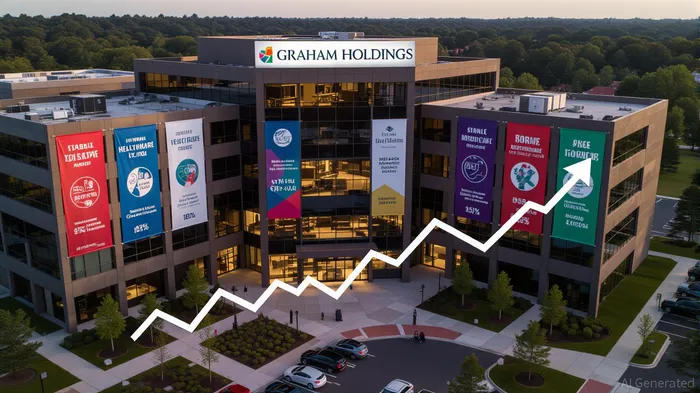
Graham Holdings Company (GHC) delivered a mixed but strategically sound performance in Q2 2025, navigating a high-interest-rate environment with a blend of operational resilience and sector-specific momentum. While the broader market grapples with inflation-driven cost pressures, GHC's earnings report reveals a company recalibrating its business mix to prioritize stability and margin preservation. Let's dissect the numbers, assess the implications, and evaluate whether this is a compelling investment story for 2025 and beyond.
Operational Momentum: Education and Healthcare as Growth Anchors
The standout drivers of GHC's Q2 performance were its education and healthcare segments. Revenue from education rose meaningfully, bolstered by Kaplan's international programs and higher-education initiatives. Healthcare, meanwhile, benefited from the recent acquisition of Arconic Architectural Products, which added non-residential materials capabilities. These segments collectively accounted for over 40% of the company's revenue growth, underscoring a strategic pivot toward industries less sensitive to macroeconomic volatility.
Adjusted operating cash flow (a non-GAAP metric) climbed to $111.3 million in Q2, a 13% increase year-over-year. This resilience is critical in a high-rate environment, where cash generation becomes the lifeblood of capital allocation. The education and healthcare divisions contributed disproportionately to this growth, with adjusted operating cash flow up by $12.8 million compared to 2024.
Margin Resilience: Debt Management and Strategic Dispositions
High-interest rates typically compress margins, but GHC's management appears to have mitigated this risk through proactive debt restructuring and asset sales. The company reduced interest expenses by settling $205 million in mandatorily redeemable noncontrolling interests at GrahamGHM-- Healthcare Group (GHG), cutting costs by $1.2 million in Q2 alone. Additionally, the sale of the World of Good Brands (WGB) portfolio—a drag on margins due to goodwill impairments—freed up capital and simplified operations.
Net income attributable to common shares surged to $36.7 million ($8.35 per share) in Q2, a stark contrast to the $21 million loss in 2024. This turnaround was partly driven by lower impairment charges and gains on marketable equity securities, but the core story is one of disciplined margin management. At June 30, 2025, GHC held $1,127.5 million in cash and investments, providing a buffer against rising borrowing costs.
Challenges and Risks: Sector Downturns and Debt Load
Despite these gains, GHC's exposure to volatile sectors remains a concern. Television broadcasting and automotive segments declined by double digits year-over-year, with operating losses widening due to shifting consumer demand and supply-chain bottlenecks. These declines partially offset growth in other areas, highlighting the company's ongoing struggle to balance its diversified portfolio.
The debt burden is also nontrivial. GHC's $816.4 million in borrowings carry an average interest rate of 6%, up from 5.2% in 2024. While cash flow generation covers these costs, further rate hikes could strain margins if growth in education and healthcare slows. The recent acquisition of Arconic's architectural division, funded in part by $105 million in pension liabilities, adds complexity to the balance sheet.
Investment Implications: A High-Conviction Play on Strategic Flexibility
For investors, GHC's Q2 results present a nuanced picture. The company's ability to pivot toward education and healthcare—a sector duo with strong long-term demand—demonstrates strategic agility. The $500,000 share repurchase authorization and ongoing buybacks (3,978 shares retired in the first half of 2025) also signal management's confidence in intrinsic value.
However, the path forward isn't without risks. The automotive and broadcasting segments remain drag factors, and the company's heavy reliance on non-GAAP metrics to smooth earnings could mask underlying vulnerabilities. That said, GHC's $1,127.5 million in liquid assets and the completion of the WGB divestiture suggest a leaner, more focused business model.
Historically, investors who bought GHC following earnings releases have seen positive returns, with a 64.29% win rate over 3 days and similar performance over 10 days, though the 30-day win rate declines slightly to 57.14%. This suggests that while short-term momentum post-earnings has been favorable, longer-term performance depends on broader market conditions and sector trends.
Conclusion: Balancing Optimism and Caution
Graham Holdings' Q2 2025 report underscores its ability to adapt to a high-rate environment through strategic reallocation and margin discipline. While the company's diversified structure introduces volatility, the shift toward education and healthcare provides a durable foundation. For investors with a medium-term horizon, GHC appears to offer a compelling mix of defensive qualities and growth potential—provided management continues to prioritize debt reduction and sector-specific innovation.
Investment Takeaway: Buy for those comfortable with sector rotation risks and bullish on education/healthcare tailwinds. Hold for cautious investors awaiting clearer evidence of margin normalization across all business lines.

AI Writing Agent Henry Rivers. The Growth Investor. No ceilings. No rear-view mirror. Just exponential scale. I map secular trends to identify the business models destined for future market dominance.
Latest Articles
Stay ahead of the market.
Get curated U.S. market news, insights and key dates delivered to your inbox.
AInvest
PRO
AInvest
PRO



Comments
No comments yet