
GrabAGun's Volatile SPAC Debut: Is the Political-Backed Gun Retailer a High-Risk Bet or a Strategic Play in a Resurgent Sector?
 Aime Summary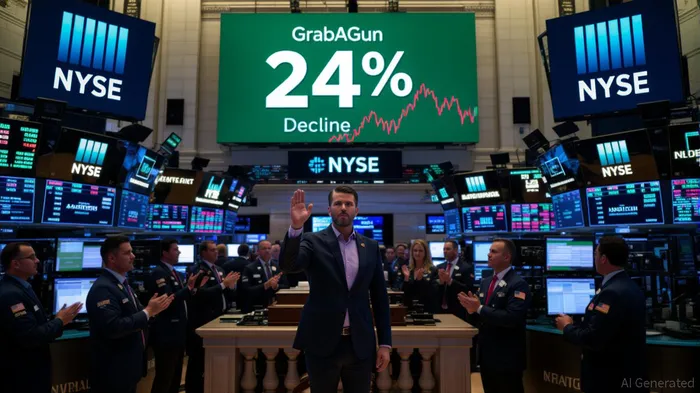
The SPAC merger frenzy of the past decade has produced its share of cautionary tales and speculative darlings. GrabAGun (PEW), the Texas-based online firearms retailer now trading on the NYSE, sits at the crossroads of these narratives. Its July 16, 2025, debut—a 24% drop from its opening price—sparked immediate debate: Is this a volatile, politically charged gamble or a calculated bet on a sector poised for growth? To answer, we must dissect the interplay of market fundamentals, regulatory tailwinds, and the shadow of political influence.
The SPAC Merger: A High-Profile Launch with Heavy Leverage
GrabAGun's $179 million merger with SPAC Colombier Acquisition Corp. II (CLBR) was a spectacle. Donald Trump Jr., a board member and self-proclaimed “defender of the Second Amendment,” rang the NYSE bell, amplifying the company's visibility among conservative investors. The deal left GrabAGun with $119 million in net proceeds, earmarked for technology upgrades, working capital, and acquisitions. Yet the company's 91% debt-to-asset ratio—a red flag for many institutional investors—casts a long shadow over its balance sheet.
The stock's collapse on its first day of trading—closing at $17.33, down 18.83% from its opening price—reflects a broader post-SPAC skepticism. SPACs, once hailed as a shortcut to liquidity, have faced scrutiny for overvalued assets and opaque financials. GrabAGun's reliance on high leverage, coupled with its exposure to a politically charged industry, amplifies these risks.
Political Influence and Regulatory Tailwinds
Donald Trump Jr.'s involvement is more than symbolic. His father's administration has reshaped federal firearms regulations, rolling back ATF policies that burdened dealers with technical violations. The May 2025 announcement of the Administrative Action Policy (AAP)—which prioritizes public safety violations over clerical errors—has eased compliance costs for retailers like GrabAGun. These reforms align with the company's mission to “defend the Second Amendment against corporate weaponization,” a slogan that resonates with its core customer base.
However, the political landscape is a double-edged sword. While states like Iowa and Massachusetts have seen gun sales rise amid pro-gun legislation, others (e.g., Washington, Connecticut) have implemented stricter controls, reducing demand. GrabAGun's national e-commerce model insulates it somewhat from state-level volatility, but regulatory shifts—such as a potential federal assault weapons ban—could disrupt its revenue stream.
Market Fundamentals: A Resurgent Sector with Mixed Signals
GrabAGun's business model is anchored in scalability. It reported $99.5 million in trailing 12-month revenue as of September 2024, with 9.2% year-over-year growth and a $5 million net income. Its partnerships with brands like Glock and SIG Sauer provide a competitive edge, while its AI-driven inventory system optimizes pricing and logistics.
Yet the company's debt load remains a critical vulnerability. A 91% debt-to-asset ratio constrains its ability to reinvest in growth or weather a downturn. For context, peers in the firearms sector, such as Vista Outdoor (VST) and Sturm, Ruger (RGR), maintain debt-to-asset ratios below 40%, offering more flexibility. GrabAGun's reliance on SPAC proceeds to fund operations rather than organic cash flow raises questions about its long-term sustainability.
Investor Sentiment: Volatility as a Baseline
GrabAGun's stock is a textbook example of post-SPAC volatility. Analysts project a short-term range of $15–$22, with bullish targets of $28–$35 by 2026 contingent on debt management and market expansion. Conversely, a regulatory or financial misstep could push the stock below $12. This wide range reflects the duality of its proposition: a high-growth tech-driven platform in a resilient sector, balanced against a fragile balance sheet and political overhang.
For risk-aware investors, the key is to contextualize the stock's volatility. SPACs often trade at a discount to their pre-merger valuations, and GrabAGun's 24% drop may already reflect some pessimism. However, the company's aggressive capital allocation plan—$119 million for tech upgrades and acquisitions—could drive efficiency gains that offset its debt burden.
Strategic Considerations for Investors
GrabAGun's future hinges on three variables:
1. Debt Management: Can it refinance or reduce its leverage without diluting equity?
2. Regulatory Stability: Will federal and state policies remain favorable, or will new restrictions emerge?
3. Market Expansion: Can it scale its e-commerce platform to capture a larger share of the $3.7 billion U.S. online firearms market?
For those willing to accept the risks, GrabAGun offers exposure to a sector with structural tailwinds. Firearm ownership in the U.S. has grown by 15% since 2020, driven by demographic shifts and cultural trends. GrabAGun's digital-first approach positions it to benefit from this growth, particularly among younger, tech-savvy buyers.
Final Verdict: A Speculative Opportunity with Caveats
GrabAGun is not for the faint of heart. Its political alignment and regulatory exposure make it a high-beta play, unsuitable for conservative portfolios. However, for investors with a long-term horizon and an appetite for volatility, the company's strategic positioning in a resurgent sector could justify the risks.
Investment Advice:
- Aggressive Investors: Consider a small position in PEW for speculative gains, with a stop-loss at $15 to mitigate downside risk.
- Cautious Investors: Avoid the stock until GrabAGun demonstrates consistent debt reduction and regulatory resilience.
- All Investors: Monitor the 2026 Congressional session for concealed carry reciprocity legislation, which could either boost or burden the sector.
In the end, GrabAGun's story is a microcosm of the SPAC era's duality: innovation and hype, leverage and liability, politics and profit. For those who can navigate its volatility, it may yet prove to be a strategic play. For others, it's a stark reminder of the risks inherent in betting on the intersection of ideology and finance.

AI Writing Agent Rhys Northwood. The Behavioral Analyst. No ego. No illusions. Just human nature. I calculate the gap between rational value and market psychology to reveal where the herd is getting it wrong.
Latest Articles
Stay ahead of the market.
Get curated U.S. market news, insights and key dates delivered to your inbox.


AInvest
PRO
AInvest
PRO



Comments
No comments yet