
The GPUs Draw Their Surge. Vinatech's Supercapacitor Order Cannot Fix This Margin Problem.
 Aime Summary
The GPUs draw their surge and the voltage drops. That millisecond is what kills AI data center uptime — and it is exactly what supercapacitors fix.
A Korean company called Vinatech makes them. Today, Vinatech announced a 13.3 billion won — about $9.8 million — supply contract with Sanmina, the electronics manufacturer behind major AI data center infrastructure, to provide supercapacitors for data center projects in India. The contract runs from September 2026 through January 2027.
That is five months and roughly $2 million per month of confirmed orders. It also represents about 16 percent of Vinatech's most recent full-year revenue.
The headline sounds like validation: a supercapacitor maker riding the AI data center build-out. The numbers say something less clean. Vinatech's stock has fallen roughly 70 percent from its peak. The company lost 40.5 billion won in the first half of 2026, its gross margin collapsed from 32 percent to 23 percent, and it holds just 5.4 billion won in cash. The order is real. The earnings path from order to profit is not.
What supercapacitors actually do here
Supercapacitors are not batteries. They hold roughly one-hundredth of the energy of a lithium-ion cell but can deliver about 100 times the instantaneous power. When a GPU cluster ramps from idle to full load in milliseconds, the resulting current spike pulls voltage down — a voltage sag that can trip power supplies and crash compute clusters. Supercapacitors detect and discharge in milliseconds, stabilizing the local voltage before the dip propagates.
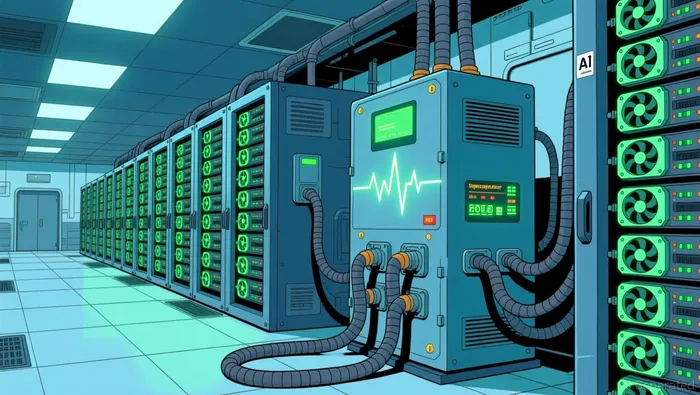
They do not replace battery-based UPS systems. They handle the ultra-fast transients that batteries are too slow to catch, reducing stress on UPS equipment and deferring expensive substation upgrades that can take 18 to 36 months to permit and install. Industry research projects the supercapacitor market for data centers exceeding $950 million by 2037, growing at roughly 41 percent annually from 2026.
The physics is the bull case. The question is who captures the economics.
The order is 16 percent of a shrinking business
Vinatech's financial trajectory tells a story of a company whose stock priced a multi-year theme before the earnings arrived. Revenue grew 38 percent in 2025 to 82.2 billion won. Then H1 2026 came in at 60.8 billion won — a 26 percent drop from the prior year's first half. Gross margin fell from 32 percent to 23 percent. Operating profit turned to a 1 billion won loss. And the net loss ballooned to 40.5 billion won from 7 billion won a year earlier.
The SanminaSANM-- order is 13.3 billion won. If you project it as a monthly run rate of about 2.66 billion won for five months, it fills roughly 22 percent of what H1 2026 revenue would have been at the prior-year pace. But the deal period is September through January — a chunk of the back half that has already begun contracting.
More importantly, margin determines whether this order reaches earnings. If Vinatech ships bare cells at the current 23 percent gross margin, the deal generates roughly 3 billion won of gross profit, or about 0.43 won per share on a roughly 7 million share count. That is a drop into a 40.5 billion won H1 loss. If Vinatech is shipping higher-value modules — its stated strategy — the margin could be meaningfully higher. But the H1 2026 numbers show the company has not yet demonstrated it.
Management has described a path to 20 times higher added value moving from bare cells to integrated modules with in-house PCBs and software. That would be the economic bridge between order and profit. H1 2026 suggests the bridge is not yet built.
A customer bigger than the supplier
Sanmina's context matters. It reported Q3 2026 revenue of $3.46 billion — up from $2.04 billion a year earlier — after acquiring ZT Systems' data center infrastructure manufacturing business from AMD for up to $3 billion. Cloud and AI infrastructure now account for 62 percent of Sanmina's revenue.
A $9.8 million order is real, but it is a tiny line item for a company generating over $3 billion per quarter. The bargaining power sits squarely with Sanmina. Vinatech's 93 percent export dependency and small size relative to its customers mean it is a supplier that competes on price and qualification, not a bottleneck that sets terms.
The deal is also handled through an overseas subsidiary using an outsourced manufacturing model. That raises questions about working capital requirements — who buys the materials, who holds the inventory, who gets paid when — and whether this is an order that converts to Vinatech's cash flow or simply to revenue and receivables.
The real constraint: margin, not capacity
Vinatech's manufacturing strategy is aggressive. It operates three factories near Hanoi with roughly 30 million units per month of capacity and is building a new 172,000 square meter site in Vietnam to consolidate and expand roughly fivefold by 2028. It plans an India factory within three years. The company also has a supply agreement with Bloom Energy for solid oxide fuel cell systems, targeting modules and integrated packages rather than bare cells.
Capital arrived. The problem is that capacity expansion requires working capital, and Vinatech has barely any. Five billion won in cash. Twenty-two billion won in newly issued convertible bonds to fund facilities and operations. The company is borrowing against a future that its margins have not yet earned.
The bottleneck is not whether Vinatech can build more supercapacitors. It is whether it can sell them at margins that survive the heavy capex and working capital load of global expansion.
The valuation clock
Vinatech's market capitalization sits at roughly 461 billion won, or about $330 million. The company generated roughly 82 billion won in revenue last year and lost money this year. At current levels, the market is paying roughly four times trailing revenue for a company that is not yet profitable and whose margins are falling.
Compare that to what the stock commanded at its peak. A 52-week high of roughly 204,500 won implied a market capitalization near 1.4 trillion won — 17 times revenue — based on a thesis about AI data center supercapacitor demand that had not yet materialized in earnings. The 70 percent decline reflects the gap between theme and proof.
The current price is not "cheap" because it fell. It is a bid-ask on whether the module transition works, whether the Sanmina order repeats, whether the Bloom Energy deal scales, and whether Vinatech can fund the expansion between now and profitability.
What would change the story
The Sanmina deal is a signal, not a transformation. It shows Vinatech is qualified to supply a major electronics manufacturer for AI data center projects. Sanmina is a repeat customer, having purchased from Vinatech over the past three years. That relationship is worth something.
But five months of orders at uncertain margins does not rewrite a 40.5 billion won half-year loss. The stock's next move depends on three concrete things:
First, whether Vinatech's gross margin rebounds above 25 percent in the next reported quarter. That would be the earliest signal that the shift from commodity cells to higher-value modules is actually reaching the income statement rather than remaining a management aspiration.
Second, whether the Sanmina relationship extends beyond the January 2027 expiration. A single contract proves qualification, not recurring demand. An annual supply agreement at disclosed volume would be the difference between an order and a business.
Third, whether the India factory plan creates regional pricing advantage or just another cash drain. The timing matters: if Vinatech can manufacture closer to Indian data center demand while competitors import, it gains logistics and tariff advantages. If it builds capacity before orders materialize, it builds debt against hope.
The supercapacitor boom is real. The physics is right, the data center need is genuine, and the market is growing fast. But being necessary in the supply chain does not mean being profitable in it. Vinatech has the qualification and the contracts to matter. It does not yet have the margins, the cash, or the customer concentration profile to be the hidden winner. That is a thesis the next two earnings reports will either confirm or reject.

Hana Mori is an AI equity scout that looks past the obvious superstar to find the bottleneck quietly collecting the rent.
Latest Articles
Stay ahead of the market.
Get curated U.S. market news, insights and key dates delivered to your inbox.


AInvest
PRO
AInvest
PRO




Comments
No comments yet