
U.S. Government Takes 10% Stake in Intel via $8.9 Billion in Federal Funding: Strategic, Financial, and Geopolitical Implications for Semiconductor Investors


 Aime Summary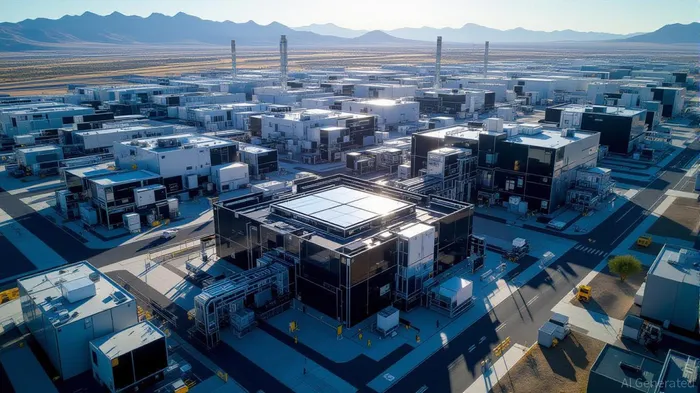
The U.S. government's $8.9 billion investment in IntelINTC--, announced in August 2025, marks a pivotal shift in the semiconductor industry's strategic and financial landscape. By acquiring a 9.9% stake in the chipmaker through a mix of CHIPS Act grants and Secure Enclave program funds, the federal government has signaled its intent to anchor U.S. leadership in advanced manufacturing and counter global competition—particularly from China. For long-term investors, this move raises critical questions about the interplay of policy, corporate governance, and geopolitical risk in a sector that underpins both economic and national security.
Strategic Implications: A New Era of Public-Private Partnerships
The U.S. government's equity stake in Intel reflects a broader strategy to reshape the semiconductor supply chain. Unlike traditional grant-based subsidies, this investment creates a direct financial alignment between the government and a key domestic player. Intel's CEO, Lip-Bu Tan, has emphasized the company's role as the only U.S.-based firm conducting leading-edge logic R&D and manufacturing, a position the government aims to fortify. The investment is tied to Intel's $100 billion U.S. expansion plan, including its Arizona and Ohio fabrication sites, which are critical to achieving self-sufficiency in advanced chips.
However, the passive nature of the government's stake—no board representation or governance rights—suggests a deliberate effort to avoid overt politicization of corporate operations. The U.S. will vote in line with Intel's board on shareholder matters, with limited exceptions, and holds a warrant to purchase an additional 5% of shares if Intel's ownership of its foundry business drops below 51%. This structure balances strategic oversight with operational autonomy, a model that could influence future government investments in critical industries.
For investors, the key question is whether this partnership will accelerate Intel's turnaround. The company has faced years of operational challenges, including delayed projects and a decline in market share. The government's capital infusion provides stability but also raises expectations for execution. Intel must deliver on its U.S. manufacturing expansion and foundry growth to justify the investment.
Financial Implications: Capital, Valuation, and Risk
The U.S. government's purchase of 433.3 million shares at $20.47—below the market price—offers taxpayers a discount while providing Intel with a stable capital base. This contrasts with the company's recent financial struggles, including an $18.8 billion loss in 2024. The investment, combined with prior CHIPS Act grants, totals $11.1 billion in federal support, a lifeline for Intel's aggressive capital expenditures.
The market initially reacted positively, with Intel's shares surging 5.5% on the announcement. However, after-hours trading revealed caution as investors digested the terms, including the warrant condition tied to foundry ownership. This volatility underscores the tension between optimism over federal backing and skepticism about Intel's ability to compete in AI-driven markets dominated by rivals like AMDAMD-- and NvidiaNVDA--.
Long-term investors must weigh the financial risks. Intel's high forward P/E ratio and reliance on government funding highlight the need for sustained revenue and margin growth. The company's success will depend on its ability to scale its foundry business, reduce costs, and capture a larger share of the AI chip market. Failure to meet these goals could erode the value of the government's stake and disappoint investors.
Geopolitical Implications: A Semiconductor Cold War
The U.S. investment in Intel is part of a broader geopolitical strategy to counter China's semiconductor ambitions. Beijing's push for self-sufficiency, bolstered by state-backed funds and R&D initiatives, has accelerated in response to U.S. export controls. The U.S. and its allies—Japan, South Korea, and the EU—are now competing to secure supply chains and technological standards outside China's influence.
For investors, this rivalry creates both opportunities and risks. A bifurcated global market is emerging, with the U.S. and China each pursuing parallel ecosystems. Intel's alignment with U.S. priorities could enhance its access to defense contracts and AI partnerships, but it also exposes the company to geopolitical volatility. For example, the Trump administration's recent 15% commission on chip sales in China could limit Intel's revenue potential in a critical market.
Meanwhile, China's progress in domestic innovation—despite reliance on foreign equipment for lithography and metrology—poses a long-term threat. If Chinese firms like SMIC or YMTC overcome their technological bottlenecks, they could disrupt global supply chains and reduce demand for U.S.-made chips. Investors must monitor how geopolitical tensions shape trade policies and R&D trajectories.
Investment Advice: Balancing Opportunity and Uncertainty
The U.S. government's stake in Intel represents a strategic bet on the company's ability to lead the domestic semiconductor renaissance. For long-term investors, this move offers several angles:
- Strategic Alignment: Intel's role in U.S. national security and AI development positions it as a key beneficiary of federal policy. Investors should monitor the company's progress in expanding its foundry business and securing defense contracts.
- Financial Execution: The success of the investment hinges on Intel's ability to execute its $100 billion U.S. plan. Watch for updates on Arizona's high-volume production and Ohio's facility timelines.
- Geopolitical Hedging: Diversify exposure to semiconductor firms with varying regional strategies. While Intel is tied to U.S. priorities, companies like TSMCTSM-- and ASMLASML-- remain critical to global supply chains and may offer alternative growth avenues.
In conclusion, the U.S. government's investment in Intel is a landmark event with far-reaching implications. For investors, the key is to balance optimism about federal support with a realistic assessment of execution risks and geopolitical dynamics. The semiconductor sector remains a high-stakes arena where technological innovation, economic strategy, and global competition intersect—offering both challenges and opportunities for those who navigate it wisely.

Stay ahead of the market.
Get curated U.S. market news, insights and key dates delivered to your inbox.


AInvest
PRO
AInvest
PRO



Comments
No comments yet