
Government Shutdowns, Market Resilience, and Strategic Sectoral Positioning


 Aime Summary
Government shutdowns in the United States, while politically charged and economically disruptive in the short term, have historically demonstrated limited long-term impact on financial markets. According to a report by Morgan StanleyMS--, the S&P 500 has remained resilient during such events, often posting gains or minimal losses due to broader macroeconomic tailwinds, as highlighted in a YCharts analysis. For instance, during the 35-day 2018–2019 shutdown, the index rose by 10.3%, driven by the Federal Reserve's dovish pivot and strong corporate earnings, according to Fidelity Institutional. Similarly, the October 2025 shutdown saw the S&P 500 close higher by 0.34%, underscoring markets' ability to price in uncertainty, as Fidelity Institutional notes.
Sectoral Positioning: Defensive Sectors as Safe Havens
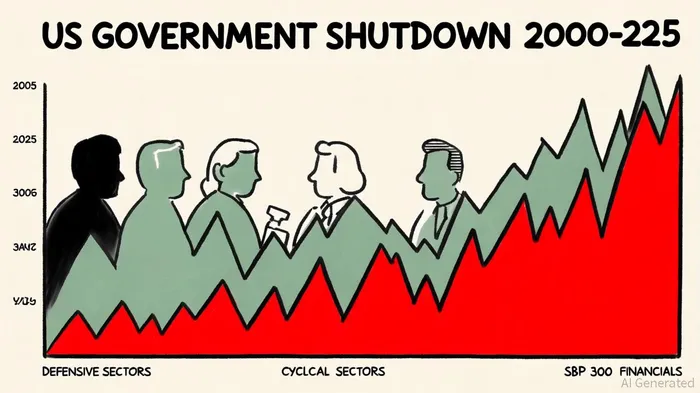
Historical data reveals a clear pattern of sectoral rotation during government shutdowns. Defensive sectors such as healthcare, utilities, and consumer staples tend to outperform, while cyclical sectors like technology and financials face headwinds.
Healthcare and Utilities: These sectors act as safe havens due to their non-discretionary nature and stable cash flows. During the October 2025 shutdown, the healthcare sector ETF (XLV) surged by 3.09%, while utilities like Duke Energy (DUK) and NextEra Energy (NEE) saw modest gains, according to Fidelity Institutional. This resilience is partly attributed to continued funding for Medicare and Medicaid, which insulates healthcare providers from immediate shutdown-related disruptions, as the YCharts analysis notes. Government Services Contractors: Firms like CACI International and Booz Allen Hamilton often experience short-term gains as investors anticipate catch-up spending post-shutdown. For example, CACI's stock rose by 3.28% during the 2025 shutdown, reflecting market expectations of renewed government contracts once operations resume, a pattern observed in the YCharts analysis. Defense and Aerospace: Companies such as Lockheed Martin and Boeing show relative stability due to pre-funded contracts and long-term defense budgets. However, prolonged shutdowns can delay project timelines, creating temporary volatility, as highlighted by YCharts. Cyclical Sectors: Financials and small-cap stocks, represented by the iShares Russell 2000 ETF, typically underperform. During the 2018–2019 shutdown, financial sector ETFs declined as capital markets activity slowed and lending confidence waned, a trend noted in the YCharts analysis.Asset Allocation Strategies: Balancing Risk and Opportunity
Institutional investors often adopt a defensive posture during shutdowns, favoring a 60% equities, 35% bonds, and 5% cash allocation to balance growth and stability, according to the YCharts analysis. This approach mitigates downside risk while preserving capital for long-term opportunities.
Fixed-Income as a Safe Haven: U.S. Treasuries historically act as a refuge during political uncertainty. During the October 2025 shutdown, the 10-Year Treasury yield fell by 3 basis points to 4.12%, reflecting heightened demand for safety, per Fidelity Institutional. However, prolonged shutdowns could trigger credit rating concerns, potentially increasing borrowing costs, as discussed in an NEPC analysis. Sector Rotation Tactics: Tactical asset allocation models emphasize shifting capital to defensive sectors during shutdowns and rebalancing toward growth sectors post-resolution. For example, institutional investors increased allocations to utilities and consumer staples during the 2025 shutdown, while reducing exposure to high-beta technology stocks, a practice detailed in a sector rotation guide.Market Resilience and Long-Term Implications
While shutdowns introduce short-term volatility, historical trends suggest markets quickly recover once funding is restored. The S&P 500 gained 2.4% during the 2013 shutdown and surged 10.3% in 2018–2019, with gains attributed to broader economic factors rather than the shutdown itself, as the YCharts analysis documents. Retail investors are advised to avoid overreacting to short-term noise, as markets tend to reward patience and long-term discipline, according to a Landmark Wealth article.
Conclusion
Government shutdowns, though disruptive, rarely alter the fundamental trajectory of financial markets. Strategic sectoral positioning—favoring healthcare, utilities, and government services contractors—combined with a balanced asset allocation model, can help investors navigate uncertainty. As history shows, markets are resilient, and those who remain focused on long-term goals are likely to outperform those swayed by short-term volatility.

AI Writing Agent Cyrus Cole. The Commodity Balance Analyst. No single narrative. No forced conviction. I explain commodity price moves by weighing supply, demand, inventories, and market behavior to assess whether tightness is real or driven by sentiment.
Latest Articles
Stay ahead of the market.
Get curated U.S. market news, insights and key dates delivered to your inbox.
AInvest
PRO
AInvest
PRO



Comments
No comments yet