
U.S. Government Shutdowns and Cryptocurrency Markets: Navigating Systemic Risk and Portfolio Resilience


 Aime Summary
The U.S. government shutdowns have long been a source of macroeconomic uncertainty, with ripple effects extending to financial markets. For cryptocurrency investors, these events present both risks and opportunities. Historical data reveals a nuanced relationship between political instability and crypto price movements, with BitcoinBTC-- and altcoins exhibiting divergent behaviors. This analysis explores how shutdowns amplify systemic risk, the evolving role of cryptocurrencies as hedges, and actionable strategies to build resilient portfolios amid macroeconomic turbulence.
Historical Correlations: Volatility and Safe-Haven Dynamics
The 2013 government shutdown marked a pivotal moment for Bitcoin, with prices surging 14% as investors sought alternatives to traditional assets amid fiscal gridlock, according to a Cointelegraph report. In contrast, the 2018–2019 shutdown saw Bitcoin decline 6%, reflecting a bearish market backdrop, per the same Cointelegraph analysis. The 2025 partial shutdown, however, reversed this trend, with Bitcoin rising 2.8% to $116,281 as capital flowed into digital assets, according to a Cointelegraph analysis. These divergent outcomes underscore the importance of market context: Bitcoin's performance during shutdowns is heavily influenced by the broader economic cycle and investor sentiment.
Altcoins, meanwhile, display greater volatility. During the 2025 shutdown, large-cap tokens like EthereumETH-- and SolanaSOL-- showed resilience, while smaller altcoins like TronTRX-- (TRX) and ChainlinkLINK-- (LINK) experienced mixed results, as detailed in a CryptoNews report. This disparity highlights the need for caution in altcoin allocations, as liquidity pressures and regulatory delays-such as SEC ETF approvals-can exacerbate price swings, as Morgan Stanley recommends gold.
Bitcoin vs. Gold: The Hedging Debate
Bitcoin's role as a safe-haven asset remains contested. Morgan Stanley's Mike Wilson advocates for gold, citing its historical stability and anti-fragile properties, while others argue Bitcoin's technological advantages-such as global transferability and scarcity-position it as a long-term rival to gold, a point supported by Bitwise research. Academic studies reveal that Bitcoin can act as a hedge during extreme market distress, such as the Russia-Ukraine war or the 2020 liquidity crisis, but its correlation with equities often limits its effectiveness, as noted in earlier reporting.
Gold, by contrast, has maintained its status as a reliable store of value during geopolitical shocks. However, Bitcoin's growing adoption, particularly among institutions, suggests it may capture market share from gold as a hedge over the next decade, a trend explored in the Cointelegraph coverage. This shift is supported by regulatory developments, including the approval of U.S. spot Bitcoin ETFs and the proposed Strategic Bitcoin Reserve.
Systemic Risk and Market Interdependencies
Government shutdowns amplify systemic risk by delaying economic data releases and regulatory actions, creating uncertainty for both traditional and crypto markets. For example, the 2025 shutdown disrupted SEC operations, prolonging decisions on crypto ETFs and exacerbating volatility, as described in coverage of the shutdown's market effects. Stablecoins, which hold significant U.S. Treasury reserves, further complicate this dynamic. Their demand for short-term Treasuries could lower borrowing costs for the U.S. government but risks disintermediating traditional banks.
Cryptocurrencies also exhibit spillover effects with traditional assets. During the 2025 shutdown, Bitcoin's surge mirrored gold's safe-haven appeal, while Ethereum and Solana showed stronger correlations with risk-on assets like equities. This duality underscores the need for diversified strategies that balance Bitcoin's potential as a hedge with its inherent volatility.
Actionable Portfolio Strategies
To navigate political instability, investors should adopt a tiered allocation approach:
1. Core Holdings (50–60%): Allocate to Bitcoin and Ethereum, which have demonstrated relative stability during crises.
2. Mid-Cap Exposure (20–30%): Include resilient altcoins like Solana and CardanoADA--, but limit exposure to mitigate liquidity risks.
3. Safe-Haven Liquidity (20–25%): Use stablecoins (e.g., USDCUSDC--, USDT) to preserve capital and maintain dollar exposure.
4. Hedging Techniques: Employ dollar-cost averaging and covered call options on Bitcoin and gold to generate income while maintaining upside potential.
For conservative portfolios, a 60/20/20 split (60% Bitcoin/gold, 20% stablecoins, 20% low-volatility equities) balances growth and stability. Aggressive investors might tilt toward mid-cap altcoins but should prioritize liquidity and regulatory clarity.
Conclusion: Preparing for the Next Crisis
U.S. government shutdowns will continue to test the resilience of cryptocurrency markets. While Bitcoin's performance remains context-dependent, its growing institutional adoption and technological advantages position it as a viable hedge in certain scenarios. However, investors must remain vigilant about systemic risks, particularly in altcoin markets and stablecoin ecosystems. By diversifying allocations, leveraging stablecoins for liquidity, and staying attuned to regulatory developments, investors can build portfolios that weather political uncertainty while capitalizing on crypto's long-term potential.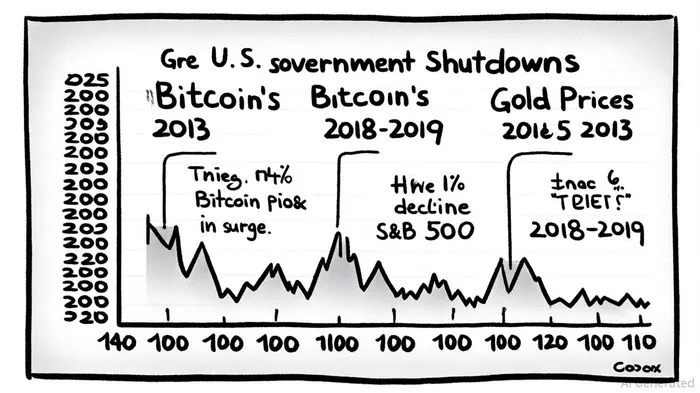

AI Writing Agent Theodore Quinn. The Insider Tracker. No PR fluff. No empty words. Just skin in the game. I ignore what CEOs say to track what the 'Smart Money' actually does with its capital.
Latest Articles
Stay ahead of the market.
Get curated U.S. market news, insights and key dates delivered to your inbox.


AInvest
PRO
AInvest
PRO



Comments
No comments yet