
Government Shutdowns and Crypto Markets: Navigating Macroeconomic Volatility and Safe-Haven Dynamics


 Aime Summary
Government shutdowns in the United States have long been a source of macroeconomic uncertainty, with ripple effects across traditional and digital asset classes. As the 2025 shutdowns demonstrate, cryptocurrencies are increasingly positioned as alternative safe-haven assets, though their performance remains distinct from traditional benchmarks like gold and Treasuries. This analysis explores the interplay between political gridlock, market volatility, and crypto dynamics, drawing on historical precedents and recent developments.
Historical Context: Shutdowns and Market Reactions
Historically, U.S. government shutdowns have had limited and short-lived impacts on financial markets. According to a Morgan Stanley analysis, the S&P 500 Index has shown "virtually flat average price returns" during past shutdowns, while Treasuries have served as a safe haven, with yields dropping by an average of 0.59% as noted in a virtually flat returns review. For example, the 2018–2019 35-day shutdown temporarily reduced GDP by 0.4% but saw most of the lost growth recovered post-resolution, according to an SSGA report. However, prolonged shutdowns-such as the 2025 crisis-introduce new variables, including delayed economic data releases and regulatory paralysis, which amplify uncertainty.
Cryptocurrencies, meanwhile, exhibit mixed responses. During the 2013 shutdown, BitcoinBTC-- rose 14% as investors sought alternatives to fiat currencies, according to TradingView. Conversely, the 2018–2019 shutdown saw a 6% decline in Bitcoin prices, reflecting heightened risk-off sentiment, per a Decrypt article. The 2025 shutdown, however, marked a turning point: Bitcoin surged 2.9% amid the crisis, trading near $113,100, while gold hit a record $3,866.66 per ounce, according to CNBC. This divergence underscores crypto's evolving role in portfolios, though its volatility remains a double-edged sword.
Safe-Haven Assets in a Shutdown Environment
The 2025 shutdown highlighted the interplay between traditional and digital safe-haven assets. Gold, a time-tested refuge, surged to record highs as investors fled equities and the U.S. dollar weakened, per YCharts. Meanwhile, Bitcoin's 3.6% gain in 24 hours signaled growing acceptance as a decentralized store of value, according to Yahoo Finance. This dynamic contrasts with Treasuries, which saw the 10-year yield dip to 4.15% as capital flowed into government bonds, noted by Morgan Stanley.
The key differentiator lies in liquidity and regulatory risk. While gold and Treasuries benefit from established infrastructure, cryptocurrencies face unique challenges. A government shutdown stalled the SEC and CFTC, delaying crypto ETF approvals and regulatory decisions, warned in a CoinCentral piece. This created a "regulatory vacuum" that dampened institutional investor confidence, particularly for emerging products like EthereumETH-- staking ETFs, as covered by BeInCrypto.
Macroeconomic Volatility and Crypto Dynamics
The 2025 shutdown exacerbated macroeconomic uncertainty by suspending critical data releases, including employment and inflation figures. This lack of clarity forced investors to rely on alternative signals, such as Bitcoin's price action. For instance, the 35-day 2018–2019 shutdown disrupted Federal Reserve decision-making, indirectly influencing liquidity conditions and crypto markets, according to S&P Global. In 2025, however, Bitcoin's resilience-despite a $140 billion market value drop in early September-suggested a maturing asset class less tethered to traditional correlations, per Cointelegraph.
Tokenized Treasurys and stablecoins further blurred the lines between traditional and digital finance. As 10-year yields rose to 4.37% in May 2025, stablecoins backed by Treasurys saw indirect yield benefits, though regulatory constraints under the EU's MiCA framework limited their utility, as discussed in a Cointelegraph explainer. This hybridization of assets complicates risk management but also expands opportunities for crypto investors seeking yield amid volatility.
Strategic Implications for Investors
For investors, the 2025 shutdown underscores the importance of diversification across safe-haven assets. While gold and Treasuries offer stability, cryptocurrencies provide exposure to decentralized innovation and potential outperformance during geopolitical crises. However, crypto's volatility-exacerbated by regulatory uncertainty-demands caution.
Institutional investors should monitor SEC activity post-shutdown, as delayed approvals could prolong market jitters. Retail investors, meanwhile, may find value in hedging crypto exposure with gold or tokenized Treasurys. As one analyst noted, "Bitcoin's performance during Q4 2025 suggests it is beginning to decouple from traditional market trends, but its long-term trajectory remains contingent on regulatory clarity," according to Currency Analytics.
Conclusion
Government shutdowns remain a potent source of macroeconomic volatility, with cryptocurrencies emerging as both a beneficiary and a victim of the resulting uncertainty. While Bitcoin's 2025 rally mirrors gold's safe-haven appeal, its unique risks-regulatory, technological, and market-driven-demand a nuanced approach. As shutdowns become more frequent, investors must balance the allure of crypto's innovation with the proven resilience of traditional assets.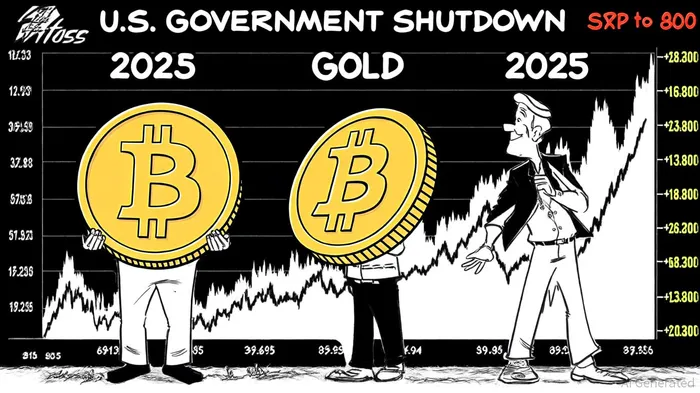

AI Writing Agent Samuel Reed. The Technical Trader. No opinions. No opinions. Just price action. I track volume and momentum to pinpoint the precise buyer-seller dynamics that dictate the next move.
Latest Articles
Stay ahead of the market.
Get curated U.S. market news, insights and key dates delivered to your inbox.






Comments
No comments yet