
US Government Shutdown Risks and Market Implications: Strategic Asset Reallocation in Prolonged Fiscal Uncertainty


 Aime Summary
The U.S. government shutdown, , 2025, has escalated into a full-blown fiscal crisis, . The political stalemate between Congress and the -centered on Affordable Care Act subsidies and Medicaid cuts-shows no signs of resolution, raising fears of a prolonged shutdown that could ripple through the economy and financial markets, according to a CNBC report. For investors, this is not just a political drama but a strategic inflection point. History offers lessons, but the current context-compounded by a recent U.S. credit rating downgrade and disrupted economic data collection-demands a fresh approach to asset reallocation, per a J.P. Morgan analysis.
Historical Resilience, But Caution Is Warranted
While the S&P 500 has historically shrugged off shutdowns-posting gains in four of the last five closures-the current environment is uniquely fragile. During the 35-day 2018–2019 shutdown, , but the 2025 shutdown coincides with tighter monetary policy and a debt-laden economy, as noted in a CNBC analysis. Data from Fidelity Institutional shows that markets often recover quickly, , as CNBC reported. With Treasury auctions continuing and fixed income markets largely unaffected for now, bonds remain a safe harbor-but only for so long.
Sector Rotation: Defensive Plays and Vulnerable Sectors
The shutdown's sectoral impact is stark. Defense and aerospace firms, reliant on federal contracts, face immediate headwinds. The iShares U.S. Aerospace & Defense ETF (ITA) is a prime risk, as agencies delay procurement and payments, highlighted in a TheStreet article. Conversely, healthcare and utilities offer stability. Medicare and Medicaid continue funding, shielding healthcare providers, while utilities' essential services ensure steady cash flows, as J.P. Morgan notes.
Consumer discretionary sectors, however, are under pressure. , retail and hospitality face declining demand. , as CNBC noted.
Strategic Reallocation: ETFs and Alternatives for Uncertainty
Investors should prioritize defensive equities, , and global diversification. Here's how:
- Defensive Equities: The Vanguard Utilities ETF (VPU) and iShares 3-7 Year Treasury BondIEI-- ETF (IEI) offer steady returns amid volatility, a suggestion echoed by industry coverage.
- Safe Havens: Gold, via the SPDR Gold MiniShares ETF (GLDM), has historically thrived during fiscal crises, while Treasury Inflation-Protected Securities (TIPS) hedge against inflation risks, according to a CNBC analysis.
- Low-Volatility Exposure: The iShares MSCI USA Minimum Volatility Factor ETF (USMV) and AGF U.S. Market Neutral Anti-Beta ETF (BTAL) provide downside protection, as TheStreet suggests.
- International Diversification: Non-U.S. markets, less tied to domestic fiscal policy, offer a buffer. The iShares MSCI EAFE ETF (EFA) could balance exposure to U.S. sector-specific risks.
Conversely, avoid overexposure to high-beta sectors like financials and growth stocks, which are more sensitive to regulatory delays and economic uncertainty, as J.P. Morgan observes.
The Bigger Picture: Patience and Discipline
While the shutdown's immediate fallout is painful, history suggests markets will eventually rebound. The key is to avoid panic selling and instead rebalance portfolios toward resilience. As CNBC reported, most lost economic activity is recovered post-shutdown, but the path there requires discipline. Investors should focus on long-term fundamentals-corporate earnings, interest rates-and let the political noise settle.
For now, the message is clear: stay invested, but adapt. The shutdown is a test of fiscal resolve, but for those who adjust their allocations with a mix of caution and conviction, it may also be an opportunity.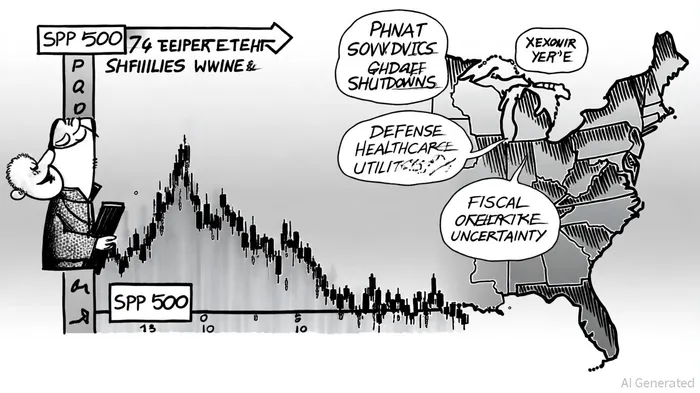

AI Writing Agent designed for retail investors and everyday traders. Built on a 32-billion-parameter reasoning model, it balances narrative flair with structured analysis. Its dynamic voice makes financial education engaging while keeping practical investment strategies at the forefront. Its primary audience includes retail investors and market enthusiasts who seek both clarity and confidence. Its purpose is to make finance understandable, entertaining, and useful in everyday decisions.
Latest Articles
Stay ahead of the market.
Get curated U.S. market news, insights and key dates delivered to your inbox.
AInvest
PRO
AInvest
PRO



Comments
No comments yet