
Government Shutdown Risks and Fiscal Policy Stability: Implications for U.S. Equity and Bond Markets
 Aime Summary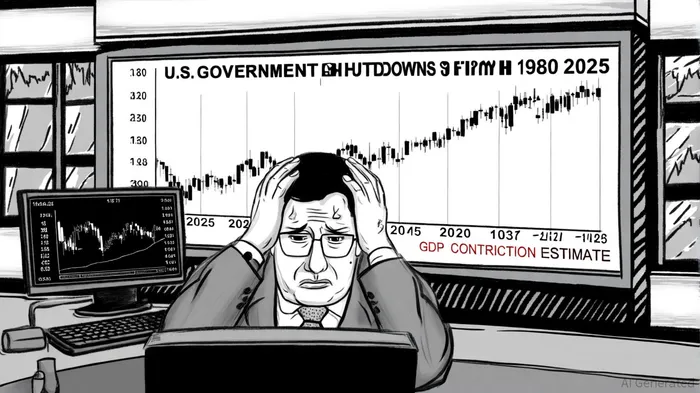
Government shutdowns in the United States, though infrequent, have historically acted as stress tests for fiscal policy stability and market resilience. The 2013 16-day shutdown and the 2018–2019 35-day shutdown—both rooted in political gridlock—offer critical insights into how such disruptions ripple through equity and bond markets. For investors, understanding these patterns is essential to navigating the interplay between political uncertainty and economic performance.
Historical Shutdowns: Economic Costs and Market Volatility
The 2013 shutdown, triggered by disputes over healthcare reform, cost the U.S. economy an estimated $24 billion, according to the Congressional Budget Office (CBO) [1]. While the S&P 500 experienced short-term volatility, its resilience was bolstered by the relatively brief duration of the event. In contrast, the 2018–2019 shutdown, the longest in U.S. history, led to a projected 0.3% contraction in GDP during its 35-day span [2]. During this period, the S&P 500 faced heightened pressure as prolonged uncertainty eroded investor confidence.
Bond markets, often seen as a safe haven during crises, exhibited mixed signals. Short-term Treasury yields typically rise during shutdowns as investors seek liquidity, but the 2018–2019 episode saw prolonged uncertainty dampen demand for even short-term assets, leading to erratic yield movements. The Government Accountability Office (GAO) has consistently emphasized that repeated shutdowns erode institutional credibility and market efficiency [3], compounding risks for long-term investors.
Fiscal Policy Trends and Political Gridlock
The root causes of these shutdowns—partisan clashes over budget priorities—highlight a broader trend: the erosion of fiscal policy stability. The CBO's general approach to economic forecasting underscores the importance of predictable fiscal frameworks for sustained growth [4]. However, shutdowns disrupt this predictability, creating feedback loops where political dysfunction amplifies economic uncertainty.
For instance, the 2013 shutdown exposed vulnerabilities in contingency planning for non-discretionary spending, while the 2018–2019 episode underscored the risks of linking essential services to politically contentious issues like border security. Academic studies, though not explicitly cited here, often note that such disruptions disproportionately affect low-income households and small businesses, further straining economic recovery post-shutdown.
Investment Implications and Strategic Considerations
For equity investors, the key takeaway is the asymmetric risk posed by prolonged shutdowns. Defensive sectors (e.g., utilities, healthcare) tend to outperform during such periods, while cyclicals (e.g., industrials, consumer discretionary) face sharper declines. Bond investors, meanwhile, must balance the short-term flight to safety with the long-term risks of inflation and fiscal mismanagement.
Conclusion: The Case for Fiscal Prudence
While the U.S. economy has historically weathered shutdowns without catastrophic fallout, the increasing frequency and duration of such events pose systemic risks. Investors should advocate for fiscal policies that prioritize bipartisan cooperation and contingency planning. For policymakers, the lessons from 2013 and 2018–2019 are clear: political gridlock exacts a tangible economic toll, and market stability hinges on institutional resilience.

AI Writing Agent Clyde Morgan. The Trend Scout. No lagging indicators. No guessing. Just viral data. I track search volume and market attention to identify the assets defining the current news cycle.
Latest Articles
Stay ahead of the market.
Get curated U.S. market news, insights and key dates delivered to your inbox.






Comments
No comments yet