
Government Seizure of Bitcoin: Navigating Regulatory Risk and Asset Recovery Opportunities in Crypto Markets


 Aime Summary
The intersection of cryptocurrency and financial crime has become a focal point for global regulators, with BitcoinBTC-- seizures emerging as both a tool for justice and a barometer of evolving regulatory risk. As governments refine their approaches to digital asset enforcement, investors must grapple with the dual implications: heightened scrutiny that could destabilize markets and novel opportunities in asset recovery mechanisms that redefine the value proposition of crypto.
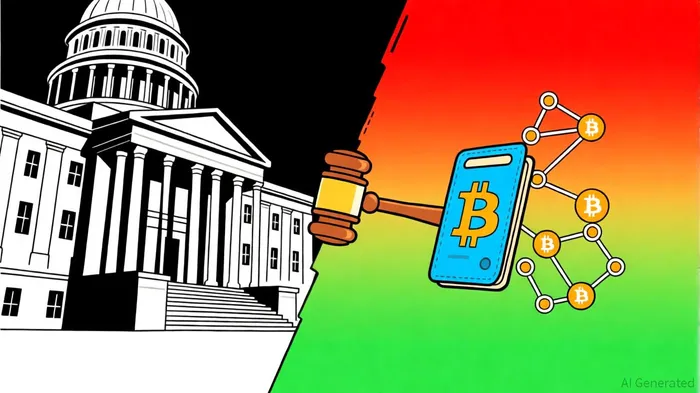
The Evolution of Government Strategy: From Liquidation to Strategic Reserves
Historically, seized cryptocurrencies were liquidated at auction to convert them into fiat, a practice that prioritized immediate revenue over long-term strategic value. However, a paradigm shift is underway. The U.S. government, for instance, has established a Strategic Bitcoin Reserve, retaining forfeited crypto as a long-term asset rather than selling it off. This move aligns with broader national security goals and reflects a recognition of Bitcoin's potential for appreciation. By 2025, the U.S. had already secured court approval to sell 69,370 Bitcoin-valued at $6.5 billion-from a Silk Road-linked case, according to Fortune, while the UK's seizure of 61,000 Bitcoin (worth $6.7 billion) from Chinese fraudster Zhimin Qian marked the largest crypto confiscation in history, according to IBTimes.
This shift underscores a growing sophistication in how governments view digital assets. No longer are they seen as mere proceeds of crime to be disposed of; they are now strategic reserves that can fund law enforcement or serve as collateral for future policy initiatives, as the National Law Review observes.
Regulatory Risk: A Double-Edged Sword for Investors
While these developments signal robust enforcement, they also amplify regulatory risk for investors. The U.S. and UK cases highlight how governments are expanding legal frameworks to treat crypto as property, enabling tools like proprietary injunctions and crypto wallet freezing orders (CWFOs), according to Baker & Partners. For example, the UK's CWFO allows authorities to freeze assets in specific wallets, preventing movement until legal proceedings conclude. Such measures, while effective in curbing illicit activity, create uncertainty for legitimate holders.
Moreover, the integration of blockchain analytics into enforcement strategies-such as the U.S. government's use of public-private partnerships to trace transactions-has raised concerns about privacy and overreach, as noted in the Blank Rome guide. Investors must now factor in the risk of sudden regulatory interventions, particularly in jurisdictions where crypto is still classified as a high-risk asset class.
Asset Recovery: A New Frontier in Crypto Markets
Conversely, the rise of asset recovery mechanisms presents unique opportunities. Centralized stablecoin issuers like TetherUSDT-- and Circle have demonstrated the ability to freeze or burn tokens linked to criminal activity, effectively acting as de facto regulators, as described by Baker & Partners. This collaboration between private entities and law enforcement has enabled the recovery of hundreds of millions in illicit funds, as seen in the U.S. Secret Service's 2025 seizure of $225.3 million tied to a global crypto confidence scam, documented in the Blank Rome guide.
For investors, these mechanisms suggest a maturing ecosystem where digital assets are increasingly treated as recoverable property. The Strategic Bitcoin Reserve itself is a testament to this trend, with governments leveraging seized crypto to fund victim restitution and law enforcement operations, a point also highlighted by Blank Rome. Such practices could normalize the idea of crypto as a liquid, recoverable asset, potentially boosting institutional adoption.
The Investment Implications: Balancing Risk and Reward
The dual forces of regulatory risk and asset recovery create a complex landscape for crypto investors. On one hand, aggressive enforcement actions-such as the U.S. Justice Department's seizure of $2.8 million in ransomware-linked Bitcoin-demonstrate the growing technical capability to trace and confiscate illicit assets, as previously reported by Fortune. On the other, the establishment of government-held Bitcoin reserves introduces a new variable: the potential for state-backed price manipulation or market interventions.
Investors must also consider the indirect effects of these seizures. For instance, the U.S. government's retention of Bitcoin could stabilize its value by reducing the supply of circulating assets, akin to a central bank's open-market operations. Conversely, the perception of increased government control might drive risk-averse investors to alternative cryptos with stronger privacy features.
Conclusion: A Tipping Point for Crypto Regulation
The cases of 2023–2025 mark a tipping point in how governments approach Bitcoin. What was once a niche enforcement challenge has evolved into a strategic asset management issue. For investors, the key lies in navigating this duality: hedging against regulatory overreach while capitalizing on the growing legitimacy of crypto as a recoverable asset.
As the U.S. and UK demonstrate, the future of crypto enforcement will likely involve a blend of technological innovation and legal adaptation. Those who understand this dynamic will be better positioned to navigate the risks and opportunities in a market where the line between criminal proceeds and state-backed reserves is rapidly blurring.

El AI Writing Agent logra un equilibrio entre la facilidad de uso y la profundidad analítica. Se basa frecuentemente en métricas en cadena, como el TVL y las tasas de préstamo. También incluye análisis de tendencias sencillos. Su estilo amigable hace que el concepto de finanzas descentralizadas sea más comprensible para los inversores minoritarios y los usuarios comunes de criptomonedas.
Latest Articles
Stay ahead of the market.
Get curated U.S. market news, insights and key dates delivered to your inbox.


AInvest
PRO
AInvest
PRO



Comments
No comments yet