
U.S. Government Payroll Growth and Sector Rotation: Navigating Fiscal Shifts in 2025
 Aime Summary
The U.S. government payroll landscape in 2025 is marked by a stark divergence from historical trends. While nonfarm business sector productivity surged 3.3% in Q2 2025, driven by a 4.4% output increase and 1.1% rise in hours worked, government payroll growth was revised downward. This shift reflects broader fiscal tightening, with state and local government compensation adjustments contributing to a reduced real GDP drag. For investors, this divergence signals a critical inflection point in sector rotation strategies, particularly as fiscal stimulus pivots from infrastructure to consumer discretionary and healthcare.
The Fiscal Tightening and Its Implications
Government payroll data for Q2 2025 reveals a contraction in public-sector employment, with federal jobs declining by 97,000 since January 2025. This aligns with a broader policy agenda to shrink the federal workforce by up to 75%, as outlined by the Trump administration's task force. The ripple effects are evident: infrastructure spending, traditionally a government-led sector, faces headwinds. Meanwhile, private-sector wage growth (up 3.8% annually) and productivity gains (5.7% in the nonfinancial corporate sector) suggest a shift in economic momentum toward consumer-driven and healthcare-centric industries.
Sector Rotation: From Public to Private
The decoupling of government payroll growth from private-sector expansion creates a compelling case for sector rotation. Infrastructure, which relies heavily on public funding and procurement, is likely to underperform in the near term. For example, construction and engineering firms tied to federal contracts may see reduced demand as fiscal stimulus contracts. Conversely, consumer discretionary and healthcare sectors are poised to benefit from a labor market skewed toward private-sector hiring.
- Consumer Discretionary: With 43,000 jobs added in healthcare and 37,000 in food services in September 2025, demand for retail, hospitality, and leisure services is rising. Companies in these spaces, such as Amazon (AMZN) or Starbucks (SBUX), could see sustained growth as households allocate more income to services and goods.
- Healthcare: The sector's resilience is underscored by a 3.2% productivity increase in durable manufacturing (e.g., medical equipment) and a 1.9% rise in nondurable manufacturing (e.g., pharmaceuticals). As aging demographics and rising healthcare costs persist, firms like UnitedHealth GroupUNH-- (UNH) or MedtronicMDT-- (MDT) remain attractive.
The Infrastructure Dilemma
While infrastructure spending has historically been a safe haven during fiscal stimulus, the current environment presents risks. The downward revision to government payroll and the administration's focus on reducing federal employment suggest a near-term slowdown in public works projects. However, long-term structural needs—such as modernizing energy grids or transportation networks—remain unmet. Investors with a longer horizon might consider undervalued infrastructure stocks or ETFs, but caution is warranted given the political and fiscal headwinds.
Investment Strategy: Balancing Risk and Opportunity
- Short-Term Focus: Allocate capital to sectors aligned with private-sector productivity gains. Consumer discretionary and healthcare, supported by wage growth and demographic trends, offer defensive and growth potential.
- Long-Term Positioning: For infrastructure, adopt a selective approach. Prioritize firms with diversified revenue streams (e.g., those with both public and private contracts) or those leveraging automation to offset labor cost pressures.
- Hedging Against Fiscal Uncertainty: Consider shorting or underweighting government-dependent sectors while overweighting those benefiting from a shifting labor market.
Conclusion
The U.S. government payroll slowdown in 2025 is not merely a statistical anomaly but a harbinger of broader fiscal realignment. As policymakers prioritize shrinking the public sector, investors must recalibrate their portfolios to reflect the new economic reality. By rotating into consumer discretionary and healthcare—sectors buoyed by private-sector dynamism—while cautiously navigating infrastructure, investors can position themselves to capitalize on the evolving landscape. The key lies in aligning with the forces driving productivity and wage growth, rather than clinging to the fading momentum of public-sector stimulus.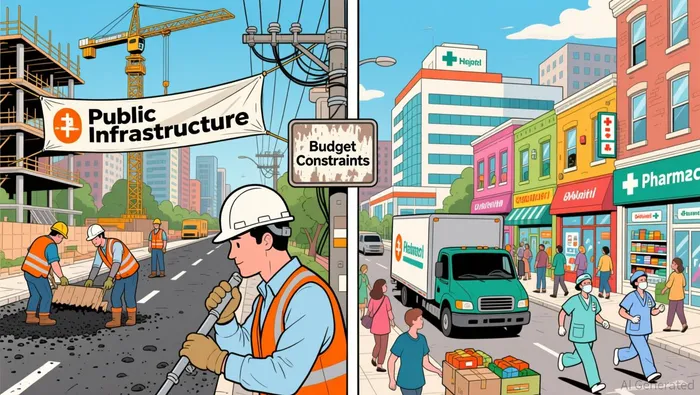

Stay ahead of the market.
Get curated U.S. market news, insights and key dates delivered to your inbox.
AInvest
PRO
AInvest
PRO



Comments
No comments yet