
The U.S. Government Halts Orsted's Offshore Wind Project, Sending Shares Plummeting 17%


 Aime Summary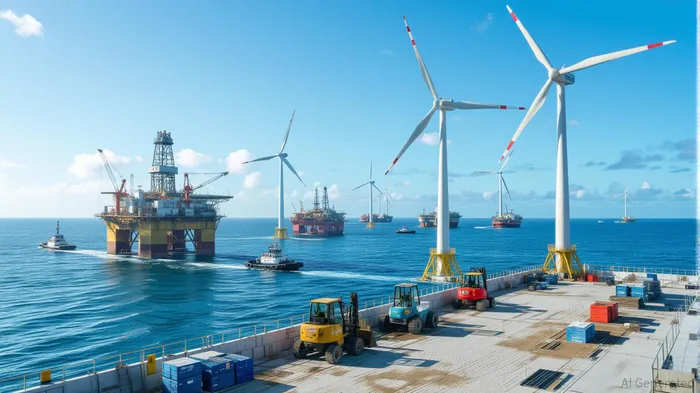
The U.S. government's abrupt stop-work order on Ørsted's Revolution Wind project in August 2025 has sent shockwaves through the renewable energy sector. Shares of the Danish energy giant plummeted 17% in a single day, underscoring the fragility of green energy stocks in the face of regulatory uncertainty. This decision, framed as a response to “national security concerns” under President Trump's broader anti-renewables agenda, raises critical questions for investors: Can renewable energy stocks weather the storm of policy-driven headwinds? And is this crisis a buying opportunity or a warning sign for long-term green energy bets?
Policy Risk: A New Era of Regulatory Volatility
The Revolution Wind project, 80% complete with 45 turbines installed, was halted under a directive from the Bureau of Ocean Energy Management (BOEM) to review all offshore wind leases. While the administration cited vague national security concerns, the move aligns with Trump's explicit campaign to prioritize fossil fuels and roll back climate policies. This marks a stark departure from the Biden-era push for offshore wind, which had positioned the U.S. as a global leader in clean energy.
For investors, the key risk lies in the unpredictability of policy shifts. The Trump administration's actions—such as rescinding wind energy lease areas and suspending new permits—create a regulatory environment where projects can be derailed overnight. This volatility is amplified by the fact that offshore wind projects require years of permitting and capital-intensive construction. A single stop-work order can erase years of progress and billions in invested capital, as seen with Orsted's $9.4 billion rights issue now hanging in the balance.
Project Timelines: Delays as a Death Knell
Offshore wind projects are inherently sensitive to timelines. Delays can lead to cost overruns, inflation-driven price hikes, and loss of market relevance. The Revolution Wind project, expected to power 350,000 homes by late 2026, now faces an indefinite pause. Even if construction resumes, the project's financial viability could be compromised.
This is not an isolated incident. The Empire Wind project in New York faced a similar halt in April 2025, resulting in a $1 billion devaluation for developer EquinorEQNR--. Such precedents suggest that regulatory delays are not just operational setbacks but existential threats to project economics. For investors, this means scrutinizing the resilience of a company's pipeline. Firms with diversified portfolios or projects in jurisdictions with stable regulatory frameworks (e.g., Europe or Canada) may fare better than those overexposed to U.S. markets.
ESG Momentum: Can Green Goals Outlast Political Cycles?
Despite the short-term pain, ESG (Environmental, Social, and Governance) momentum remains a powerful tailwind for renewable energy. Global climate commitments, corporate net-zero pledges, and the declining costs of wind and solar suggest that the transition to clean energy is irreversible. Even in the U.S., states like Rhode Island and Connecticut—key beneficiaries of Revolution Wind—have vowed to challenge the stop-work order, reflecting grassroots and political resistance to federal rollbacks.
However, ESG momentum is not a shield against policy risk. The current crisis highlights a critical tension: while demand for clean energy is growing, its supply is increasingly subject to political interference. Investors must weigh the long-term value of ESG-aligned assets against the short-term risks of regulatory capture by fossil fuel lobbies.
Is This a Buying Opportunity?
The 17% drop in Ørsted's shares has created a compelling valuation case for long-term investors. At a price-to-earnings ratio of 12x and a forward yield of 4.5%, the stock appears undervalued relative to its peers. Moreover, the company's $9.4 billion capital raise—partially jeopardized by the halt—positions it to weather short-term turbulence and emerge stronger if the project is eventually approved.
Yet, caution is warranted. The Trump administration's anti-renewables stance is not a temporary blip but a strategic pivot toward fossil fuels. Investors should consider hedging their exposure by diversifying into geographically diversified renewable firms or ESG-focused ETFs. For example, NextEra Energy and Vestas Wind Systems, with stronger footholds in stable markets like Europe and Australia, may offer safer havens.
Conclusion: Navigating the Storm
The Revolution Wind crisis is a microcosm of the broader challenges facing renewable energy stocks. While policy risk has spiked, the long-term fundamentals of the energy transition remain intact. For investors, the key is to balance optimism with pragmatism: capitalize on discounted valuations in resilient firms while mitigating exposure to politically vulnerable projects.
In the end, the U.S. government's actions may accelerate the fragmentation of the global renewable energy market. Companies that adapt to this new reality—by diversifying geographically, strengthening legal defenses, and leveraging ESG narratives—will emerge as the sector's true long-term winners. For now, the 17% drop in Ørsted's shares is a test of resolve for green energy investors. Those who pass it may find themselves rewarded when the storm passes.

Stay ahead of the market.
Get curated U.S. market news, insights and key dates delivered to your inbox.


AInvest
PRO
AInvest
PRO



Comments
No comments yet