
U.S. Government Equity Stake in Intel: Strategic Bet or Market Overreach?


 Aime Summary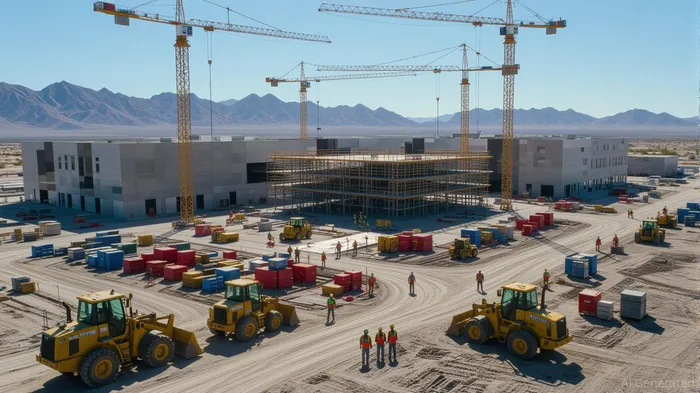
The U.S. government's $8.9 billion equity stake in IntelINTC--, secured under the Trump administration's CHIPS and Science Act, represents a bold and unprecedented intervention in the semiconductor industry. This move, part of a broader $11.1 billion investment, aims to counter TSMC's dominance in advanced chip manufacturing and mitigate the risks posed by China's growing influence in global supply chains. But does this represent a necessary strategic bet to secure U.S. technological leadership—or a dangerous overreach into private enterprise that could distort market dynamics and stifle innovation?
Strategic Rationale: Geopolitical Risk Mitigation and Supply Chain Resilience
The U.S. government's rationale for its 9.9% stake in Intel is rooted in the urgent need to address vulnerabilities in the semiconductor supply chain. TSMCTSM--, the world's largest foundry, controls over 50% of the global market for advanced chips, including those critical for AI, data centers, and military applications. Its CoWoS packaging technology, which enables heterogeneous integration of chips, has become the gold standard for high-performance computing. Meanwhile, China's semiconductor industry, despite incremental progress in domestic R&D, remains constrained by U.S. export restrictions on EUV lithography and advanced packaging tools.
By injecting capital into Intel's $50 billion U.S. manufacturing expansion, the government is betting on a domestic alternative to TSMC. Intel's Arizona facility, set to produce 18A process nodes by 2025, is a cornerstone of this strategy. The removal of profit-sharing clauses from prior CHIPS Act grants has provided Intel with financial clarity, enabling long-term planning for high-cost, long-lead-time projects. For investors, this stability is a double-edged sword: it reduces uncertainty but also ties Intel's performance to geopolitical outcomes.
The government's stake also includes a warrant to acquire an additional 5% of Intel shares if the company cedes control of its foundry business—a safeguard against foreign influence. This structure ensures that the U.S. retains a strategic interest in domestic semiconductor leadership while avoiding direct governance interference. For now, the Treasury lacks voting rights, but its position as the largest shareholder could indirectly shape Intel's priorities, such as prioritizing national security projects over commercial ventures.
Technical and Market Challenges: Can Intel Compete?
Intel's technical capabilities remain a litmus test for the viability of state-backed industrial policy. While the company has made strides in 18A process development and packaging technologies like EMIB and Foveros, it still lags TSMC in yield rates and cost efficiency. TSMC's CoWoS capacity is projected to reach 90,000 wafers per month by 2026, dwarfing Intel's current output. Moreover, Intel's foundry business, though expanding, holds a fraction of TSMC's global market share.
The geopolitical landscape further complicates Intel's path. U.S. export controls on China have limited the latter's access to advanced nodes, but they've also fragmented global supply chains, forcing companies to navigate a patchwork of regulations. Intel's U.S.-based expansion aligns with the “friendshoring” agenda, but it risks higher production costs compared to Asian rivals. A 10% tariff on semiconductorON-- materials, proposed in June 2025, could raise construction costs for advanced fabs by $6.4 billion, exacerbating these challenges.
Risks of Overreach: Market Distortion and Corporate Autonomy
Critics argue that the government's equity stake introduces systemic risks. By politicizing corporate governance, even indirectly, the U.S. could stifle innovation and reduce competition. For example, the administration might pressure Intel to prioritize Department of Defense contracts over commercial projects, creating misalignment with market demands. This could lead to inefficiencies, as seen in historical cases like the 1980s Japanese semiconductor subsidies, which initially boosted domestic firms but later led to overcapacity and market distortions.
Additionally, the government's involvement raises questions about long-term sustainability. If Intel fails to catch up to TSMC, the U.S. could face a costly write-down on its equity stake. The escrowed shares and warrant structure add complexity, with potential dilution risks for existing shareholders. For investors, this uncertainty could outweigh the benefits of a government-backed “national champion.”
Investment Advice: Balancing Strategic Imperatives and Market Realities
For investors, the U.S.-Intel partnership presents a high-stakes opportunity. The government's support has already catalyzed over $540 billion in private sector investments, creating a virtuous cycle of innovation and infrastructure. Intel's partnerships with MicrosoftMSFT--, DellDELL--, and HPHPQ-- further solidify its role in powering critical U.S. infrastructure. However, the risks of overreliance on a single company—and a government with shifting priorities—cannot be ignored.
A cautious approach is warranted. Investors should monitor Intel's progress in scaling 18A production and its ability to compete on cost and yield. Diversification across the semiconductor value chain—beyond manufacturing into design and packaging—could mitigate risks. Additionally, tracking the U.S. government's proposed equity fund, which aims to leverage $300 billion in co-investments, may reveal broader opportunities in the sector.
Conclusion: A Calculated Bet in a High-Stakes Game
The U.S. government's equity stake in Intel is a calculated bet on semiconductor supply chain security, but its success hinges on Intel's technical execution and the administration's ability to balance strategic imperatives with market dynamics. While the move addresses immediate geopolitical risks, it also raises questions about the long-term role of government in private enterprise. For investors, the key is to align with companies that can navigate both the opportunities and challenges of this new industrial era—without becoming overly dependent on state support.
In the end, the U.S. is not alone in this race. South Korea, Taiwan, and China are all pursuing aggressive industrial policies. The winner will be the country that best balances innovation, efficiency, and geopolitical resilience—a test that Intel and its government backers are now facing head-on.

Delivering real-time insights and analysis on emerging financial trends and market movements.
Latest Articles
Stay ahead of the market.
Get curated U.S. market news, insights and key dates delivered to your inbox.
AInvest
PRO
AInvest
PRO



Comments
No comments yet